



As Iran’s regime faces an unprecedented crisis of legitimacy, the Supreme Leader attempts to co-opt the nationalist legacy of Mohammad Mossadegh—revealing deep insecurity rather than historical insight.
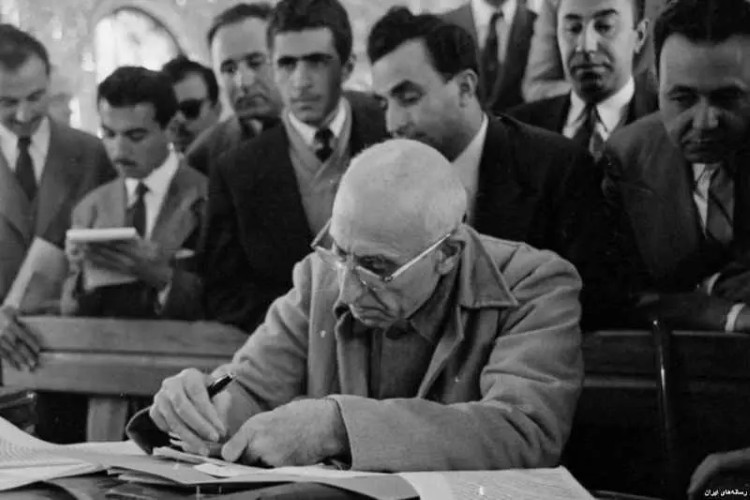
On November 4, 2025 (13 Aban in the Iranian calendar)—the regime’s annual “anti-U.S.” commemoration—Ali Khamenei repeated his usual slogans about “Death to America” and “the students following the line of the Imam.” Yet amid this predictable rhetoric, one statement stood out. He unexpectedly spoke about the 1953 coup against Prime Minister Mohammad Mossadegh, calling Mossadegh’s administration “the first national government” in modern Iran and describing it as “a national government that stood up to Britain.”
He claimed that Mossadegh, seeking to rid Iran of British domination, had turned to the United States, which then betrayed him by working with London to stage the coup that restored the Shah to power.
At first glance, Khamenei’s comments might sound like a historical reflection—but they are, in truth, a mirror of his deep political crisis. For decades, both Khamenei and his predecessor Ruhollah Khomeini denounced Mossadegh as “naïve,” “deceived,” and even “a worthless bone.” They praised cleric Ayatollah Kashani, who sided with the Shah during the coup, as the true revolutionary. Now, nearly half a century later, Khamenei is trying to attach himself to the very figure his movement vilified.
The timing is revealing. Iran’s regime is mired in its worst political, economic, and social collapse since 1979. The national currency continues to lose value, corruption is rampant, and public discontent grows amid unemployment and poverty. Inside the regime, factions—from the hardliners around Mohammad-Bagher Ghalibaf and Saeed Jalili to the remnants of the Rouhani–Zarif camp—are deeply divided. Khamenei’s every statement risks inflaming one side or the other.
In this climate, the Supreme Leader once again relies on his oldest tactic: inventing enemies to sustain power. His anti-American rhetoric is not ideological consistency—it is political survival. By evoking the 1979 U.S. Embassy takeover, Khamenei tries to distract from the regime’s present failures with the ghosts of its revolutionary past. But for most Iranians, November 4 recalls not that hostage crisis, but November 4, 1978, when high-school students protesting for freedom were shot dead by the Shah’s army—a symbol of sacrifice, not fanaticism.
Khamenei’s foreign policy follows the same logic of crisis projection. From sponsoring regional militias to pursuing nuclear brinkmanship, Tehran seeks confrontation abroad to justify repression at home. Without the “enemy,” the regime’s ideology collapses. That is why Khamenei oscillates between denouncing negotiation as “betrayal” and quietly authorizing back-channel talks through his diplomats: his target audience is not the world, but his own security forces, who need reassurance that the regime still stands firm.
But why turn to Mossadegh now? The answer lies in one word: desperation.
After decades of condemning Iran’s nationalist movement as “Westernized” and “anti-Islamic,” Khamenei’s regime now tries to appropriate Mossadegh’s legacy to regain popular legitimacy. Lacking support from workers, teachers, the middle class, or even many clerics, the leadership now cloaks itself in symbols of national pride it once scorned—Mossadegh and even Cyrus the Great.
Recent events reflect this opportunism. State-approved clerics now recite patriotic poems about ancient Iran, even as security forces block citizens from gathering at Pasargadae, the tomb of Cyrus, on national holidays. The contradiction is glaring: a regime that has long sought to erase Iran’s national identity now pretends to defend it.
Historically, Khamenei’s ideological roots lie not in Mossadegh’s democratic nationalism but in the clerical reactionary tradition of figures like Sheikh Fazlollah Nouri and Ayatollah Kashani, who opposed Iran’s 1906 Constitutional Revolution. The current Supreme Leader continues that anti-democratic lineage, using religion to justify absolute rule under the doctrine of Velayat-e Faqih (Guardianship of the Jurist).
By invoking Mossadegh, Khamenei hopes to borrow the legitimacy of a man who embodied the opposite of everything his regime represents. Mossadegh stood for national independence, democracy, and the sovereignty of the people; Khamenei stands for repression, ideological subservience, and the supremacy of the clerical elite.
In the end, Khamenei’s attempt to rewrite history exposes rather than conceals his weakness. The Iranian people have not forgotten the difference between Mossadegh’s path to freedom and the regime’s path of tyranny.