


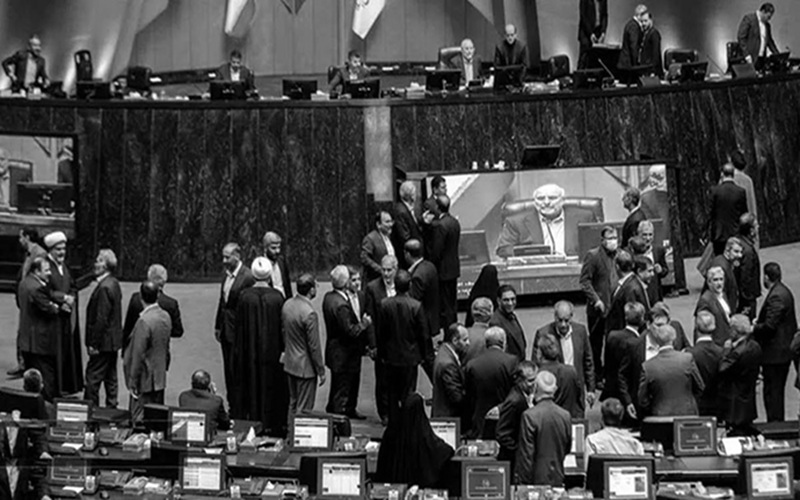

Mojtaba Khamenei’s attempt to distance himself from the consequences of negotiations with the United States has exposed growing factional tensions and raised fresh questions about the cohesion of Iran’s post-Ali Khamenei leadership.
The death of Ali Khamenei was expected to usher in a delicate transition within the Mullahs’ regime. Instead, the early days of Mojtaba Khamenei’s leadership suggest that the regime has entered a new phase of internal instability, where disputes once confined behind closed doors are increasingly surfacing in public.
Caught between the competing pressures of military confrontation abroad, negotiations with the United States, and mounting domestic crises, the regime’s new Supreme Leader appears to be struggling to consolidate authority. His carefully worded remarks on negotiations—intended to preserve unity across rival factions—have instead triggered criticism from multiple sides and exposed the fragile nature of the succession.
An Attempt to Avoid Political Responsibility
In discussing the decision to authorize negotiations with Washington, Mojtaba Khamenei stated that he had “in principle held a different opinion,” but ultimately approved the talks after receiving assurances from the regime’s president.
The wording was notable not only for what it said, but for what it appeared designed to accomplish. By emphasizing that he had initially opposed the negotiations, Mojtaba sought to distance himself from any political costs should diplomacy fail or force further concessions.
The statement reflected an effort to balance competing constituencies within the regime. Hardliners could interpret it as evidence of ideological consistency, while supporters of negotiations could point to his eventual authorization of the process. Yet the attempt to satisfy both camps ultimately pleased neither.
Hardliners Rush to Define the Leader’s Position
Senior conservative clerics quickly attempted to reinterpret Mojtaba Khamenei’s remarks in a more uncompromising direction.
Friday prayer leader Ahmad Alamolhoda argued that the Supreme Leader’s reference to having “another opinion” should be understood as favoring stronger demands, including compensation for damages rather than compromise. He insisted that the current diplomatic course did not fully reflect the Leader’s preferred position.
Such interventions illustrated an unusual development within the regime’s political establishment: influential figures publicly explaining—or correcting—the Supreme Leader’s own words. Rather than reinforcing authority, these competing interpretations highlighted uncertainty about the direction of the new leadership.
Public Criticism From Within the Regime
The reaction did not stop with attempts at reinterpretation.
Cleric Gholamreza Ghasemian openly addressed public speculation that the new Supreme Leader was attempting to avoid responsibility for the negotiations. He questioned the implication that the Leader had opposed the process while nevertheless allowing it to proceed, before directing criticism toward President Masoud Pezeshkian and his administration.
The controversy rapidly spread beyond political commentary. Slogans denouncing Foreign Minister Abbas Araghchi as a “compromiser” and hostile chants against Parliament Speaker Mohammad Bagher Ghalibaf demonstrated that divisions over negotiations have evolved into broader factional conflict.
What once appeared to be disagreements over policy increasingly resemble disputes over political legitimacy within the ruling establishment itself.
Damage Control Reveals Deeper Anxiety
The regime’s efforts to contain the fallout further underscored the seriousness of the controversy.
Gholam-Ali Haddad-Adel, Mojtaba Khamenei’s father-in-law and one of the establishment’s most influential conservative figures, argued that the Supreme Leader’s statement actually strengthened Iran’s negotiating position. According to his interpretation, the message conveyed to foreign counterparts was that even the negotiated outcome fell short of what the Leader originally wanted, thereby giving Iranian negotiators greater leverage.
Rather than ending the debate, however, the explanation reinforced perceptions that officials were scrambling to reconcile conflicting narratives surrounding the leadership’s position.
Signs of Division at the Highest Levels
Additional reports have further complicated the picture.
According to Didar News, despite public efforts to project disagreement within the Supreme Leader’s office, every member of Iran’s Supreme National Security Council—except Saeed Jalili—approved the negotiation framework.
If accurate, this suggests that consensus existed among the country’s principal security decision-makers despite the subsequent public messaging. More significantly, it points to growing inconsistencies between official rhetoric and internal decision-making, exposing fractures that extend to the highest levels of the Islamic Republic.
A Leadership Tested Before It Has Consolidated
Leadership transitions in authoritarian systems are often accompanied by uncertainty, but the early period following Ali Khamenei’s death appears unusually turbulent. Mojtaba Khamenei inherited a state confronting economic deterioration, diplomatic isolation, regional tensions, and persistent domestic discontent.
His first major political challenge has not demonstrated decisive authority. Instead, it has revealed the difficulty of balancing competing power centers within a system increasingly characterized by factional rivalry.
Whether these disputes remain manageable or evolve into a broader struggle over the future direction of the regime remains uncertain. What is already evident, however, is that the post-Khamenei era has begun not with a display of consolidated authority, but with visible disagreements over responsibility, policy, and leadership itself.
The public nature of these confrontations suggests that the regime’s succession has entered a more volatile phase—one in which the regime’s internal cohesion may prove as consequential as the external challenges it faces.