


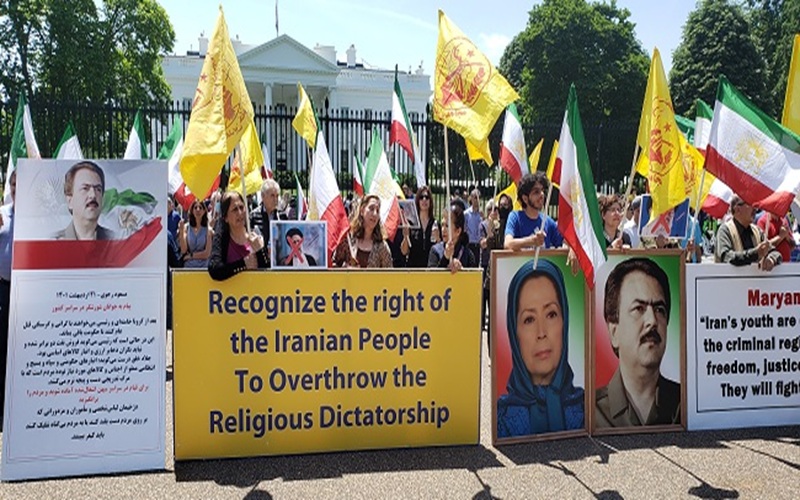

NCRI President-elect says Tehran relies on war, repression, and regional destabilization to survive, while peace would strip the regime of its last shield against popular uprising.
The Iranian regime’s response to the current regional crisis has once again exposed a fundamental reality that many observers have long recognized: Tehran’s survival depends not on stability or peace, but on perpetual confrontation, domestic repression, and external conflict.
In a statement issued on June 14, Maryam Rajavi, President-elect of the National Council of Resistance of Iran (NCRI), welcomed any understanding that could end the war and alleviate the suffering of the Iranian people. Her remarks highlighted what she described as the deep political and strategic deadlock confronting the ruling clerical establishment.
“The Iranian Resistance, which for nearly five decades has sought freedom and peace, welcomes any understanding to end the war and the suffering of the Iranian people,” Rajavi said.
Her statement comes at a moment when the Iranian regime faces mounting internal and external pressures. Years of economic collapse, growing social unrest, widespread corruption, and repeated nationwide protests have significantly weakened the foundations of the ruling system. At the same time, Tehran’s regional influence has suffered setbacks, while its nuclear ambitions have increased international isolation.
A Regime Trapped by Its Own Survival Strategy
According to Rajavi, the regime’s pursuit of nuclear weapons, regional interference, and military adventurism are not isolated policies but interconnected elements of a broader survival strategy.
“The effort to produce nuclear weapons, warmongering, and meddling in the countries of the region are part of the survival strategy of the religious fascism ruling Iran,” she stated.
For decades, the ruling establishment has sought to project strength abroad in order to compensate for its declining legitimacy at home. Regional conflicts, support for proxy forces, and escalating tensions with neighboring countries have served as tools to distract from domestic crises and justify increased repression.
However, this strategy has created a profound contradiction. The very policies designed to preserve the regime have also intensified economic hardship, international sanctions, and public dissatisfaction inside Iran.
The result is a political system increasingly trapped between external pressure and internal resistance.
Why Peace Threatens the Regime
One of the most significant aspects of Rajavi’s statement was her argument that peace represents a greater threat to the regime than war.
“War is this regime’s shield against popular uprisings, while peace and a ceasefire are, as Khomeini put it, like poison for it,” she said.
This assessment reflects a longstanding pattern in the regime’s behavior. Throughout its history, the ruling establishment has repeatedly used security crises and external threats to suppress dissent, tighten political control, and silence opposition voices.
Periods of confrontation allow authorities to portray criticism as disloyalty and justify extraordinary security measures. By contrast, periods of de-escalation expose unresolved domestic grievances, including poverty, unemployment, political repression, and systemic corruption.
In this sense, peace removes the regime’s most effective political excuse and redirects public attention toward its failures.
The leadership in Tehran understands that the greatest challenge to its survival does not come from foreign governments but from an increasingly dissatisfied population seeking fundamental political change.
The Fear of Another Nationwide Uprising
The regime’s anxiety regarding internal unrest has become increasingly visible in recent years. Successive nationwide protests have demonstrated the depth of public anger and the erosion of fear among large sections of Iranian society.
Despite mass arrests, executions, and extensive security measures, authorities have failed to eliminate the underlying causes of social discontent.
Rajavi argued that the responsibility for democratic change ultimately belongs to the Iranian people and their organized Resistance.
“The overthrow of the regime is the responsibility of the Iranian people and their organized Resistance,” she said.
Her remarks underscore a central argument advanced by the Iranian Resistance: that lasting change cannot be imposed from outside but must be achieved through the struggle of the Iranian people themselves.
Human Rights Must Be Part of Any Agreement
Rajavi also emphasized that any international effort to end the current conflict should not ignore the regime’s ongoing human rights abuses.
“I reiterate once again that any international agreement to end the war must include an end to the execution of political prisoners and the killing of protesters,” she stated.
This demand reflects growing concerns that Tehran may attempt to use diplomatic agreements to gain breathing space while continuing its domestic crackdown.
Human rights organizations have repeatedly warned that executions, arbitrary arrests, and the suppression of dissent remain central pillars of the regime’s rule.
A Sign of Strategic Weakness
The current situation reveals a regime facing an increasingly difficult reality. Its regional policies have generated isolation rather than security. Its economic management has produced poverty rather than prosperity. Its repression has failed to extinguish demands for freedom.
Most importantly, the leadership now confronts a dilemma from which it appears unable to escape. Escalation risks greater international pressure and domestic hardship, while de-escalation removes the external tensions that help justify repression.
This is the essence of the regime’s strategic deadlock.
As Iran enters a new and uncertain phase, the clerical establishment finds itself confronting the very outcome it has long feared: a society that increasingly sees through the narratives of war and recognizes that the path to peace, freedom, and democracy ultimately requires fundamental political change.