


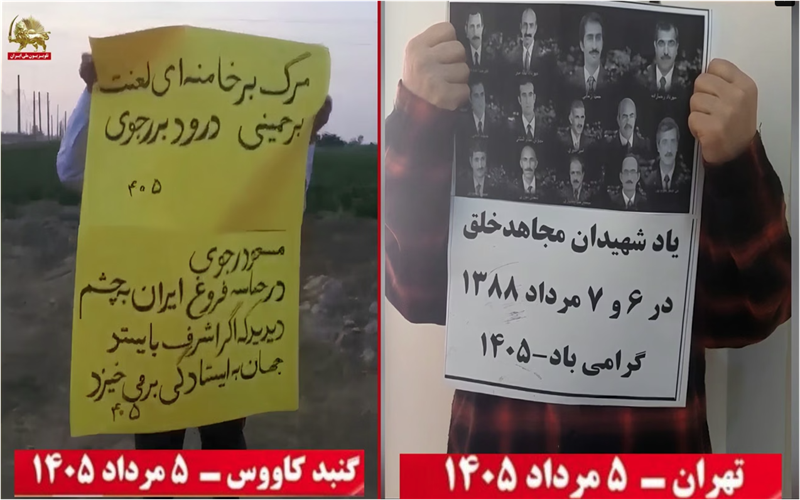

Commemorative activities honoring the 2009 Ashraf martyrs were followed by a nationwide campaign challenging the regime’s attempt to legitimize Mojtaba Khamenei’s succession through religious authority.
Resistance Units across Iran carried out two coordinated nationwide campaigns in recent days: one commemorating the martyrs of the July 2009 attack on Camp Ashraf in Iraq, and another denouncing what they described as the Iranian regime’s attempt to legitimize Mojtaba Khamenei’s hereditary succession as Supreme Leader through religious propaganda.
The activities, which spanned dozens of cities, combined memorial events, anti-regime slogans, posters, banners, and acts targeting symbols and institutions of the regime. Together, the campaigns underscored the Resistance’s message that the struggle against the clerical dictatorship continues despite leadership changes following the death of Ali Khamenei.
Remembering the Martyrs of Camp Ashraf
The first campaign marked the anniversary of the July 28–29, 2009 attack on Camp Ashraf, when Iraqi security forces under then-Prime Minister Nouri al-Maliki, acting after the transfer of camp security from U.S. forces, launched a deadly assault on residents of the camp.
Camp Ashraf, located in Iraq’s Diyala Province, housed thousands of members of the People’s Mojahedin Organization of Iran (PMOI/MEK). During the raid, Iraqi forces used live ammunition, armored vehicles, and batons against unarmed residents. At least nine residents were killed, hundreds were injured, and dozens were detained, prompting widespread condemnation from international human rights organizations.
For the Iranian Resistance, the events of July 2009 have become a symbol of sacrifice and steadfastness in the face of coordinated efforts by Tehran and its regional allies to eliminate the organized opposition.
Nationwide Commemorations Across Iran
Resistance Units organized commemorative activities in Tehran, Karaj, Isfahan, Shiraz, Kermanshah, Sari, Gonbad-e Kavus, Behshahr, and Ardabil.
Their actions included distributing leaflets, displaying photographs of the Ashraf martyrs, installing posters featuring messages from Maryam Rajavi and Massoud Rajavi, and raising banners honoring those who lost their lives during the assault.
Among the slogans displayed were:
- “Honor to the PMOI martyrs of July 28 and 29.”
- “The heroes of Iran’s Eternal Light will remain forever through their suffering, their sacrifice, and their enduring legacy.”
Other posters recalled the Resistance’s interpretation of the Ashraf confrontation as proof that determined resistance can inspire broader movements for change.
Regime Attempts to Legitimize Mojtaba Khamenei
The second campaign came in response to a broadcast aired by the regime’s state television in which representatives of the Lebanese group Hezbollah publicly pledged allegiance to Mojtaba Khamenei, who assumed the position of Supreme Leader following the death of his father during the 2026 war.
The televised declaration went far beyond a political endorsement. It asserted that pledging allegiance to Mojtaba Khamenei was equivalent to pledging allegiance to the Mahdi, the twelfth Imam in Twelver Shi’a Islam.
Why the Statement Is Significant
For readers unfamiliar with Shi’a theology, the Mahdi—often referred to as the Hidden Imam—is believed by Twelver Shi’a Muslims to be the final Imam who entered occultation centuries ago and will one day return to establish justice.
Within the doctrine of Velayat-e Faqih, the Supreme Leader is presented as governing during the Mahdi’s absence. Hezbollah’s statement, however, described Mojtaba Khamenei not merely as a political leader but as the Mahdi’s legitimate representative whose authority demands religious obedience.
The Resistance denounced the declaration as an attempt to cloak a hereditary transfer of power in religious legitimacy.
Drawing historical parallels, Resistance Units argued that Iran has once again replaced one form of absolute rule with another.
One of the campaign’s central slogans stated:
“The Shah called himself God’s shadow on Earth; the Mullah calls himself the deputy of the Hidden Imam.”
Other messages cited Quranic verses condemning tyranny, corruption, and rulers who devastate societies for their own interests.
Sixty Operations Across Iran
Resistance Units reported carrying out 60 separate operations in response to what they described as the regime’s religious deception.
The actions targeted symbols of the ruling establishment and security apparatus across numerous provinces.
Among the reported operations were:
- Setting fire to large banners and posters of Ali Khamenei and Mojtaba Khamenei in Tehran, Shiraz, Isfahan, Mashhad, Karaj, Yazd, Zahedan, Kermanshah, Kerman, Hamedan, Ilam, Nishapur, Birjand, Bushehr, Bandar Ganaveh, Khaf, and other cities.
- Burning images of former president Ebrahim Raisi and Qassem Soleimani.
- Explosions or attacks directed against Basij bases, IRGC facilities, and offices associated with the Ministry of Intelligence in Damavand, Pardis, Kermanshah, Gachsaran, Qaem Shahr, Dezful, Iranshahr, Khash, Homayounshahr, and other locations.
- Acts targeting municipal offices and institutions that Resistance Units characterize as instruments of political repression.
Several operations included slogans such as:
- “Death to Khamenei.”
- “Long live the National Liberation Army of Iran.”
- “Death to the principle of Velayat-e Faqih.”
- “Hail to Rajavi.”
Challenging Hereditary Rule
Resistance Units framed the campaign as a rejection of what they describe as the transformation of the office of Supreme Leader into a hereditary institution.
According to the campaign’s messaging, the succession of Mojtaba Khamenei represents an effort to preserve the system of Velayat-e Faqih by transferring power within a single family while relying on religious symbolism to discourage dissent.
The campaign repeatedly contrasted the monarchy overthrown in 1979 with the current clerical establishment, arguing that while the Shah justified his authority through claims of divine sanction, today’s ruling establishment seeks legitimacy by presenting the Supreme Leader as the representative of the Hidden Imam.
Continuing Resistance
The twin nationwide campaigns reflected two interconnected themes that have become central to the Iranian Resistance’s activities: preserving the memory of those killed in previous confrontations with the regime and challenging what it considers new attempts to consolidate authoritarian rule.
By commemorating the Ashraf martyrs while simultaneously opposing Mojtaba Khamenei’s succession, Resistance Units sought to present their campaign as both a tribute to past sacrifices and a declaration that the struggle against the clerical dictatorship continues across Iran.