


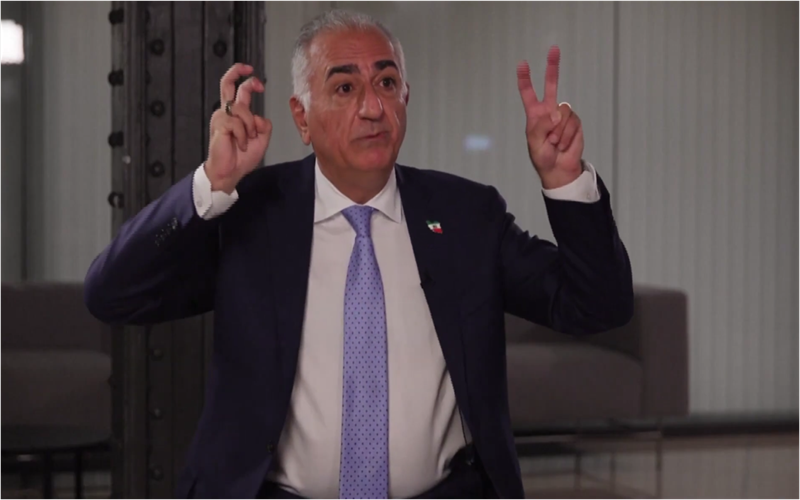

A Reuters investigation into Reza Pahlavi’s political campaign reveals a widening gap between his democratic image and his record of leadership, coalition-building, and political effectiveness.
For years, Reza Pahlavi has presented himself as the figure best positioned to guide Iran through a democratic transition. Describing himself as neither a politician seeking office nor a claimant to power, he has instead portrayed himself as a unifying bridge capable of bringing together the country’s fragmented opposition before handing Iran’s future over to its people.
A recent Reuters special report, however, presents a far more complicated picture.
Based on interviews with more than 50 people, hundreds of pages of legal documents, and months of reporting across Europe and North America, Reuters examined Pahlavi’s political campaign, his relationships with supporters and critics, and his efforts to establish himself as the leading alternative to the Iranian regime. Rather than reinforcing the carefully cultivated image of a disciplined democratic leader, the investigation documents repeated contradictions between Pahlavi’s public claims and his political record.
The report does not accuse Pahlavi of corruption or criminal conduct. Nor does it argue that he cannot play any role in Iran’s future. Instead, Reuters raises a more fundamental question: whether his record supports the leadership role he increasingly claims for himself.
Taken together, Reuters’ findings reveal a recurring pattern. Throughout the report, Pahlavi presents himself as a unifier, an organizer, and the accepted leader of a democratic transition. Yet Reuters repeatedly documents fractured alliances, disappointed supporters, failed political initiatives, and claims that independent reporting could not verify.
That gap between image and demonstrated political performance is the report’s central theme.
From “Bridge” to Claimant
One of the defining themes of Reuters’ investigation is the contrast between how Pahlavi describes his role and what his own statements imply.
During his interviews, Pahlavi insists that “it has never been about me” and repeatedly describes himself as “a bridge” rather than the destination for Iran’s future. According to him, the Iranian people alone must determine the country’s political system after the regime falls.
Yet elsewhere in the same interviews and in public statements quoted by Reuters, he declares that “The Iranian people have called on me to lead the transition after the regime is gone” and that he has accepted this responsibility.
These are not identical ideas.
A bridge facilitates a transition without becoming its center. A political leader who publicly accepts responsibility for directing that transition inevitably occupies a much more central role.
Reuters does not suggest that these statements are mutually exclusive. Nevertheless, they reveal an important ambiguity at the heart of Pahlavi’s political messaging. While he rejects the image of a politician seeking office, he simultaneously presents himself as the individual already entrusted with leading Iran’s post-regime future.
For a figure whose political legitimacy rests largely on public trust rather than electoral support or an organized movement inside Iran, that distinction matters.
Recognition Is Not the Same as Leadership
Reuters acknowledges something that few observers dispute: Reza Pahlavi is today the best-known Iranian opposition figure living abroad.
He is regularly invited to international conferences, receives significant media attention, and has cultivated relationships with influential politicians in Washington and Europe. During the recent conflict involving Iran, he appeared before enthusiastic audiences at the Conservative Political Action Conference (CPAC), where supporters greeted him with a lengthy standing ovation.
Recognition, however, is not the same as political influence.
Much of Reuters’ reporting focuses on the gap between Pahlavi’s international visibility and his ability to translate that visibility into meaningful political support.
As the report notes, President Donald Trump publicly questioned how much support Pahlavi actually enjoyed inside Iran. Behind the scenes, senior American officials reportedly discouraged Iranian-American activists from even mentioning his name during a United Nations Security Council session devoted to the Iranian regime’s repression. When the United States later reached a ceasefire understanding with Tehran, the agreement made no reference to regime change, while Vice President JD Vance publicly dismissed suggestions that Washington intended to install Pahlavi as Iran’s future leader.
These developments are significant not because foreign governments should determine Iran’s future—they should not—but because they illustrate the limited political leverage that accompanied Pahlavi’s considerable international profile.
The same contrast appears elsewhere in Reuters’ reporting.
Pahlavi claims to communicate with more than a thousand groups inside Iran spanning labor, academia, religious communities, and ethnic organizations. Reuters, however, states that it was unable to independently verify those claims.
This distinction is important.
Reuters does not conclude that Pahlavi lacks supporters inside Iran. Rather, it notes that one of his central assertions—that he has built an extensive organized network capable of guiding a transition—could not be independently confirmed.
For a politician asking to be recognized as the leader of a future democratic transition, the difference between public claims and independently verified organizational capacity is substantial.
Independence from Foreign Governments—or Reliance on Their Recognition?
Throughout the Reuters interviews, Pahlavi repeatedly argues that no foreign government should decide Iran’s future leadership.
“It is not for a foreign government to decide who or what should be the alternative for Iran,” he tells Reuters. “That’s up to the Iranian people.”
Few would disagree with that principle.
Yet Reuters simultaneously documents how deeply Pahlavi’s political campaign has become intertwined with Western political circles.
The report follows his meetings with American lawmakers, his growing profile among conservative organizations in the United States, and the efforts of prominent Iranian-American donors who contributed millions of dollars hoping he could emerge as the leader of a transitional government.
Reuters also notes how quickly those expectations began to erode.
Several donors became frustrated after concluding that Pahlavi ignored repeated advice to broaden opposition unity and respond more forcefully to the behavior of some of his supporters. One donor summarized the growing disappointment in blunt business terms: “We’re all business people. You want to have a return on investment.”
Equally revealing was Pahlavi’s muted response after President Trump spoke of “blasting Iran into oblivion.” Reuters reports that some of his own financial supporters expected an immediate public condemnation but were disappointed when it did not come.
None of this demonstrates dependence on foreign governments in the formal sense.
It does, however, expose a political reality that runs throughout Reuters’ investigation: although Pahlavi argues that Iran’s future should be determined exclusively by Iranians, much of his campaign has depended on recognition, funding, and political acceptance abroad.
When those sources of support weakened, Reuters suggests, so too did the momentum behind his leadership bid.