



Behind its patriotic slogans, the regime undermines Iran’s national interests, represses citizens, and exploits the idea of “nation” as propaganda for its survival.
In Iran today, the regime’s claims of nationalism ring hollow. The Islamic Republic is not a “national” government in any meaningful sense of the word. Its authority does not rest on the will or consent of the people, and its policies do not aim to serve the nation’s interests. Instead, the regime’s recent display of nationalist posturing is nothing more than a cynical attempt to disguise its illegitimacy and authoritarian nature.
A Regime Without National Legitimacy
Political science defines a “national political system” as one based on legitimacy, structured institutions, interdependence, and genuine participation by citizens — through free elections, respect for laws, and trust in state symbols. Such systems exist to protect the collective interest of the nation and ensure the rule of law.
By contrast, the Islamic Republic lacks all these attributes. It suppresses free elections, censors the press, imprisons critics, and rules by force, not by consent. The so-called “national” image it projects is a performance — a calculated deception meant to hide the absence of citizen participation and the erosion of public trust.
In this staged nationalism, the people are not seen as free, active citizens but as a uniform mass — an imagined “nation” whose only role is obedience and loyalty to the ruling system. The regime portrays this fictional nation as perpetually “under threat,” demanding absolute loyalty to survive. But this nation, as defined by the regime, is a shadow — a substitute used to justify the survival of a state divorced from its people.
Propaganda of Patriotism
The regime’s rhetoric is filled with patriotic symbols — the flag, national songs, and terms like “independence,” “territorial integrity,” and “homeland.” Yet these are hollowed out, repurposed to conceal the absence of justice, equality, and freedom. This pseudo-nationalism serves one purpose: to maintain the regime’s undemocratic grip on power.
Far from protecting Iran’s sovereignty or unity, the regime’s actions have eroded national cohesion and alienated citizens. It targets journalists, academics, activists, and political opponents — the very people who could strengthen national dialogue and civic trust. Instead of fostering an open, secure space for discussion, it relies on fear, surveillance, and imprisonment to silence dissent.
Anti-National Policies and Betrayal of Interests
Despite its nationalist rhetoric, the regime consistently acts against Iran’s national interests. It has plundered the country’s natural resources — oil, gas, water, and environment — for ideological projects and regional adventurism. Its economic mismanagement and corruption have impoverished millions while enriching a small elite tied to the security establishment.
Internationally, the regime has bound Iran to authoritarian powers, trading away independence for political survival. While claiming to defend territorial integrity, its policies have weakened Iran’s geopolitical position and deepened the country’s isolation. Regional neighbors are growing stronger economically and diplomatically, while the regime’s failures have left Iran marginalized — and even vulnerable to losing control over strategic territories like the three Persian Gulf islands.
Repression in the Name of “National Unity”
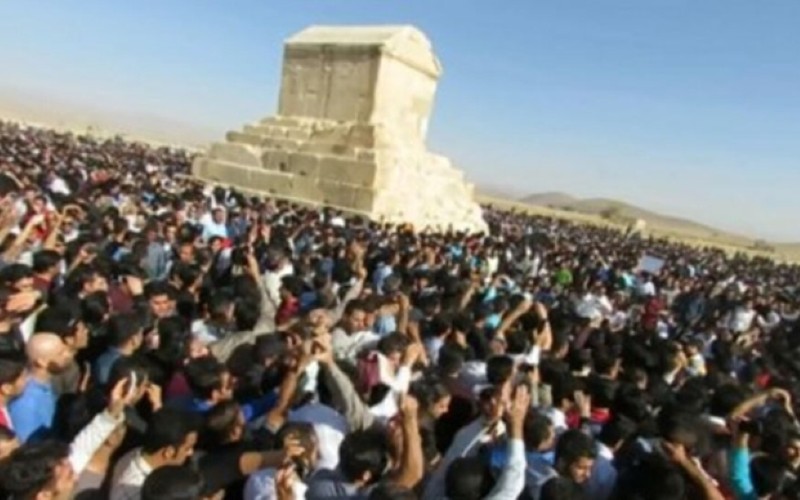
The regime’s fear of public unity and national awakening is evident in its repression of symbolic gatherings, such as those at Pasargadae, the tomb of Cyrus the Great — a historical figure representing Iranian identity and freedom. While the authorities claim to honor Iran’s heritage, they simultaneously ban citizens from celebrating it, exposing the hypocrisy of their “national” posture.
Through propaganda and coercion, the regime transforms nationalism into a tool of domestic control. True patriotism — the love of homeland rooted in justice, dignity, and freedom — is replaced with obedience to tyranny.
The Silenced Nation
What remains of the Iranian nation under this regime is not the vibrant connection of engaged citizens, but a society of silenced voices, censored media, and imprisoned dissidents. The regime’s false nationalism has hollowed out the concept of “nation,” turning it from a living collective of people into a decorative slogan.
Yet, history shows that nations cannot be erased by propaganda or repression. The truth of the Iranian nation — defined by its people, culture, and enduring demand for freedom — will ultimately prevail. Even as the regime hides behind symbols of patriotism, the reality of a betrayed and silenced nation continues to expose its lies.
The Islamic Republic may wave the flag, but it has long ceased to represent Iran.