




Why peer-to-peer access tools like Psiphon Conduit are turning the regime’s internet shutdowns into a losing strategy
Expensive commercial VPNs have become a double burden for users in Iran. Beyond their high financial cost, many of these services lack basic stability and security, frequently disconnecting or degrading under pressure. In this environment, Conduit has emerged as a more resilient and secure alternative—one rooted not in commercial interests, but in solidarity between Iranians inside and outside the country.
Unlike the VPN market, Conduit is not driven by profit. Its purpose is singular: to bypass censorship, maintain access to free information, and sustain communication during deliberate internet shutdowns imposed by the Iranian regime.
A Surge of Digital Solidarity
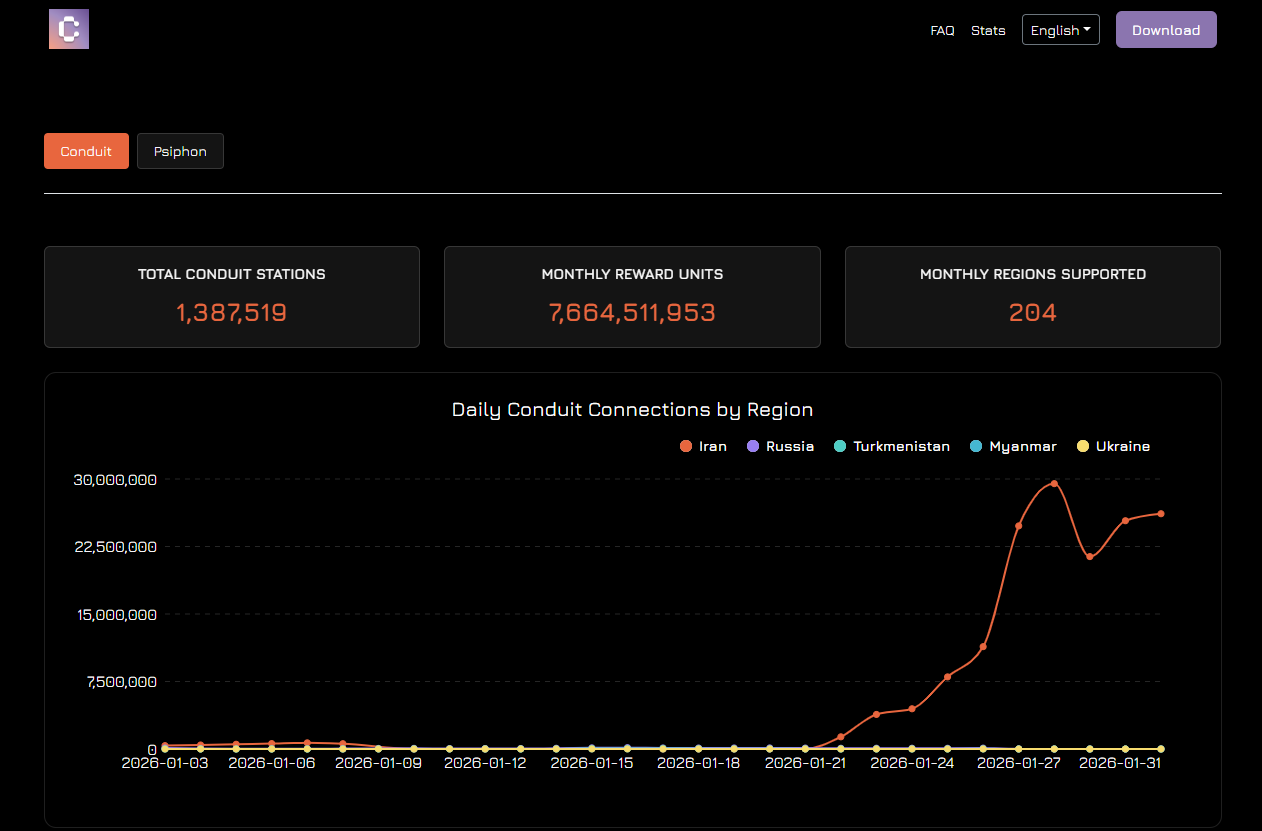
According to Psiphon, in the two weeks following Iran’s most recent nationwide internet disruptions, approximately 200,000 new Iranian users outside the country registered on Psiphon’s website. Their goal was not personal access, but to help fellow Iranians inside the country reconnect to the global internet through virtual tunnels.
This rapid mobilization highlights a critical shift: internet access during repression is no longer an individual workaround—it is becoming a collective, networked response.
What Is Conduit and How Does It Work?
Conduit is a feature within the Psiphon network designed specifically to counter censorship and preserve access to open internet under extreme conditions. During widespread shutdowns or throttling, Conduit functions as a vital decentralized infrastructure.
Through this mechanism, users outside Iran can turn their devices into Conduit stations, voluntarily sharing a portion of their internet bandwidth with users inside Iran. The result is a peer-to-peer network that allows individuals in censored regions to reach the global internet indirectly, bypassing state-controlled chokepoints.
Access from Inside Iran
For users inside Iran, connection to this network is straightforward. By downloading and running the Psiphon app from Google Play or the App Store, users can connect without complex configuration. The application automatically attempts to establish a secure connection to available Conduit stations.
For stability, other VPNs or filtering tools should be disabled during use. Once connected to a Conduit station, users can regain access to the global internet even amid widespread shutdowns.
Turning Devices Abroad into Lifelines
Iranians outside the country play a decisive role in this ecosystem. By installing the Psiphon Conduit version on their computers or mobile devices, they can easily activate a Conduit station. The process is simple: install, launch, and press “start.”
Each active station expands the network’s capacity.
Strength in Numbers
The effectiveness of Conduit scales directly with participation. The more volunteer Conduit stations are online, the greater the network’s bandwidth, stability, and resistance to detection or blocking. As the system grows, it becomes increasingly difficult—and costly—for authorities to disrupt.
This is a structural disadvantage for censorship regimes: decentralized systems improve as repression intensifies.
Internet Shutdowns as a Tool of Repression
For years, filtering, throttling, and deliberate internet shutdowns have been central instruments of repression in Iran. At moments of political and social crisis—particularly during nationwide protests—the regime seeks to monopolize information by cutting the country off from the outside world.
This strategy is designed to isolate protesters, suppress documentation of abuses, and fragment collective action.
A Tool with an Expiration Date
Technical experts have repeatedly warned that internet shutdowns are a diminishing tool of control. The rapid evolution of digital technologies—combined with tools like Conduit and the growing availability of satellite internet—means that state-enforced information blackouts are increasingly unsustainable.
The signs of this shift are already visible. Each shutdown now triggers innovation, solidarity, and wider adoption of censorship-resistant technologies.
From Control to Connectivity
What is unfolding is not merely a technical workaround, but a political transformation. Digital solidarity is eroding one of the regime’s most relied-upon mechanisms of suppression. As peer-to-peer networks expand and adapt, the balance of power over information continues to shift—away from centralized control and toward distributed resilience.
In this emerging landscape, connectivity itself becomes an act of resistance.