



Recently, Iran’s Supreme Leader, Ali Khamenei, delivered a speech accusing the United States of instigating unrest in the country. His remarks revealed a growing apprehension about the resurgence of street protests, signaling a deeper fear of systemic instability.
The Roots of Khamenei’s Concerns
Khamenei’s anxieties appear to stem from two converging issues: the potential intensification of the U.S. “maximum pressure” policy under a new administration and the worsening economic crisis within Iran. These factors, combined with the regime’s inefficacy, heighten the likelihood of popular protests.
Recent demonstrations in Tehran’s Grand Bazaar, triggered by soaring exchange rates and skyrocketing prices, underscore the legitimacy of these concerns. Economists warn that Iran’s economic indicators reflect the onset of a severe collapse. Rather than addressing these challenges, the government denies their existence, opting instead to suppress dissent and ignore public grievances.
Blame-Shifting and Suppression
Faced with mounting public discontent, Khamenei and the Islamic Revolutionary Guard Corps (IRGC) attribute the protests to “foreign interference,” refusing to acknowledge the regime’s inefficiencies. This deflection not only obstructs viable solutions but also perpetuates a cycle of denial, threats, and repression.
Khamenei’s labeling of external actors as the primary cause of unrest betrays his underlying fear of systemic collapse. This apprehension stems not only from external pressures and economic frailty but also from the regime’s repeated failures on the regional stage and diminishing domestic legitimacy.
Propaganda and Reality
Clerics like Ahmad Khatami amplify the regime’s narrative, asserting that Iran is nearing “the peak of progress.” Such rhetoric starkly contrasts with the harsh realities of economic and social distress. By perpetuating denial, the regime deepens public dissatisfaction and lays the groundwork for broader, more intense protests—a common trait of authoritarian regimes on the brink of collapse.
The IRGC’s recent statements mirror Khamenei’s rhetoric, dismissing legitimate grievances and blaming foreign adversaries. Yet, these suppression tactics highlight the regime’s fragility rather than its strength, exposing an acute fear of potential overthrow.
Rising Protests and Radical Demands
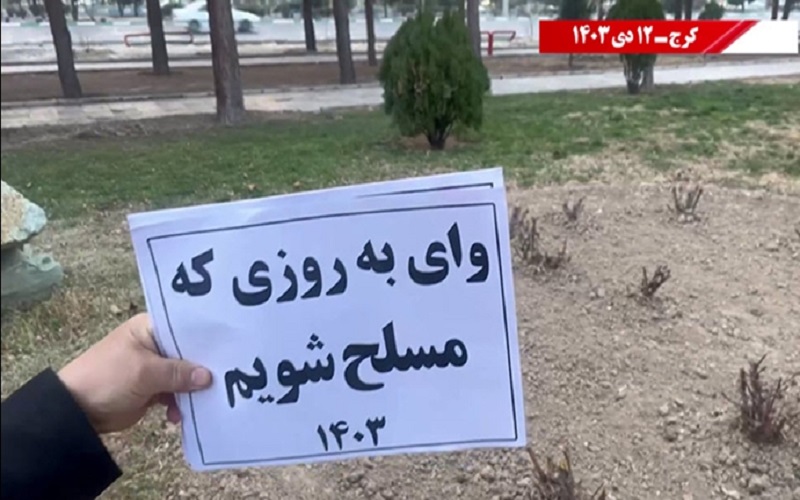
Despite intensified repression, protests have grown in both scale and intensity. The frequency of demonstrations has increased, and the demands have become more radical. Initially centered on economic hardships and electoral fraud, today’s protests call for the regime’s complete overthrow.
The protests span across numerous cities and involve diverse social groups, including pensioners, workers, nurses, farmers, students, and women. Protesters have displayed unprecedented courage in confronting repressive forces, signaling a shift in the public’s resilience and determination.
A Clear Vision for the Future
Contrary to claims that Iranians lack a unified vision, evidence suggests that the majority seek fundamental change. They have concluded that reforms within the current regime are futile and demand a democratic system rooted in respect for human rights and the separation of religion from politics. Most importantly, they advocate for a government whose form will be determined by popular vote, favoring a democratic republic over any form of dictatorship, whether monarchic or religious.
Assertions that Iranians are uncertain about their aspirations often serve to demoralize the populace and bolster the regime’s survival. However, repression is not a sign of strength; it is a reflection of the regime’s fear of collapse. The Iranian government’s reliance on suppression underscores its vulnerability in the face of a society increasingly united in its demand for change.