


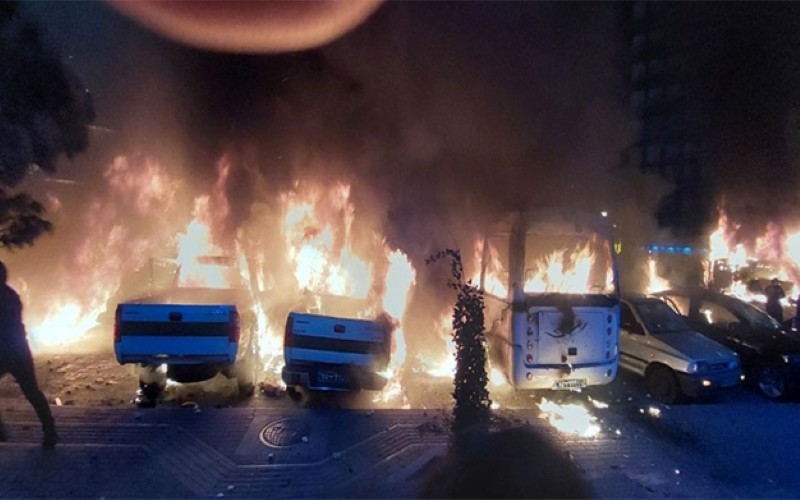

Nightly clashes, internet blackouts, and nationwide deployments expose the gap between Tehran’s propaganda and reality on the ground
While Iran’s state television and official propaganda outlets repeatedly declare that “unrest has been eliminated” and the uprising has come to an end, a simple question remains unanswered: if the protests are truly over, why are the streets still under round-the-clock occupation by security forces—and why does the internet remain shut down?
The answer cannot be found in official statements or on the screens of regime’s tightly controlled media. The real answer comes from Iran’s streets.
According to documented reports published by opposition-affiliated sources, including the People’s Mojahedin Organization of Iran (PMOI/MEK), recent nights have witnessed continuous clashes across dozens of cities, despite heavy deployment by the Law Enforcement Command of the regime and other security units. These confrontations are clear evidence that the fire of the uprising remains alive beneath layers of censorship and repression.
January 16, 2026: A Nationwide Show of Defiance
On Friday, January 16, 2026, protesters honored those killed in the uprising by igniting 60 coordinated acts of resistance across a wide geographic span. These actions were reported in cities including Qom, Tehran, Karaj, Mashhad, Kermanshah, Zahedan, Ahvaz, Abadan, Khorramshahr, Chabahar, Mahshahr, Qazvin, Shahin Shahr, Aligudarz, Dorud, Iranshahr, Saveh, Astara, Khomein, Azadshahr, and Azna.
In several districts of Tehran—including Naziabad, Tehranpars, Pirouzi, and Ekbatan—running street battles continued throughout the night. In Zahedan, Baluchi youth confronted security forces with chants of “Death to Khamenei” and “Death to the Basij,” delivering an unambiguous message to the Supreme Leader and his paramilitary enforcers.
Escalation in the Days Before
The unrest did not emerge suddenly on January 16. On Thursday, January 15, 2026, protests and clashes continued in Tehran and multiple provincial cities despite violent crackdowns. In Pirouzi Street and Tehranpars, demonstrators openly confronted riot police with anti-regime slogans.
In Qolhak, a weapons depot linked to the Islamic Revolutionary Guard Corps (IRGC) and the Basij militia was reportedly targeted. Cities such as Langarud, Mashhad, and Saveh also joined this expanding chain of resistance.
The night before, Wednesday, January 14, 2026, saw direct clashes between protesters and special anti-riot units in Tehran, particularly along Gorgan Street and Tehranpars. At the same time, Khoy, Kermanshah, Ilam, Karaj, and Isfahan turned into active confrontation zones. Reports described barricade-to-barricade fighting in Kermanshah and organized resistance in Hesarak, Karaj.
In Isfahan, especially Malekshahr and Motahhari Street, security forces were pushed back amid chants of “Death to Khamenei.” In Mashhad, Daneshjou Boulevard became the scene of clashes between protesters and units of the IRGC and special forces.
Propaganda Versus Reality
When streets remain this active, persistent, and confrontational, constant threats, pressure, and propaganda are not signs of authority. They are indicators of strategic exhaustion.
These reports demonstrate that beneath Iran’s digital blackout and pervasive censorship, hope, courage, and emerging organization continue to grow. Contrary to official claims, the uprising has not been extinguished. It has adapted—and it remains burning.
The regime may control television studios and press statements, but the streets of Iran are telling a very different story.