


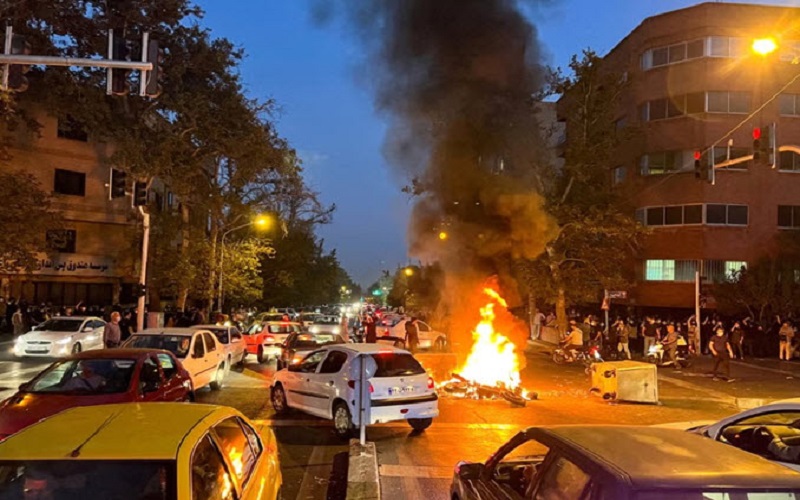

Looking back at Iran’s nationwide uprising in 2022, all the signs of a society on the brink of explosion were evident. These signs had been manifesting for years, visible in previous uprisings such as those in 2009, 2017, and 2019. By September 2022, Iranian society had become so unstable that even the slightest provocation could trigger a nationwide protest. This atmosphere of unrest was palpable in the people’s eyes, words, and actions.
Just four days before the protests erupted, the state-run website Khabar Fori captured the mood of the nation:
“People are under pressure. People are pessimistic. While they insult you with just one swear word, they bombard Islam, Khamenei, and Khomeini with dozens. You’ve made people so pessimistic about Khomeini, the revolution, and the system. They show their anger in their words and actions. You don’t believe it? Give people just one day of freedom and see what they do.”
Similarly, Etemad, another state-run daily, quoted Ali Rabiei on September 14, 2022:
“A kind of restlessness and a feeling of living in a rough and turbulent environment can be seen.”
Despite these clear warnings, Iran’s Supreme Leader, Ali Khamenei, chose to ignore them. Rather than address the grievances of the people, his oppressive apparatuses ramped up the pressure. Iran’s “restless and turbulent” society was like a powder keg, waiting for a spark. That spark came with the heart-wrenching murder of Mahsa Amini, a 22-year-old Kurdish woman, at the hands of the morality police. This horrific event ignited the nation, setting off a wave of protests that spread like wildfire.
The regime, particularly Khamenei, was caught off guard. In shock, Khamenei initially opted for silence. On September 21, 2022, a moderator on the regime’s TV channel 3, referencing the People’s Mojahedin Organization of Iran’s (PMOI/MEK) call for uprising, remarked that previous uprisings had typically evolved from moderate beginnings into more radical actions. This time, however, the uprising began in a radical state from the very outset.
Mohsen Mahdian, an Islamic Revolutionary Guard Corps (IRGC) member, expressed his astonishment during an interview on the same TV channel:
“I want to tell you that the events of these past two days are unprecedented. We’ve never seen protests like this in the last 40 years. Unprecedented in what way? Because we’ve never witnessed a period of protests where violence and disturbance erupted from the very first hour.”
What Mahdian referred to as “violence and disturbance” was, in reality, the uncontrollable anger of Iran’s youth, who defied the regime’s repressive forces and fearlessly took to the streets. This time, the revolt was led by the women and girls of Iran, who are among the most oppressed under the regime’s inhuman and reactionary laws.
In the midst of this unrest, some regime officials and supporters expressed frustration over the continued operation of the morality police, the force responsible for Mahsa Amini’s death. They questioned why this agency had been allowed to function despite the volatile situation. However, what these critics failed to recognize was that the uprising’s aim went far beyond the issue of mandatory hijab.
The true target of the protests was the very foundation of the regime itself. As in previous uprisings, the people were demanding a free country, free from any form of dictatorship. They knew, from the bitter experience of living under two past dictatorships, that the only solution was the establishment of a free democratic republic, one that rejected all forms of tyranny.
Mahdian himself acknowledged this during his interview:
“The story is not about the hijab at all. It’s not about the morality police, or even the tragic death of Mahsa Amini. This is about the government itself, the system. Their slogans make this clear. If you analyze the slogans from these past few days, you’ll realize that the issue isn’t the hijab or the morality police—it’s the principle of the government.”
The 2022 uprising saw a large portion of society rise up against the regime. The moment news of Mahsa Amini’s death spread, protests erupted in Tehran, quickly followed by uprisings in Saqqez, Sanandaj, Mahabad, Gohardasht, and Karaj.
By the third day of protests, cities like Saqqez, Mahabad, Sanandaj, Oshnavieh, Bukan, Marivan, Baneh, Sardasht, Piranshahr, Urmia, Javanroud, and Divandarreh had gone on strike. Tehran University’s rebellion against the regime was echoed in many other universities, including Amir Kabir University (Polytechnic), Allameh Tabataba’i University, Art University, Tarbiat Modares University, Beheshti National University, and universities in Tehran and Isfahan.
Divandarreh, in particular, became a war zone, as young protesters clashed with the regime’s repressive forces. By the evening of the third day, Tehran itself had risen up, inspiring the people of Gohardasht, Mashhad, Ilam, Baneh, Qorveh, and Rasht to join in. In the following days, the protests spread to even more cities across Iran. By the final months of 2022, not a single day passed without some form of rebellion against the regime.
Hamidreza Jalaipour, a former IRGC commander, reflected on those critical days and warned the regime’s officials not to be complacent. He cautioned:
“There is another narrative—that this is just the beginning. This was the first phase, the first episode, and we are now on a revolutionary path.”