



In response to growing public dissatisfaction, the Iranian regime has resorted to heightened repression and an alarming increase in executions. Daily killings—carried out both officially through the judicial system and unofficially through torture and beatings—are being used as tools to suppress a society on the verge of explosion. The regime hopes these brutal tactics will prevent future uprisings. According to available statistics, 150 people were executed in a short span after Masoud Pezeshkian was selected as the regime’s president, with 126 of them hanged in August alone.
However, this surge in executions, along with cases of extreme brutality like the torture and killing of Mir Mohammad Mir Mousavi, has failed to quell public unrest. Quite the opposite: protests and gatherings have surged, with people increasingly taking to the streets to demand their rights.
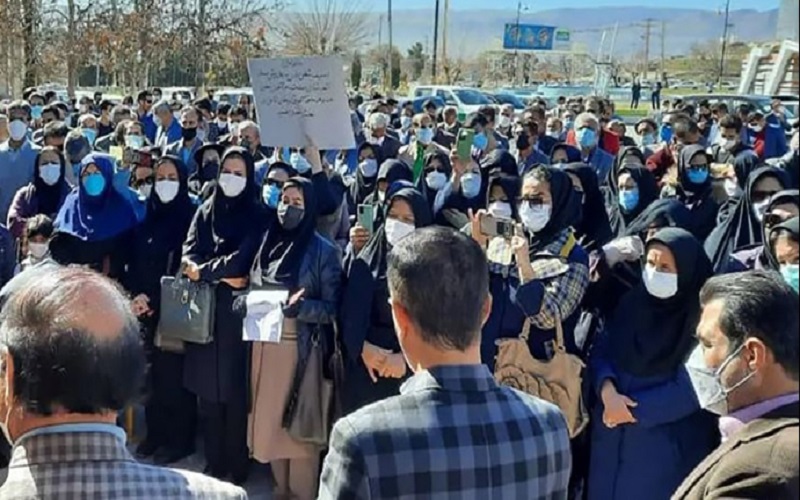
Despite the regime’s strict censorship, reports indicate that 686 protests and gatherings took place in August, more than double the 334 protests recorded in July. This dramatic increase reflects a persistent and growing dissatisfaction with the regime’s actions.
One of the most significant protest movements in August came from nurses, who organized 304 demonstrations in over 70 cities. These protests, which spanned dozens of hospitals and medical centers, marked a historic moment for Iranian nurses. As noted by the Secretary General of the Nursing Home on August 9, 2024, “During the 100-year history of modern nursing in the country, it is the first time that protests have taken the form of quitting work.”
Following the nurses, workers staged 174 protest gatherings, while farmers registered 22 movements. Educators and teachers held six protests, truck drivers staged seven, and other social groups contributed 90 additional movements. All of these protests reflect the growing anger among Iranians over the regime’s failure to address the country’s dire conditions.
Amid this mounting unrest, one question repeatedly surfaces: why does Khamenei, despite his vast resources, continue to ignore the people’s demands? Is he unaware of the situation? The answer is clear: he is fully aware. However, solving the people’s problems was never the regime’s goal. The root of Iran’s crises lies in the corruption of its officials, who prioritize their own interests over the well-being of the population.
Recent weeks have brought another scandal to light, this time within the regime’s banking system. On September 10, the state-run Hamdeli newspaper revealed that while ordinary people struggle to obtain loans of 10 to 20 million tomans, and essential loans such as marriage loans are delayed or halted due to alleged shortages, bank employees have been granted low-interest loans worth several hundred million tomans with long repayment periods.
Another revelation, which led to the resignation of the head of the stock exchange organization, involved the allocation of more than 10 billion tomans in a 4% loan, referred to in the media as the “Eshghi loan.” Meanwhile, despite the banking system’s substantial financial losses, bank executives have approved exorbitant compensation for attending board meetings and hefty year-end bonuses.
These revelations have only fueled public outrage. Protesters chant, “If there were less embezzlement, our problems would be solved.” It is evident that the rise in repression and executions has only led to an increase in dissatisfaction and protests.
The Iranian people have come to understand that their suffering—despite living in one of the world’s richest countries in terms of oil, gas, and mineral resources—is directly tied to the regime itself. To maintain its grip on power, the regime controls all aspects of the economy, with Khamenei, the institutions under his control, and the Islamic Revolutionary Guard Corps (IRGC) diverting the nation’s wealth to fund expansionist policies, warmongering, and the export of terrorism.
Khamenei himself is widely regarded as the country’s chief embezzler. In June 2020, during the height of the COVID-19 pandemic, the state-run Mostaghel newspaper cited a statement from Behzad Nabavi, who disclosed that four institutions tied to Khamenei’s office control 60% of the country’s wealth. The paper concluded that these institutions collectively hold assets worth around $1 trillion. This information dates back four years; since then, Khamenei’s wealth has only grown, largely due to the regime’s ability to sell billions of dollars’ worth of oil and gas, facilitated by the appeasement of Western powers.
Khamenei has no intention of addressing the people’s grievances. Instead, he has relied on two main tactics: repression and terror, through executions, and the deliberate impoverishment of the population. His goal is to prevent the people from even contemplating their right to live as free individuals. However, the persistent rise in protests indicates the severity of Iran’s economic and social crises. An all-encompassing uprising seems inevitable; it’s just a matter of time.