


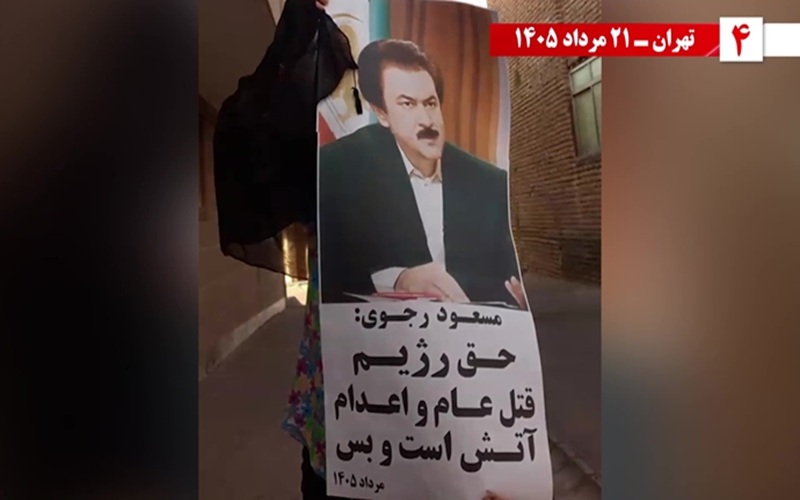

As war and repression become intertwined in the regime’s strategy for survival, Iranian society is increasingly responding with a unified demand for peace, freedom, and an end to executions.
Iranian society is going through a profoundly painful period. Alongside hunger, poverty, unemployment, and economic insecurity, millions of people have lost another essential element of daily life: a sense of safety.
War and the threats surrounding it have created one source of anxiety. Executions, arrests, and systematic repression have created another. Together, they have devastated the psychological security of Iranian society.
Yet amid this suffering, an important political development is taking shape.
In recent protests, alongside sectoral demands over pensions, wages, and living conditions, protesters have increasingly raised broader slogans such as “No to Executions” and “No to War.”
These are no longer isolated political slogans. They are increasingly becoming popular demands that cut across social groups.
From economic demands to political demands
One of the clearest examples can be seen among Iranian retirees.
These are people who spent their productive years working and contributing to society with the expectation that retirement would bring them at least a measure of stability and dignity. Instead, they have found themselves confronting poverty, inflation, inadequate pensions, and growing psychological pressure.
That pressure has driven them back into the streets.
But what is particularly significant is how quickly their economic demands become political.
The interval between a retiree demanding his or her livelihood and the same protester raising a political slogan can be measured in minutes.
This is not accidental.
It reflects the emergence of a society that has become increasingly conscious of the connection between its immediate suffering and its political roots.
Iranians increasingly understand that poverty, unemployment, inflation, repression, and insecurity do not exist as separate problems. They are interconnected consequences of the policies of a regime that has prioritized its own survival over the welfare and security of the population.
The economic crisis is therefore becoming political by necessity.
The connection between war and repression
For the regime, war and repression serve complementary purposes.
War creates an atmosphere of emergency. It allows the authorities to invoke national security, restrict public space, intensify surveillance, and portray dissent as a threat.
Under the cover of war, executions can increase. Arrests can expand. Security forces can tighten their grip on society.
The result is a society kept under permanent pressure.
This is why the emergence of the slogan “No to War” alongside “No to Executions” is politically significant.
The two slogans identify two sides of the same problem.
The regime uses the external threat of war to justify internal repression, while repression is used to prevent the social consequences of economic and political crises from developing into a broader uprising.
The people, meanwhile, are increasingly rejecting both.
Resistance does not stop at prison walls
The growing opposition to executions is reinforced by another important development: the persistence of resistance inside Iran’s prisons.
Despite executions, torture, interrogation, prosecution, and systematic pressure, political prisoners continue to send messages to the outside world.
Their words demonstrate that repression has failed to eliminate political resistance.
Political prisoner Ali Moezi recently wrote:
“Simay-e Azadi is our guide through doubts, darkness, and distortions, and it is a source of hope in despair. At this critical juncture, the role of this people’s media is many times greater, because this is the year of the war of wars and the year of determining the fate of this treacherous and bloodthirsty regime, with conspiracies, obstacles, and barriers ahead.”
Another political prisoner, Loghman Aminpour, wrote:
“May it be forbidden for me to forget the memory and ideals of Commander Vahid and his comrades. I tell the regime’s executioners and ‘King Mojtaba’: executing and killing rebellious young people only strengthens our fiery determination. By the blood of our comrades, we stand firm to the end.”
These messages are significant not simply because they express defiance.
They demonstrate that the regime has been unable to isolate political prisoners from the broader struggle taking place outside prison walls.
The prisoners continue to communicate with society. Society continues to hear them.
And their resistance, in turn, becomes part of the political consciousness outside the prisons.
The example of Vahid and his comrades
The execution of political prisoner Vahid Bani-Amerian and his comrades provides a powerful example.
Their resistance and conduct in the days leading up to their execution had an impact that extended far beyond the prison walls, reaching people throughout Iran and among the Iranian diaspora.
The significance of such resistance cannot be measured simply by the number of people who hear a particular message.
It lies in what that resistance demonstrates: that the regime’s machinery of repression does not automatically produce submission.
Even when the state controls the prison, the interrogation room, the courtroom, and the execution chamber, it cannot necessarily control the meaning that prisoners’ resistance acquires outside.
That is why the regime’s execution policy carries a political risk of its own.
Every execution intended to intimidate society can instead become another symbol of resistance.
From prisons to the streets
The connection between resistance inside prisons and protest outside them can also be seen among the young people who took to the streets in January 2026.
The courage of these young protesters and the defiance of political prisoners represent two manifestations of the same social phenomenon: a growing refusal to accept fear as the permanent condition of Iranian life.
The prisoner’s message reaches society.
Society’s protests, in turn, give meaning to the prisoner’s resistance.
This creates a feedback loop that repression alone cannot easily break.
The more the regime attempts to silence dissent through executions and arrests, the more those measures themselves become political grievances.
The emergence of an alternative: peace and freedom
Two developments are therefore converging.
The first is the increasing popularity of “No to Executions” as a public demand.
The second is the persistence and expansion of resistance among political prisoners.
Together, they point toward something larger than opposition to individual executions.
They point toward an emerging social alternative to the two pillars on which the regime seeks to preserve itself: repression and war.
The antithesis is increasingly clear:
Peace and freedom.
The regime’s model is based on maintaining power through coercion at home and confrontation abroad.
Iranian society is increasingly articulating the opposite vision: an Iran in which people are not executed for political opposition, young people are not imprisoned for demanding change, and the country is not kept in a state of permanent conflict and insecurity.
That is why the slogans “No to War” and “No to Executions” have significance beyond the immediate circumstances in which they are raised.
They express a broader demand for a fundamentally different political order.
A society refusing to choose between war and repression
The regime may attempt to present war and repression as unavoidable necessities. Iranian society is increasingly rejecting that premise.
People do not want to choose between external conflict and internal repression.
They want neither.
They want security without militarization, dignity without poverty, justice without executions, and political life without fear.
This is why the message emerging simultaneously from Iranian streets and Iranian prisons is increasingly coherent.
Political prisoners continue to resist, send messages, and expose the regime’s practices.
Protesters continue to gather and raise demands that move beyond immediate economic grievances.
Retirees who initially take to the streets over pensions can quickly turn their attention to executions and war.
Young people who confront security forces in the streets become part of the same broader current of resistance expressed by prisoners behind bars.
The convergence is unmistakable.
Against a system that has tied its survival to war and repression, Iranian society is increasingly putting forward its own formula: peace and freedom.
And because that demand corresponds not only to the political aspirations of Iranians but also to their most basic needs for security, dignity, and a normal life, it has the potential to reach far beyond any single protest, prison, or social group.
The regime can suppress a slogan for a day.
It cannot indefinitely suppress the reality that produced it.