


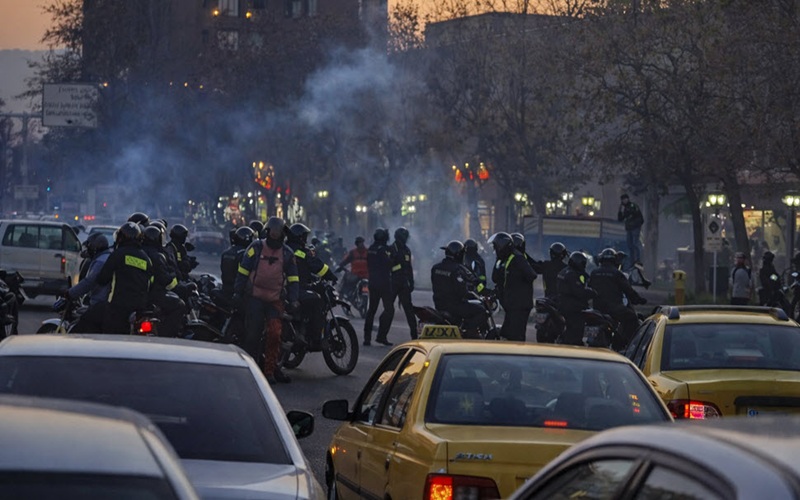

Growing warnings from within the regime reveal a deeper fear: that economic hardship and accumulated public anger could turn recurring protests into a sustained process beyond the authorities’ control.
For years, Iran’s rulers have portrayed foreign pressure and alleged external conspiracies as the principal causes of unrest. Whenever people took to the streets to protest poverty, corruption, repression, or economic mismanagement, the regime sought to dismiss their grievances by attributing the protests to foreign interference.
But repeated nationwide uprisings have increasingly exposed the weakness of that narrative.
Today, even media outlets associated with the regime are acknowledging that its most serious security challenge lies not beyond Iran’s borders, but within Iranian society itself. The growing warnings about another explosion of public anger reveal a regime increasingly aware that its accumulated crises cannot be contained indefinitely through repression and propaganda.
A recent commentary published by the Jamaran news outlet provides a revealing example of this growing anxiety.
The Regime’s Real Security Threat Is at Home
For decades, the regime’s political discourse has emphasized foreign threats while portraying domestic unrest as the product of outside manipulation. Yet the worsening economic and social crisis has made that explanation increasingly difficult to sustain.
The Jamaran commentary explicitly acknowledged that the greatest national-security threat is not simply external pressure, but the accumulation of domestic grievances. It warned that unresolved economic, political, and social demands, together with declining public trust, create the conditions for deeper instability.
This admission is significant.
It amounts to recognition that the regime’s fundamental vulnerability is the widening gap between the population and those who rule it. Foreign pressure may aggravate existing problems, but it does not create the underlying grievances. Those grievances are produced by years of corruption, repression, economic mismanagement, institutional dysfunction, and the systematic denial of basic rights.
In other words, the regime itself is increasingly identifying society—not foreign adversaries—as the center of its security problem.
Economic Pressure Is Becoming a Political Threat
The economic crisis is at the heart of this fear.
Persistent inflation, the erosion of purchasing power, the collapse of the national currency, unemployment, poverty, energy shortages, and deteriorating infrastructure have placed enormous pressure on ordinary Iranians. For millions of families, economic insecurity is no longer a temporary difficulty but a permanent feature of daily life.
Under these circumstances, decisions that further increase the cost of living can have consequences far beyond the economic sphere.
The regime’s own media have increasingly warned against what they describe as “shock therapy.” Jamaran called on the government to reduce the crushing economic pressure on the population and explicitly warned against measures that could intensify public hardship.
Such warnings reveal an important contradiction. The regime needs revenues and economic reforms to address its mounting fiscal problems, but it also understands that forcing the costs of those problems onto an already exhausted population could trigger a new wave of protests.
The experience of previous nationwide uprisings has demonstrated how quickly an economic grievance can become a political confrontation.
A price increase, a fuel-policy decision, cuts in subsidies, or another deterioration in living standards can become the spark that ignites much broader grievances. Once people take to the streets, the original economic issue can rapidly evolve into demands for fundamental political change.
That is precisely what the regime fears.
The Nightmare of Consecutive Uprisings
The most serious concern for the security apparatus is not necessarily one isolated uprising. It is the possibility that nationwide protests could become recurrent, overlapping, and increasingly difficult to suppress.
A regime can attempt to contain an isolated protest through arrests, intimidation, censorship, and force. But repeated uprisings impose a different kind of pressure.
Each new wave can reinforce the previous one. Each protest can deepen public confidence that resistance is possible. Each round of repression can generate new grievances. And each failure to resolve the underlying causes makes another confrontation more likely.
This creates a cycle that becomes increasingly difficult for the authorities to break.
The Jamaran commentary’s warning about the December 2025 uprising is therefore particularly revealing. It argued that the events of December 2025 should not become a recurring experience and described them as a warning that must not become “the first chapter of repetition.”
The wording is more significant than it may initially appear.
The fear is clearly not merely that another protest might occur. The deeper fear is that protests could become a recurring political process—one that exhausts the regime’s security institutions, exposes divisions within its ruling structure, and gradually undermines its ability to restore control.
Repression Cannot Resolve the Causes of Unrest
The regime’s dilemma is structural.
Its response to dissent has traditionally relied on repression rather than addressing the causes of dissent. Arrests, executions, censorship, internet restrictions, intimidation, and the militarization of public space may suppress protests temporarily, but they cannot eliminate poverty, corruption, unemployment, inflation, or the loss of public trust.
Nor can repression restore legitimacy.
Indeed, excessive repression can deepen the very grievances that fuel future protests. Families affected by arrests or executions become additional sources of anger. Young people who see no economic or political future become increasingly alienated from the ruling system. Workers, retirees, students, farmers, and other social groups continue to confront problems that cannot be solved through security measures.
This is why the regime’s growing concern about another nationwide uprising is so important.
Its own warnings suggest that the authorities understand the limitations of repression. They know that the problem is not simply the organization of demonstrations; it is the accumulation of grievances across society.
The Fear of a Process the Regime Cannot Stop
The repeated nationwide uprisings in Iran have changed the political landscape. Protest is no longer an isolated phenomenon that can simply be treated as an exceptional security incident. The memory and experience of previous uprisings remain embedded in society, while the underlying conditions that produced them continue to deteriorate.
The regime’s increasingly explicit warnings therefore reveal more than ordinary political anxiety. They point to a deeper fear of a society reaching a point where accumulated grievances converge and individual protests merge into a broader nationwide movement.
That is the nightmare facing Iran’s rulers: not merely another protest, but a sequence of uprisings that becomes increasingly difficult to contain.
As long as the regime remains unwilling or unable to address the fundamental political, economic, and social demands of the Iranian people, the forces driving unrest will remain in place.
The warnings coming from within the regime are, in this sense, an admission of its own vulnerability. They acknowledge that the greatest danger to the existing power structure is not simply external pressure, but the unresolved anger of millions of Iranians.
And that anger cannot be permanently suppressed.