



Khamenei’s language reveals how Iran’s ruling system weaponizes “nonviolence” to legitimize repression and control society
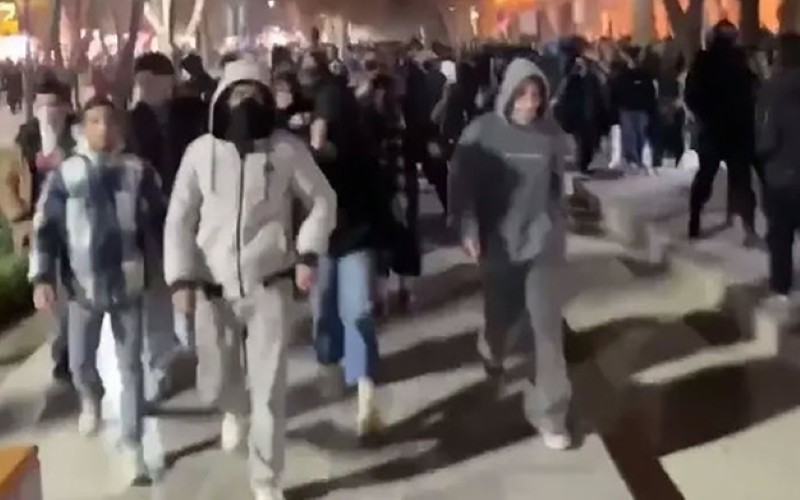
On the seventh day of Iran’s nationwide uprising in January 2026, Ali Khamenei the regime’s supreme leader addressed a gathering he described as “families of the martyrs of the 12-day war” and declared: “Protest is legitimate, but protest is different from rioting.” He went on to add: “Officials must speak with protesters, but speaking with rioters is pointless; they must be put in their place.”
At first glance, this statement appears conciliatory. In reality, it is a confession. When the regime says “protest yes, riot no,” it is announcing that it alone acts as judge, prosecutor, and executioner. Within this framework, “peaceful” is not an objective description of behavior; it is a political permit issued exclusively by the state.
Any action that disrupts the regime’s balance of power—even a calm labor strike or a coordinated economic boycott—is immediately reclassified as “riot” and therefore criminalized. Once relabeled, it becomes subject to military-style repression. The terminology does the work of the bullet long before the trigger is pulled.
This artificial binary systematically shifts responsibility for violence from the perpetrator to the victim. The regime tells the public, and its own wavering security forces: “We did not want to shoot. But once the protest crossed the line into ‘riot,’ we had no choice.” In this narrative, the protester’s commitment to nonviolence does not protect them; it becomes the mechanism through which their killing is justified. The regime simply claims that an invisible boundary of “peacefulness” has been crossed.
In a police–military state, calls for “peaceful protest” are invitations to operate strictly within a battlefield defined by the suppressor. Stay within it, and your actions are rendered ineffective. Step outside it, and you are erased under the label of “rioter.”
This deadlock explains why dictators adore the nonviolence of their opponents. It allows them to carefully design the boundaries of “acceptable dissent” so that the regime’s real pillars of power—the Revolutionary Guards, the garrison economy, and the surveillance apparatus—are never seriously threatened.
For an entrenched authoritarian system, survival is not ideological; it is economic and logistical. The more an uprising is stripped of hard pressure tools that shake the system, the more efficiently repression can be optimized. A protest that poses no operational cost is not a threat—it is manageable noise.
The police–military regime in Iran recognizes no rules of engagement, yet demands total moral discipline from its opponents. This asymmetry places protesters in the position of a boxer with tied hands facing an opponent wielding brass knuckles.
Modern dictatorship favors an opposition that:
- Publicly announces its time and location
- Possesses no means of self-defense
- Commits in advance to predictability and non-surprise
Within such conditions, absolute nonviolence ceases to be a resistance strategy. It becomes part of the regime’s own security protocol for neutralizing crises at low cost. The Iranian regime does not fear the kindness of society; it fears the day when dissent shifts from predictable slogans to actions it cannot manage or contain.
Here, “nonviolence” is not treated as a moral value but as a surgical blade—used to dissect, fragment, and isolate the opposition. Those who insist on “absolute patience and civility” are elevated as “reasonable” and “responsible” dissenters. This moral reward system turns them into an internal police force within the movement, suppressing costly action before the regime has to.
Conversely, any segment of society that moves toward legitimate self-defense is immediately stigmatized with heavy labels—terrorist, separatist, violent—and pushed into isolation. Through this division, the regime raises the social cost of supporting resistance. Absolute nonviolence thus becomes a tool that separates genuine fighters from the broader public, leaving them alone in front of the repression machine.
The regime’s active promotion of nonviolence—through its media, clerics, and security-linked “think tanks”—reveals how the concept of the “right to protest” has been transformed into a technology of control. If the regime openly declared that no one has the right to protest, confrontation would immediately escalate, and responsibility for bloodshed would be unmistakable.
Instead, it grants conditional permission—only to later revoke it—and then blames the victims for their own deaths by claiming: “We allowed protest, but they turned violent.” This is not tolerance. It is a calculated architecture of repression.
And it is a sign not of confidence, but of fear.