Keynote Speakers and Global Leaders at the Free Iran Convention 2025 Affirm the Iranian Regime’s Terminal Weakness, Reject Monarchy and Theocracy, and Endorse the NCRI as the Tested, Legitimate Alternative.
The Unmistakable Message of Inevitability
The closing session of the Free Iran Convention 2025 focused on charting the path forward, uniting voices from politics, science, and global policy who unanimously declared that the regime change, carried out by the Iranian people and their organized resistance, is the only solution.
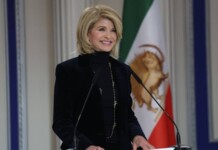
Dr. Sofey Saidi, who opened the session, asserted that Iran’s transition to a democratic, secular, and non-nuclear republic is “not only possible but inevitable”. She stressed that history shows that when dictatorships fall, movements without unified leadership often dissolve into chaos, but where “disciplined, principled alternatives existed, transitions had a chance to succeed”.
Mrs. Maryam Rajavi, President-elect of the National Council of Resistance of Iran (NCRI), joined the event from Paris. Mike Pompeo, former U.S. Secretary of State, followed her remarks, stating that the situation on the ground for the Iranian people is difficult, but the regime “is weak” and has “zero popular legitimacy”. He assured attendees of the certainty of the regime’s collapse, noting that while the date is “unpredictable,” its failure will come with “unbelievable speed”, just as the Soviet Union’s end did.
Rejecting Dictatorship: “No Turban, No Crown”
A major theme of the closing session was the wholesale rejection of both the current theocracy and the previous Pahlavi monarchy.
John Bercow, former Speaker of the U.K. House of Commons, argued that the current regime, characterized by “barbarity against its own people” and a lack of comprehension that government should “serve, to facilitate, and to empower the people”, cannot be reformed: “They can’t be improved. They have to be removed”.
He directed sharp criticism toward the monarchist alternative, declaring that the alternative is not “son of Shah. No way!”, criticizing the “chutzpah” of a figure who lived a life of luxury and proposes to appoint the heads of the executive, judicial, and legislative branches. Bercow concluded that the most obvious source of legitimacy for an alternative is “being on the ground, not having run away, organizing resistance, sticking at it”.
Professor Hossein Sadeghpour provided historical context to this rejection, noting that the struggle to free Iran has been an “epic struggle against the icons of authoritarianism and brutality”. He stated unequivocally that the Iranian people “en masse thoroughly rejected monarchy in 1979. Period”. Furthermore, he argued that freedom is not bestowed by dynasties or foreign patrons but “is earned through sacrifice, resistance, and an unbreakable commitment to justice”.
Carla Sands, former U.S. Ambassador to Denmark, summarized the national consensus plainly: “Iran will not trade a turban for a crown”.
The NCRI’s Capacity and the Ten-Point Plan
The speakers highlighted the NCRI’s long-term structure and preparedness to govern the transitional period.
Ambassador Sands affirmed that the NCRI is “not a theory. It is not an opposition on paper. It is a government in waiting”, emphasizing that the movement is feared by the regime because it is organized, has leadership, has structure, and “has Resistance Units within Iran who are focused on confronting the Revolutionary Guards”.
Patrick Kennedy, former Congressman, credited the NCRI for demonstrating that transition is possible because it “has the back room, as we say in politics. There are smart people in the back room”. He noted that NCRI events showcase “brilliance, people capable, people who are motivated”.
Dr. Morteza Gharib, Hans W. Liepmann Professor of Aeronautics and Mechanical Engineering at Caltech, spoke of his discussions with Mrs. Rajavi, who he called an “amazing scientist” whose questions covered everything from AI to quantum physics. Dr. Gharib, who holds over 170 patents, endorsed Mrs. Rajavi’s Ten-Point Plan, which he has studied carefully, saying: “It’s a rejuvenated U.S. Constitution, in a way. It’s amazing, and it is also designed for Iranians”. His only suggestion for the Resistance was to “Just follow that”.
Dr. Mohammad Hossein Tasooji echoed this sentiment, noting that Mrs. Rajavi’s focus on scientific implementation in the organization to make it “even more efficient” is truly remarkable.
The International Duty: Forward, Not Appeasement
Speakers urged the international community to change its policy immediately.
Mike Pompeo warned against the failure of appeasement: “If you appease tyrants, they will grow in power and stature, and they will prolong the time until a regime falls”. He stressed that pallets of cash delivered from the West “only enable the brutalization of the opposition” and fund the regime’s efforts to rebuild proxies like Hamas and Hezbollah.
Guy Benson, a political commentator, noted that the world has seen the regime’s “utter weakness” since October 7th. He insisted that anyone who stands for human rights has a “moral requirement to speak out against the regime in Iran and on behalf of the people of Iran”.
Ambassador Sands asserted that democratic governments must recognize the right of the Iranian people to overthrow the regime, stop legitimizing Tehran with concessions, and “acknowledge that the NCRI is the legitimate representative of the Iranian people’s struggle for freedom”.
Patrick Kennedy concluded by reminding the audience of the universality of the fight, stating that the Iranian struggle is “not an Iranian fight, even though it’s the people of Iran who are waging it. This is a universal fight”. He urged the movement to heed the motto: “Keep fighting, keep believing, keep working, keep campaigning,” because, as Bercow declared, the change to democracy “is as inevitable as the passage of the seasons”.