


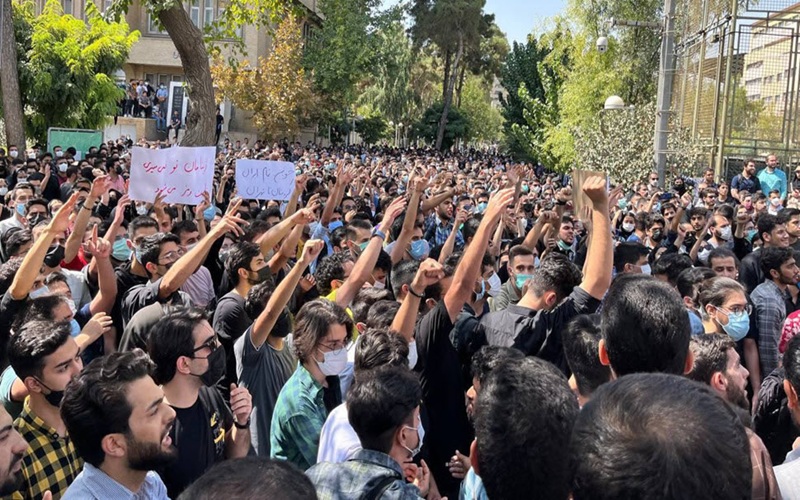

Alarming warnings from regime officials reveal deep concern over schools and universities as potential centers of dissent, organization, and renewed resistance.
As Iran’s new academic year begins, officials of Iran’s regime are once again warning about the political dangers they see inside schools and universities. The language is striking: Rather than describing educational institutions simply as places of learning, regime officials portray them as strategic spaces that could be “conquered” by an alleged enemy.
Speaking at Friday prayers in Bojnurd, regime cleric Reza Nouri warned education officials to remain vigilant, saying that the “enemy” was seeking to “conquer” the education system, universities, and other educational centers. He called on teachers, administrators, and officials to work together to “sanitize” the educational environment and urged them to enlist students and university students in that effort.
The warning raises a basic question: Why does the reopening of schools and universities generate such anxiety for Iran’s regime?
The answer lies in the political significance that educational institutions have acquired over decades of confrontation between Iranian society and the ruling system.
A Regime That Sees Education as a Political Battleground
The regime’s concern is not simply about what students learn in classrooms. It is about what happens when large numbers of young people gather, communicate, exchange ideas, and develop relationships beyond the immediate control of the authorities.
Iran’s regime has repeatedly relied on repression, surveillance, ideological controls, and the presence of security forces to maintain its grip over public spaces. Schools and universities have consequently become another arena in which the authorities seek to prevent dissent from developing into collective action.
The interview underlying this article argues that the regime’s displays of strength and its extensive security apparatus should not be mistaken for broad social legitimacy. Whatever estimates are offered regarding the regime’s actual social base, its conduct itself demonstrates its dependence on coercive control.
The authorities understand that relinquishing control over strategic public spaces could create opportunities for opposition forces to organize and communicate.
Educational institutions are among those spaces.
A Long History of Student Resistance
The regime’s anxiety has a long history.
In July 1999, protests that began at Tehran University developed into one of the most serious student confrontations with the regime since the 1979 revolution. The crackdown that followed demonstrated how quickly university campuses could become focal points of wider political opposition.
A decade later, students again played a prominent role during the nationwide protests of 2009.
Student participation also featured prominently in the waves of unrest that followed, including the protests of 2017–18 and the nationwide uprising of November 2019.
The 2022 uprising once again demonstrated the political importance of Iran’s younger generation. University campuses became centers of demonstrations, while students and young people carried opposition slogans beyond educational institutions and into streets and neighborhoods across the country.
The significance of these episodes is not merely historical. They help explain why regime officials continue to view universities as politically sensitive territory.
From Campuses to the Streets
Universities do not exist in isolation from Iranian society.
Students have families, workplaces, neighborhoods, and social networks. Teachers and university personnel are similarly connected to wider society. Ideas and grievances that emerge inside educational institutions can therefore spread well beyond campus boundaries.
This is one reason the regime has repeatedly attempted to impose ideological and security controls on universities while simultaneously seeking greater influence over schools.
The concern is not necessarily that every school or university will become a center of protest. It is that these institutions provide an environment where large numbers of young people can communicate and where grievances can develop into collective expressions of opposition.
For a government already sensitive to the possibility of renewed unrest, that potential alone is significant.
What Does “Sanitizing” Education Mean?
Nouri’s use of the term “sanitizing” the educational environment is particularly revealing.
In the regime’s political vocabulary, maintaining a “healthy” or “safe” environment has often meant preventing political dissent, monitoring students and teachers, and strengthening ideological supervision.
The language also reveals how the authorities perceive the relationship between education and political control. Instead of treating students as citizens entitled to independent political views, the regime approaches the educational environment as a space that must be protected from ideas it defines as hostile.
This is why the regime’s warnings about the new academic year go beyond ordinary concerns about security or school discipline.
They are political warnings.
Why the New Academic Year Matters
The reopening of schools and universities brings millions of students and educators back into a common social environment after the summer break.
For the regime, this creates both a challenge and a potential source of instability.
The authorities can deploy security measures, ideological programs, administrative controls, and surveillance. But none of these measures eliminates the underlying grievances that have repeatedly brought students and other sectors of Iranian society into confrontation with the regime.
Indeed, the more aggressively the authorities attempt to control educational institutions, the more clearly they demonstrate how politically consequential they believe those institutions to be.
The regime’s own rhetoric is therefore revealing.
When a senior cleric warns that the “enemy” is trying to “conquer” schools and universities, he is effectively acknowledging that these institutions matter in the broader struggle over Iran’s political future.
The Fear Behind the Warnings
Iran’s regime has repeatedly attempted to prevent dissent from moving between different sections of society. Yet the history of Iran’s protests demonstrates how difficult it is to isolate students from the wider population.
Workers, teachers, students, shopkeepers, retirees, and other social groups have repeatedly expressed grievances against the ruling system. Educational institutions are one of the environments in which the younger generation encounters and articulates those grievances.
This helps explain why the regime is so concerned about maintaining control over universities and schools.
Its fear is not simply about a student protest.
It is about the possibility that a crack in one controlled space could connect with grievances elsewhere and contribute to a broader challenge to its authority.
The reopening of schools and universities therefore presents Iran’s regime with a familiar dilemma. It can intensify surveillance and repression in an attempt to prevent dissent—or it can tolerate greater political and social freedom and risk losing control over spaces it considers strategically important.
The regime’s warnings suggest that it already knows how consequential the second possibility could be.
For a government confident in its social legitimacy, schools and universities would be places of education. For a government that sees dissent as an existential threat, they become battlegrounds.
That is why the regime’s anxiety over the new academic year is itself significant. Its warnings reveal that behind the machinery of repression lies a persistent fear: that Iran’s young generation may once again turn educational spaces into launching points for demands that extend far beyond the classroom.