Iran faces escalating water and electricity shortages, sparking protests, economic losses, and growing social unrest.
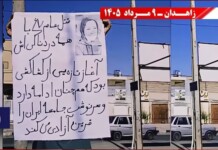
On Friday, August 22, the people of Shiraz once again took to the streets in protest against repeated power outages, gathering in front of the governor’s office and a local gas station. Demonstrators chanted slogans such as “Water and electricity, life is our inalienable right,” while demanding an end to the regime’s chronic failures in providing basic services.

Security forces swiftly moved in, blocking roads, dispersing the crowd with tear gas, and arresting several protesters. Eyewitnesses reported that the regime’s police confiscated the mobile phones of those who were recording the events. Protesters also booed regime forces, chanting “dishonorable, dishonorable,” reflecting the public’s mounting anger at the government’s disregard for their daily hardships.
Broken Promises, Broken Infrastructure
Four and a half decades after Ruhollah Khomeini, the founder of the Iranian regime promised free water and electricity for the poor, Iranians now find themselves in the middle of a full-scale energy crisis that experts had long predicted. Severe shortages of water and electricity have brought large parts of the country to a semi-shutdown in the peak of summer 2025.

Instead of addressing the root causes through investment in infrastructure and proper energy management, the regime has chosen the most disruptive solution: mass closures of government offices, banks, and industries. From August 20 to September 1, many provinces—including Tehran, Khorasan Razavi, North Khorasan, Kerman, Qom, Kurdistan, Khuzestan, Qazvin, and Chaharmahal and Bakhtiari—have been shut down.
Officials in Tehran even announced that government institutions, except for emergency and law enforcement services, will remain closed on Saturday to “reduce electricity consumption.” In reality, this decision deals another heavy blow to Iran’s already fragile economy.

Economic Fallout
According to economic experts, each day of closure costs Iran at least five trillion tomans in lost productivity. This comes on top of a collapsing currency, soaring inflation, and a deepening budget deficit. Small and medium-sized industries—already under immense strain—are facing devastating setbacks that could prove fatal.
Local markets are also in turmoil. Merchants in Tehran, Javanroud, Saveh, Babolsar, Ahvaz, Zahidshahr, Fars, and other cities have staged protests against extended blackouts, which now stretch from two hours to as long as eight hours a day.
Blackouts Beyond Homes and Offices
The crisis extends beyond households and businesses. Outdated telecommunications towers and failing backup batteries mean that each blackout cripples Iran’s mobile and internet networks. Users across the country report losing mobile signals and experiencing sharp drops in internet speed just minutes after a power outage.

At the same time, Iran’s overstretched healthcare system is crumbling under staff shortages. The Director General of the Nursing System Organization recently confirmed that some hospital emergency rooms and ICUs have been forced to close due to a severe shortage of nurses. With at least 100,000 nurses missing from the workforce—and thousands leaving the country annually due to low pay and unbearable conditions—the healthcare system is on the brink of collapse.
Regime’s Misguided Priorities
The current crisis is not the result of hot weather or reduced rainfall, but decades of deliberate mismanagement. Successive governments under Supreme Leader Ali Khamenei have diverted billions of dollars in oil and gas revenues into nuclear development, missile programs, and financing proxy groups abroad, while neglecting domestic infrastructure.
As a result, power plants are outdated and unable to support each other. When water reserves drop, hydroelectric plants fail; in winter, gas shortages shut down thermal power plants. The result is nationwide blackouts—planned or otherwise—across nearly every season of the year.

Social Collapse on the Horizon
With families enduring multiple daily water cuts and blackouts lasting four hours or more, the crisis is eroding public trust and fueling further unrest. Tavanir, Iran’s Electricity Transmission Organization, has already admitted that outages will occur at least twice daily, citing low dam reserves and a heat wave.
In Tehran province, entire industrial parks are being shut down for days each week. Local officials admit that backup generators only provide a fraction of the power needed, pushing hundreds of businesses into semi-closure.
The broader impact is devastating: a shrinking GDP, rising unemployment, an accelerating brain drain, and the disintegration of critical infrastructure. Hospitals without nurses, cities without power, and markets without functioning supply chains point to a society sliding deeper into crisis.
Despite this, regime officials continue to offer empty promises about new power plants and energy-saving measures—pledges that have been repeated for decades but never fulfilled. For ordinary Iranians, each passing summer brings longer blackouts, while every winter delivers new gas shortages.
As protests intensify, the growing anger of the Iranian people underscores a stark reality: the regime’s decades of corruption and misplaced priorities have left Iran with neither stability nor sustainability—and the people are no longer willing to remain silent.