


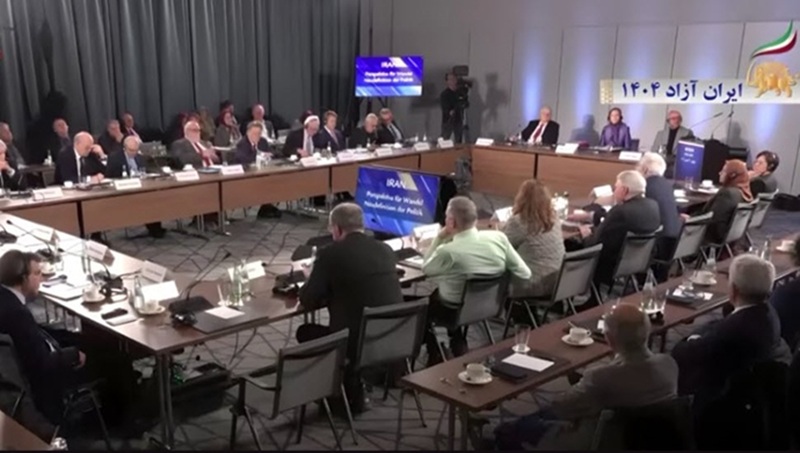

Former German and U.S. officials outline a vision for change in Iran, endorsing a democratic platform while warning against misinformation, dynastic succession, and Western complacency.
A Platform for Democratic Transition
At the “Iran Conference: Prospects for Change” in Berlin, senior former officials from Europe and the United States addressed the future of Iran and the viability of an organized democratic alternative.
Among the keynote speakers was Franz Josef Jung, who argued that Iran’s opposition movement represents a credible and structured alternative to the current clerical establishment. He emphasized that many Iranians seek an end to authoritarian rule and demand political freedoms, rule of law, and equality before the law.
Jung pointed to a ten-point democratic framework proposed by Mrs. Maryam Rajavi, describing it as a constructive foundation for a future Iranian constitution. According to his summary, the plan calls for:
- The abolition of absolute clerical rule
- Freedom of speech, assembly, press, and political parties
- Universal suffrage and political pluralism
- Separation of religion and state
- Full gender equality in political, social, cultural, and economic spheres
- An independent judiciary grounded in international human rights standards
- A ban on torture and the death penalty
- Dissolution of the Islamic Revolutionary Guard Corps
- A non-nuclear Iran committed to regional peace
Jung stressed that any successful transition must rest on democratic legitimacy and inclusivity. He also criticized what he described as ongoing efforts by Tehran to discredit opposition groups through systematic smear campaigns, arguing that appeasement policies by Western governments have historically emboldened repression rather than moderated it.
Dynastic Succession and Manufactured Narratives
Another central address was delivered by Lincoln Bloomfield Jr., who focused on what he characterized as a deliberate manipulation of public discourse surrounding Iran’s political future.
Bloomfield suggested that discussions about succession within Iran’s ruling structure increasingly revolve around the son of Supreme Leader Ali Khamenei, while external media speculation often centers on the son of the former Shah, Reza Pahlavi. He argued that framing Iran’s future as a choice between dynastic figures—whether clerical or monarchical—serves to marginalize organized democratic opposition forces.
According to Bloomfield, neither hereditary succession nor restorationist narratives offer a legitimate path forward. He contended that both figures owe their prominence largely to inherited wealth and name recognition rather than demonstrated political leadership or democratic mandate.
Information Warfare and Western Policy
A recurring theme in Bloomfield’s remarks was what he described as a long-running information campaign by Tehran aimed at shaping Western perceptions. He argued that successive Western governments have at times accepted simplified or misleading narratives—particularly when nuclear negotiations, hostage diplomacy, or economic incentives were involved.
In his assessment, Western policymakers often compartmentalized Iran’s nuclear file from its broader record, which includes regional proxy warfare, maritime attacks, domestic repression, and transnational operations targeting dissidents.
Bloomfield also referenced allegations of severe human rights violations during the 1980s, including mass imprisonment and executions of political prisoners. He argued that insufficient international scrutiny of these events has contributed to a broader failure of accountability.
Terrorism Cases and Legal Judgments in Europe
The conference also revisited several high-profile European cases involving Iranian state-linked operations.
Speakers cited the 1992 assassinations of Kurdish leaders at the Mykonos restaurant in Berlin, which German courts ultimately linked to senior Iranian officials.
They also referenced the foiled 2018 bombing attempt against a large opposition gathering near Paris. The case led to the conviction of an Iranian diplomat in Antwerp, marking one of the rare instances in which a European court held a serving Iranian official criminally responsible for terrorism-related activities on European soil.
Bloomfield claimed such incidents demonstrate that Tehran’s security apparatus has consistently targeted organized opposition abroad, particularly the National Council of Resistance of Iran (NCRI) and its principal member organization, the People’s Mojahedin Organization of Iran (PMOI/MEK).
Ideological Conflict Within Islam
A significant portion of the discussion addressed ideological differences between Iran’s ruling theocracy and opposition interpretations of Islam.
Bloomfield argued that the opposition leader Massoud Rajavi challenged the theological basis of clerical absolutism, promoting instead an interpretation of Islam compatible with political pluralism and gender equality. This ideological confrontation, he suggested, contributed to the regime’s enduring hostility toward the movement.
Speakers maintained that the opposition’s platform asserts compatibility between Islamic faith and democratic governance, including voluntary religious observance and legal equality for women.
The Strategic Importance of Information
Both Jung and Bloomfield underscored the role of information in shaping Iran’s political trajectory. They argued that exposing documented human rights abuses, financial networks of elite figures, and foreign operations could shift international policy calculations and strengthen domestic calls for accountability.
The conference concluded with a consistent message: that Iran’s future should not be framed as a binary contest between authoritarian past and authoritarian present, but as an opportunity for democratic reconstruction grounded in secular governance, human rights, and electoral legitimacy.
Whether that vision can translate into political reality remains uncertain. But in Berlin, the emphasis was clear—structured democratic alternatives exist, and the contest for Iran’s future is as much about narrative control as it is about political power.