


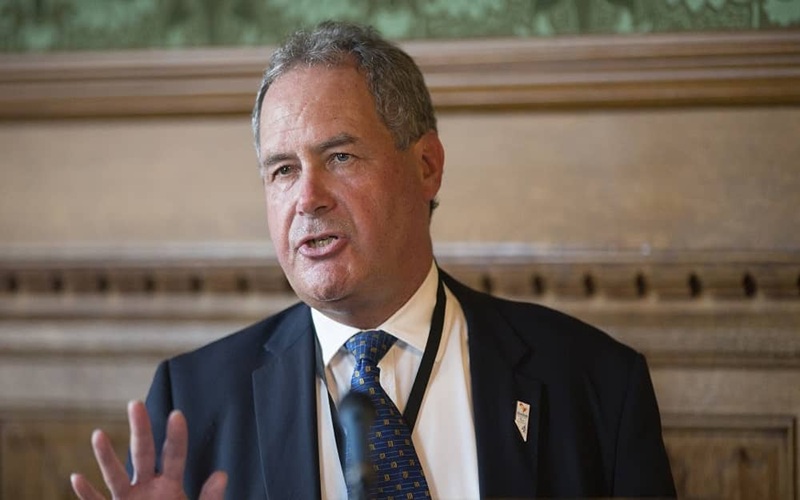

Bob Blackman said Iran’s protests reflect a sustained demand for democratic change and called for accountability over executions and past atrocities.
UK Member of Parliament Bob Blackman said Iran has entered a new political reality shaped by years of nationwide protests and uprisings, arguing that the Iranian people are seeking fundamental democratic change.
Speaking at the UK Parliament, Blackman said the protests of recent years and months demonstrated what he described as widespread rejection of Iran’s regime. He argued that the situation could not simply return to the conditions that existed before 2026 or before 2017.
Blackman also rejected both military conflict and appeasement as sustainable solutions to the Iran crisis, referring to six months of military conflict alongside decades of international engagement.
Iran’s Crisis and the Question of Political Change
Blackman said the decisive struggle should not be viewed primarily as a confrontation between Iran and Western governments. Instead, reflecting the position long advanced by the National Council of Resistance of Iran (NCRI), he described it as a struggle between the Iranian people and the country’s theocratic government over Iran’s political future.
He argued that the regime’s reliance on repression, terrorism, and regional destabilization reflected what he described as a lack of popular legitimacy.
Blackman further said that the increasing use of repression should be viewed as a sign of fragility rather than strength. Against this backdrop, he identified the Iranian people and their organized resistance as the principal forces seeking democratic change.
Warning Over Executions and Accountability
A major part of Blackman’s remarks concerned reports of possible preparations for another wave of executions in Iran.
He said such reports should alarm the international community and pointed to the experience of the 1980s, particularly the 1988 massacre of political prisoners. Blackman cited the figure of 30,000 victims and said thousands of those killed were supporters of the People’s Mojahedin Organization of Iran (PMOI/MEK).
He also referred to former UN Special Rapporteur on Iran Javaid Rehman’s conclusions concerning the 1988 killings, saying that Rehman had concluded that aspects of the crimes may amount to genocide.
Blackman called for the international community to confront these allegations directly. He also referred to warnings from the UN fact-finding mission concerning increased executions involving people associated with the PMOI and individuals detained during recent anti-regime protests.
He argued that officials connected to the alleged atrocities of the 1980s should not be able to rely indefinitely on impunity.
“Impunity cannot be assumed and accountability cannot be postponed indefinitely,” Blackman said.
Resistance Continues Inside Iran
Blackman also highlighted activities attributed to the PMOI’s Resistance Units.
Referring to the organization’s 61st anniversary, he said Resistance Units had organized public activities and commemorations in several Iranian cities, including Tehran, despite what he described as significant personal risks.
Blackman presented these activities as evidence, in his assessment, that the demand for freedom remains organized and resilient inside Iran.
He argued that the UK should recognize this development when formulating its Iran policy.
Blackman’s Call for a New UK Policy
Blackman called on the British government to support the Iranian people and recognize what he described as their right to resist repression by the Islamic Revolutionary Guard Corps (IRGC) and mobilize for democratic change.
He went further by calling for the UK government to recognize the NCRI as the provisional authority for a democratic transition and to endorse Maryam Rajavi’s Ten-Point Plan for Iran’s future.
These are political positions advanced by Blackman in his speech, rather than established UK government policy.
He also argued that a restoration of the former monarchy should not be treated as equivalent to a democratic alternative. Referring specifically to Reza Pahlavi, Blackman cited what he described as his support from foreign military strikes, the conduct of some of his supporters toward other opposition groups, and his alleged failure to provide a clear reckoning with abuses under the former monarchy.
Blackman said these issues had raised questions about Pahlavi’s democratic credentials, including, in his characterization, among Iranians.
Popular Sovereignty at the Center
Blackman concluded by arguing that Iran’s political future should be determined by what the majority of Iranian people demand, emphasizing popular sovereignty, pluralism, and democratic accountability.
He contrasted that principle with what he called “dynastic restoration,” arguing that the future of Iran should instead be based on the political choices of its people.
Blackman said the courage displayed by Iranians in pursuing this future should be recognized internationally. He identified the NCRI and PMOI as being at the forefront of that struggle and called on the United Kingdom to support them.
His closing argument was that British policy should be directed toward what he described as a peaceful, democratic, and stable future for Iran, while ensuring that the Iranian people themselves remain the decisive actors in determining that future.