
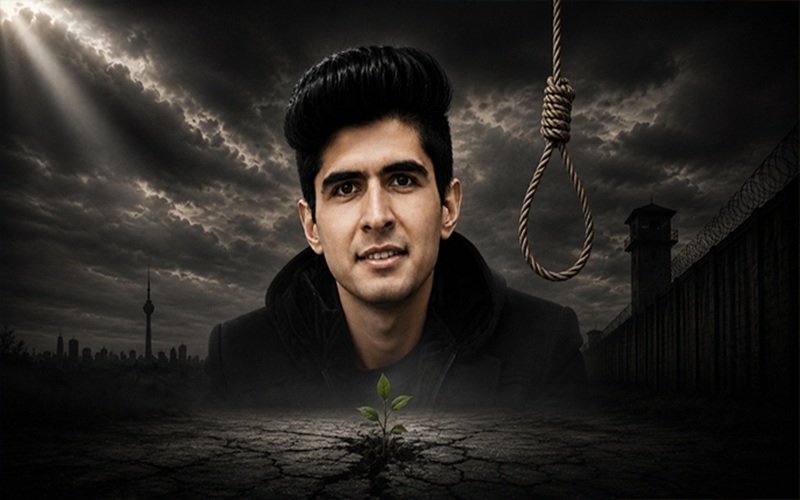

Months before his execution, 26-year-old PMOI member Mehdi Khanaki pledged to continue fighting dictatorship until the establishment of a democratic Iran.
Executed After Months of Detention
The Iranian regime executed 26-year-old PMOI member Mehdi Khanaki on July 22 after holding him in detention for five months. A law graduate from Karaj, Khanaki had been arrested on February 10 and later sentenced to death by the Revolutionary Court on charges of membership in the People’s Mojahedin Organization of Iran (PMOI/MEK) and organizing resistance activities.
His execution came amid a continuing wave of executions targeting political prisoners and individuals accused of links to the organized opposition, a campaign widely viewed by human rights advocates as an effort to suppress growing public dissent.
A Young Man Who Publicly Declared His Commitment
Long before his execution, Khanaki openly expressed why he had joined the struggle against the Iranian regime.
In a video message recorded during Muharram in July 2025, he addressed fellow members of the Resistance Units and declared his determination to continue the fight until the regime’s downfall.
“For freedom, justice and the liberation of Iran, like my brothers and sisters, I swear that I am fully prepared.”
He also praised those who, in his words, had pledged “to tear down this corrupt rule brick by brick.”
A Testament Against Dictatorship
An even more detailed statement, written in September 2024, outlined the convictions that shaped his political activism.
Reflecting on more than four decades of clerical rule, Khanaki described a country marked by repression, executions, torture, and the suppression of fundamental freedoms.
“For 45 years this land has known nothing but suffering. Joy has disappeared, replaced by mourning.”
He argued that successive waves of repression—from the mass executions of the 1980s to the present—had convinced him that remaining silent was impossible.
“Even a small fraction of these injustices is enough to awaken any human conscience. It is enough for me to decide that until the last moment of my life I will never retreat from the struggle against dictatorship.”
His Vision for Iran
Among the most striking passages of his statement was his reference to Iran’s prisons, which he viewed as symbols of decades of political repression.
He wrote:
“Today I have no greater hope than to see the walls of Qezel Hesar torn down and every prison used to silence political prisoners destroyed, so that no human being will ever again be imprisoned there.”
Khanaki concluded his testament with a pledge to remain committed to the struggle regardless of the personal cost.
“I pledge and swear by the blood of the martyrs and the suffering of our prisoners that I will remain steadfast in this path, remain a Mojahed until my final breath, and continue this struggle with all my strength.”
Execution Amid an Escalating Crackdown
Iranian judicial authorities accused Khanaki of involvement with the PMOI and claimed security forces recovered weapons, explosives, and communications equipment during his arrest. Opposition organizations reject those accusations, arguing they are part of a longstanding pattern of politically motivated prosecutions used to justify harsh sentences against regime opponents.
His execution comes as the authorities continue to intensify arrests and executions while repeatedly warning about the activities of Resistance Units and organized opposition networks.
For supporters of the Iranian Resistance, Mehdi Khanaki’s final writings now stand as a testament to the convictions that led him to confront the regime despite knowing the risks. His execution has become another symbol of the authorities’ continuing reliance on capital punishment against political opponents, even as calls for democratic change persist across Iran.