


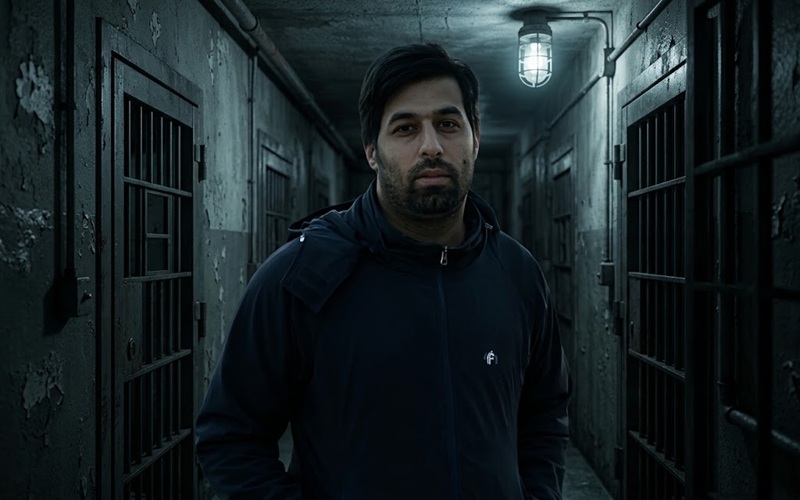

In a message from Qezel-Hesar Prison, political prisoner Seyed Mehdi Vafaei reflects on more than six decades of organized resistance, the emergence of new generations of prisoners resisting the regime, and the leading role of Iranian women in the struggle for freedom.
A political prisoner held in Qezel-Hesar Prison has issued a message praising the decades-long struggle of the People’s Mojahedin Organization of Iran (PMOI/MEK) and highlighting the growing determination of political prisoners and resistance supporters inside Iran’s prisons.
In his message, dated September 2026, Seyed Mehdi Vafaei describes the history of resistance in Iran as a continuing process in which successive generations have carried forward the struggle despite repression, imprisonment, executions, and enormous personal sacrifices.
Addressing the Iranian people, Vafaei begins by pointing to the more than six decades of struggle by the PMOI/MEK, describing it as a historical experience whose significance cannot easily be measured.
“If I am to speak of the many long years of bloody struggle in history, it is enough to look at more than 60 years of the Mojahedin’s bloody struggle,” he writes. “It is a complete and eloquent book.”
He argues that, rather than disappearing from the political scene like many historical movements, the organization has continuously evolved and adapted to changing circumstances.
“The organization, instead of becoming merely a part of history and being removed from the scene, has created evolution within itself,” Vafaei writes, adding that it has paid an “infinite cost” over the course of its struggle.
A New Generation of Resistance Behind Prison Walls
A central theme of the message is the emergence of political prisoners and supporters of resistance inside Iran’s prisons. Vafaei notes that many of these individuals had never been part of the PMOI/MEK’s organizational structures, yet he says they have developed a similar spirit of resistance.
“Most of the supporters and Resistance Units who are in prison, although they have never been part of the Mojahedin’s organization, are standing and growing with an astonishing resemblance to the Mojahedin’s organizational spirit and with a resistance similar to that of the 1988 Sarbedaran,” he states.
According to Vafaei, this development has confounded the regime’s security apparatus. He asks how an organization that has been physically separated from much of Iranian society, experienced generational changes, and endured decades of repression could continue producing people willing to make extraordinary sacrifices.
“How is it possible that the organization, while physically separated from the current of Iranian society and through multiple generational changes and countless difficulties and tragedies, can raise such tall cypresses who give up everything—family and all else?” he asks.
He contrasts this endurance with what he describes as the regime’s control over Iran’s resources and institutions, including wealth, information, media, and religious beliefs.
Iranian Women at the Front Line
Vafaei also emphasizes the role of Iranian women in confronting repression. He describes women activists as occupying a leading position in the struggle and attributes their determination to the political and organizational legacy associated with Maryam Rajavi.
“Iranian women, relying on the revolution of Sister Maryam, are always on the front line of the struggle and, with complete liberation, are opening the way,” he writes.
For Vafaei, the developments inside Iran’s prisons are part of a broader historical trajectory. He argues that the emergence of new resistance networks and committed individuals represents not simply continuity, but an expansion of the struggle.
“This was a summary of the past, the present, and the path toward the future,” he writes, predicting that continued growth and multiplication of resistance forces will open “a new path in the history of the world.”
Concluding his message from Qezel-Hesar Prison, Vafaei reaffirms his support for the Iranian resistance and expresses his hope for a dignified future for Iran.
His final words are accompanied by a poem reflecting perseverance in the face of hardship:
“I said this is the beginning that has no end; If love is love, it knows no easy path. You said we must travel from autumn, Though the flower cannot withstand the storm.”
The message offers a glimpse into the determination expressed by political prisoners and resistance supporters inside Iran’s prisons, where imprisonment and repression have failed, according to Vafaei, to prevent new generations from embracing the call for fundamental political change.