


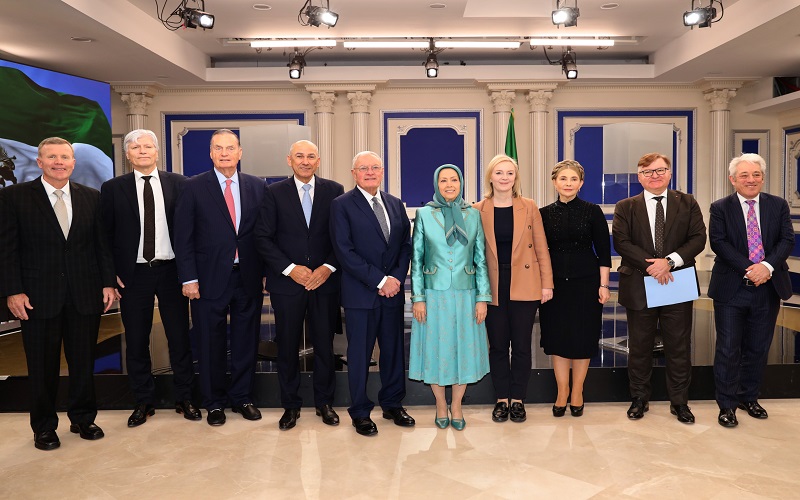

On Saturday, January 11, Paris hosted a pivotal conference aimed at redefining international policy toward the Iranian regime. Distinguished speakers from around the globe emphasized the catastrophic outcomes of appeasing Tehran’s leadership and stressed the urgent need to support the Iranian people and their organized resistance as cornerstones of a robust and effective policy.
Maryam Rajavi Highlights the Shifting Balance of Power
Maryam Rajavi, President-elect of the National Council of Resistance of Iran (NCRI), opened the event with a powerful address. She stated, “Today, the balance of power in the region has shifted against the regime. The foundation of the mullahs’ blackmail diplomacy and their efforts to sustain a policy of appeasement have significantly eroded.”
Rajavi further noted the regime’s failures in Syria and its inability to quell growing domestic resistance. She condemned decades of Western appeasement, arguing that it facilitated Tehran’s nuclear ambitions and spread of fundamentalism. “The regime will be overthrown,” she asserted, highlighting the pivotal role of organized resistance and public uprisings in this effort.
Calls for Firmness and Recognition of the Iranian Resistance
Prominent international leaders and officials shared their insights, underscoring the importance of a decisive and united global approach:
Liz Truss: “2025 is a Critical Year”
Liz Truss, former UK Prime Minister, described 2025 as a defining year for Iran and the world. She praised Mrs. Rajavi’s leadership and called for Western powers to “stop Iran acquiring nuclear weapons” and “back the Iranian people in their quest for freedom and democracy.” Truss emphasized that change must originate from within Iran but urged the West to abandon the notion of the regime’s inevitability.
John Bercow: “A Resilient Alternative Exists”
Former UK Parliament Speaker John Bercow highlighted the NCRI’s long-standing commitment to democracy, pluralism, and human rights. “This is the alternative,” he declared, pointing to the Resistance’s integration with Iranian society and its rejection of dictatorship, whether under the shah or the mullahs.
General James Jones: “Repression Fuels Resistance”
General James Jones, former U.S. National Security Advisor, condemned the regime’s unprecedented execution rate in 2024, noting nearly 1,000 executions under President Masoud Pezeshkian. He praised the resilience of MEK-affiliated Resistance Units, stating, “Repression cannot extinguish the flames of resistance; it only strengthens our resolve.”
General Keith Kellogg: “A Maximum Pressure Policy is Essential”
General Keith Kellogg urged the reinstatement of a maximum pressure policy, coupled with global support for Iran’s democratic aspirations. He lauded the NCRI’s Ten-Point Plan as a “clear roadmap to a non-nuclear, democratic Iran.”
General Tod Wolters: “2025 Will Be Transformative”
Former NATO Commander General Tod Wolters expressed confidence in the NCRI’s preparedness, describing 2025 as a transformative year. “Madam Rajavi has set clear milestones for the next two years,” he stated, emphasizing the importance of a unified global strategy.
Janez Janša: “Transition from Engagement to Firmness”
Former Slovenian Prime Minister Janez Janša criticized Europe’s historical engagement strategies and called for sanctions and the designation of the IRGC as a terrorist organization. “Change in Iran is inevitable, and the NCRI is the key to achieving it,” he concluded, endorsing the Ten-Point Plan as a blueprint for democracy.
Yulia Tymoshenko: “Iran and Ukraine Share a Common Fight”
Former Ukrainian Prime Minister Yulia Tymoshenko compared Iran’s struggle for freedom to Ukraine’s resistance against tyranny. She praised the courage of Iranian women and urged moral and political support for the NCRI. “The fall of the Iranian regime will mark a turning point for global peace and stability,” she declared.
David Jones: “The Regime’s Vulnerabilities Are Exposed”
Former UK Minister David Jones highlighted recent geopolitical shifts, including the fall of Bashar al-Assad, as critical blows to Tehran’s regional influence. He emphasized the resilience of the Iranian Resistance and called for international recognition of the Iranian people’s right to self-determination.
Ola Elvestuen: “Acknowledge the NCRI’s Legitimacy”
Former Norwegian Minister Ola Elvestuen exposed Tehran’s defamation campaigns against the NCRI as evidence of its fear of organized resistance. He called for global acknowledgment of the NCRI’s legitimacy, stressing that “sanctions alone are insufficient” and urging proactive engagement with the Iranian Resistance.
Conclusion
The Paris conference underscored a critical shift in international discourse on Iran. With growing consensus among global leaders, the focus is turning toward supporting the NCRI and the Iranian people in their quest for a free and democratic future. As 2025 approaches, the call for firmness, recognition of legitimate resistance, and rejection of appeasement grows louder, marking a potential turning point for Iran and the world.