
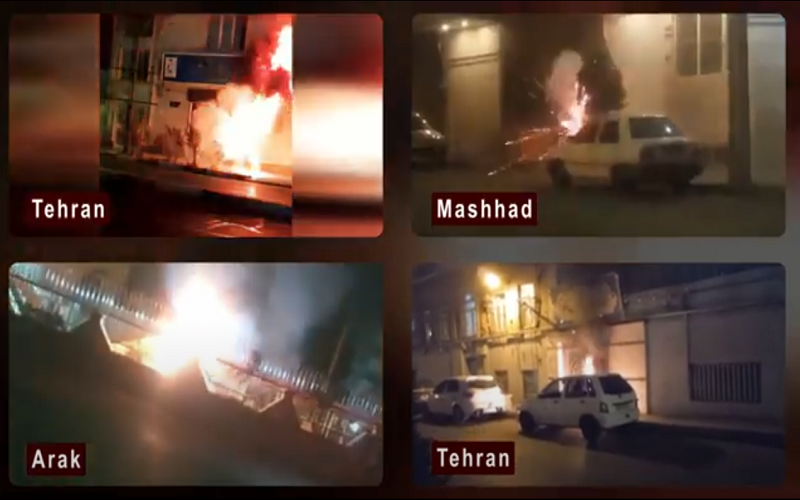

On Tuesday, February 11, Iran’s rebellious youth launched a new wave of defiant operations to mark the anniversary of the 1979 anti-monarchic revolution. Despite heightened security measures, they targeted symbols of the regime’s repression and corruption, setting fire to government banners and regime-affiliated centers.
Targeting Centers of Oppression
In Tehran, the youth struck multiple sites, including two IRGC Basij bases and institutions enforcing misogynistic policies. Operating under the slogans “We fight, we die, we take back Iran” and “Death to the dictator—be it the Shah or the mullahs,” they carried out their mission with determination.
A particularly symbolic act took place in Delijan, where a statue of Qasem Soleimani, the infamous IRGC Quds Force commander killed in 2020, was set ablaze. In Tehran, a massive government banner over Mowlavi Highway was torched. The youth also burned posters of the regime’s key figures, including Ruhollah Khomeini, Ali Khamenei, and Soleimani, in multiple cities. These acts of resistance spread across Tehran, Tabriz, Karaj, Isfahan, Shiraz, Ahvaz, Kerman, Sari, Bandar Abbas, Zahedan, Yasuj, Birjand, Qaemshahr, Ramsar, Borazjan, Bijar, and Tabas, delivering a severe blow to the regime and its supreme leader.

A Coordinated Nationwide Offensive
Just days earlier, on February 19, marking the 47th anniversary of the revolution, rebellious units carried out 47 coordinated operations. Key targets included the judiciary offices in Ilam, police headquarters in Kerman, and regime-controlled religious institutions in Tehran and Aligudarz. The government’s punitive enforcement offices were also attacked. In addition, banners celebrating the revolution were set on fire in cities such as Tehran, Tabriz, Mashhad, Isfahan, Karaj, Rasht, Urmia, Kermanshah, Qazvin, Arak, Khorramabad, Ardabil, Birjand, Bushehr, Shahr-e Kord, Ramsar, Khorramshahr, Amol, Lahijan, Buin Zahra, Lordegan, Borujen, Jiroft, Iranshahr, Sarbaz, Khash, Sirjan, Saravan, Chabahar, and Hafshejan.
The Spirit of Revolution Lives On
These coordinated actions highlight the continuity of the revolutionary struggle that toppled the Shah in 1979. The burning of regime symbols under the slogan “Death to the dictator—neither the colonialist Shah nor the reactionary mullahs” is a testament to the unbroken spirit of resistance against tyranny.

The latest wave of operations underscores that the Iranian revolution is far from over. The same fervor that led to the monarchy’s collapse now fuels the new generation’s fight against those who hijacked the revolution. With over four decades of organized resistance, the movement remains committed to consigning the mullahs’ rule to history.
A Path Toward Change
On the anniversary of the 1979 revolution, Iran’s rebellious youth reaffirmed their resolve through bold and relentless operations against the supreme leader’s oppressive regime. Their actions signal that the struggle for democracy and freedom continues.
True change in Iran can only come from the people and their organized resistance. Through these defiant acts, the youth demonstrate that they have the determination and capability to shape the future—one free from both monarchy and theocratic rule.