


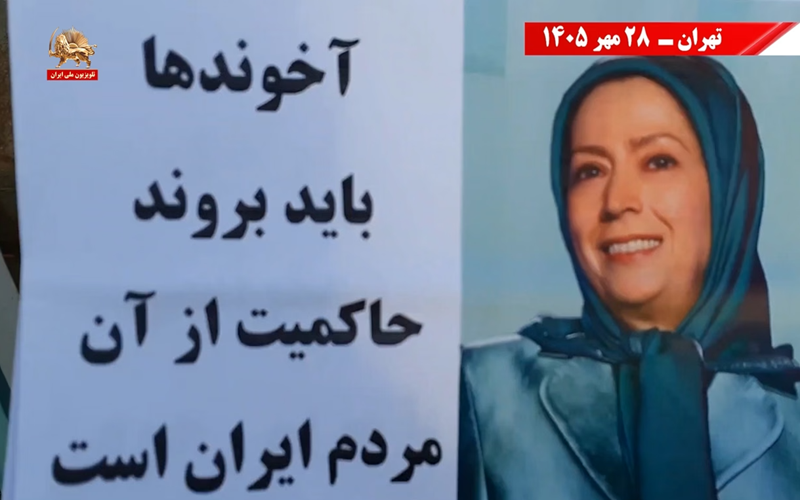

Resistance Units carried out poster displays, slogan-writing, and other anti-dictatorship activities during the fourth week of Mehr 1405, promoting a democratic republic and rejecting both monarchical and clerical dictatorship.
Resistance Units Promote a Democratic Republic Across Iran
Iran’s Resistance Units carried out a new series of anti-dictatorship activities across 20 cities during the fourth week of Mehr 1405, corresponding to October 16–22, 2026, according to reports published by the Iranian Resistance.
The activities coincided with the anniversary of October 22, when Maryam Rajavi was introduced as the Iranian Resistance’s president-elect for the transition of sovereignty to the Iranian people. Young activists used posters, printed and handwritten leaflets, photographic displays, wall slogans, and recorded messages to promote freedom, democracy, and the establishment of a democratic republic.
The campaign emphasized popular sovereignty, equality, women’s participation in political change, and resistance to the ruling theocracy. Its slogans also rejected the restoration of monarchy, presenting the struggle against dictatorship as a rejection of both the Shah’s rule and the clerical system.
The geographical spread of the reported activities—from Tehran and Mashhad to Sanandaj, Kermanshah, Ahvaz, Shiraz, and smaller cities—underscored the Resistance Units’ effort to keep the demand for political change visible despite the regime’s repressive environment.
Tehran, Shiraz, and Major Cities: A Message Against Dictatorship
In Tehran, young activists displayed colorful posters and images of Maryam Rajavi, distributed leaflets, and circulated handwritten and printed messages. Their slogans called for the removal of the clerical regime and the transfer of sovereignty to the Iranian people.
Among the messages were: “The mullahs must go; sovereignty belongs to the Iranian people,” and “Establishing a democratic republic through Maryam Rajavi’s Ten-Point Plan.”
The campaign also presented Rajavi as a symbol of national solidarity and a democratic future, linking the anniversary to the Resistance’s proposed political transition.
In Shiraz, a four-person action featured photographic displays of posters depicting Maryam Rajavi and images of Maryam and Massoud Rajavi. The slogans explicitly rejected both forms of dictatorship.
One declared: “Neither crown nor turban; the mullahs’ time is up.”
Another stated: “Both Pahlavi and the Supreme Leader—both are dictatorships.”
These messages reflected the Resistance’s position that Iran’s future should not involve a return to monarchy or the continuation of clerical rule, but a democratic alternative based on popular sovereignty.
In Mashhad, activists displayed printed leaflets and wrote slogans on walls, including: “The uprising-generating and overthrow-seeking youth—this movement will not stop.”
In Isfahan, the activities emphasized freedom, democracy, and solidarity in the struggle to reclaim Iran. In Ahvaz, activists used printed messages and wall slogans to express support for a democratic future and the Resistance.
Women and Young People at the Center of Political Change
A recurring theme throughout the campaign was the role of Iranian women and young people in challenging the ruling regime.
In Sanandaj, activists displayed handwritten messages describing Iranian women as an enduring challenge to the clerical establishment and presenting Maryam Rajavi as a model of resistance and perseverance.
In Baneh, posters carried the slogans “Maryam Rajavi, the hope of the Iranian people for a better tomorrow” and “Iranian women are Khamenei’s never-ending nightmare.”
Activities in Kermanshah also highlighted women’s role in political transformation. One message attributed to Rajavi stated: “Iranian women are the main force for change; women are the voice of the oppressed.”
The campaign’s emphasis on women’s leadership reflects the Resistance’s broader political platform, which calls for gender equality and an end to institutionalized discrimination. By placing women’s participation alongside the demand for a democratic republic, the activities sought to connect political change with the rights and aspirations of Iranian society.
Slogans Across Cities Keep the Demand for Change Visible
The reported activities extended well beyond the country’s largest urban centers, reaching Sari, Ardabil, Kerman, Bandar Abbas, Khorramabad, Bushehr, Hamedan, Arak, Lahijan, Bukan, and Javanrud.
In Sari and Ardabil, handwritten leaflets presented Maryam Rajavi as a symbol of a free Iran. In Kerman, Bandar Abbas, Arak, and Lahijan, messages repeated the slogan: “Maryam’s commitment is our commitment; victory will be ours.”
In Bushehr, activists displayed black-and-white panels and a color poster, promoting democracy and freedom. A recorded message addressed to Rajavi stated: “Dear sister Maryam, our commitment is your commitment. Iran is restless, awaiting your visit.”
In Khorramabad, a four-person action featured a large paper leaflet carrying the message: “Maryam Rajavi, the hope of the Iranian people for a better tomorrow.”
In Bukan, a banner described the movement associated with Rajavi as a revolution marked by sacrifice and perseverance. In Javanrud, activists displayed handwritten and printed messages on vehicles, including the slogan “Tomorrow’s Iran with Maryam Rajavi.”
Kermanshah saw a particularly varied series of activities, including photographic displays, printed and handwritten leaflets, posters, and recorded messages. The slogans called for the overthrow of the clerical system and the establishment of popular sovereignty.
“Neither Shah Nor Mullahs”
The campaign’s central political message was the rejection of dictatorship in all its forms.
In addition to calling for the end of clerical rule, the activities in Shiraz and other locations explicitly opposed the restoration of the Pahlavi monarchy. The slogan “Death to the mullah, death to the Shah,” displayed in Islamshahr, reinforced this position.
The Resistance Units paired this rejection of dictatorship with support for a democratic republic and the Ten-Point Plan proposed by Maryam Rajavi. Their messages presented the transfer of sovereignty to the Iranian people as the defining objective of political change.
The fourth-week Mehr campaign combined anniversary commemorations with a broader effort to maintain a visible presence for the Resistance’s political program inside Iran. Through posters, slogans, leaflets, and recorded messages, activists sought to keep demands for freedom, gender equality, and popular sovereignty in public view.
The activities, as reported by the Iranian Resistance, demonstrate the movement’s continuing use of decentralized public messaging to challenge the legitimacy of the clerical system and promote its proposed democratic alternative.