


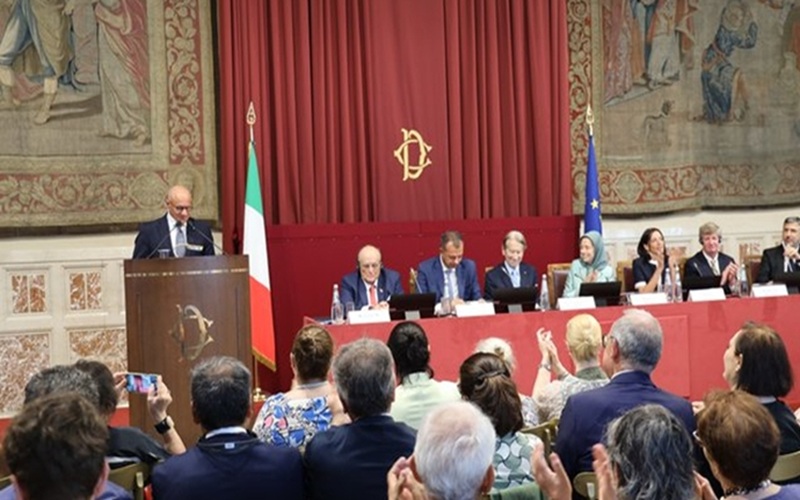

Italy’s Deputy Speaker outlines support for human rights, accountability, and a democratic future for Iran during a parliamentary conference attended by Maryam Rajavi and international leaders.
On July 16, the Italian Parliament hosted a high-profile conference examining Iran’s political, human rights, and regional crises. The event brought together Maryam Rajavi, President-elect of the National Council of Resistance of Iran (NCRI), alongside Italian lawmakers and prominent international figures to discuss the regime’s repression, regional policies, and the international community’s response.
Among the keynote speakers was Fabio Rampelli, Deputy Speaker of the Italian Parliament, who presented Italy’s position on human rights in Iran, the country’s internal situation, and the need for sustained international pressure on the ruling establishment.
Structural Weaknesses Behind Iran’s Domestic Crisis
Opening the conference, Rampelli welcomed participants and acknowledged the presence of international figures supporting the Iranian people’s democratic aspirations.
He described Iran as a nation with a rich civilization and a predominantly young population that has endured decades of political repression. According to Rampelli, the widespread protests witnessed in recent years have exposed deep structural weaknesses within the regime, particularly its inability to address mounting economic hardships.
He argued that soaring inflation, especially affecting food and other essential goods, has intensified public dissatisfaction while highlighting the government’s failure to provide effective solutions. Rather than responding to legitimate social and economic grievances, he said, the authorities have relied on an increasingly coordinated security apparatus to suppress demonstrations through force, involving police, the IRGC, and other armed institutions.
Italy’s Parliamentary Actions on Human Rights
Rampelli devoted a significant portion of his remarks to measures already taken by the Italian Parliament in support of human rights in Iran.
He recalled that, in December 2022, the Italian Chamber of Deputies’ Foreign Affairs Committee unanimously approved a resolution urging the government to work through both bilateral and multilateral channels to oppose death sentences imposed on Iranian protesters.
He also pointed to developments within the international community, noting that the United Nations Human Rights Council had extended the mandate of the Independent International Fact-Finding Mission on Iran. According to Rampelli, the renewed mandate enables investigators to continue examining allegations of serious human rights violations, including arbitrary detentions, politically motivated executions, property confiscations, and discrimination based on gender, ethnicity, religion, or political beliefs.
Regional Security and the Nuclear Issue
Turning to foreign policy, Rampelli argued that the Iranian regime’s regional conduct has contributed significantly to instability affecting global energy markets and international commerce.
Referring to recent military and diplomatic developments, including the June 2025 conflict and subsequent European discussions in June 2026, he reaffirmed Europe’s position that Iran must never acquire nuclear weapons.
He emphasized that any broader diplomatic settlement requires Iran’s full and verifiable compliance with its obligations under the Nuclear Non-Proliferation Treaty (NPT), including comprehensive cooperation with the International Atomic Energy Agency.
Targeted Sanctions Against Repression
Rampelli also addressed the European Union’s sanctions policy, highlighting the extension of restrictive measures against individuals responsible for human rights violations through 2027.
He stressed that these sanctions are designed to target officials responsible for repression—not the Iranian people. According to his remarks, those subject to sanctions include senior security officials, commanders involved in violent crackdowns, judges responsible for issuing politically motivated rulings without fair trials, and individuals linked to cross-border repression extending into European territory.
Support for the Iranian People’s Future
Concluding his address, Rampelli emphasized the long-standing historical ties between Italy, Europe, and Iran. While affirming that the future of Iran ultimately belongs to its own people, he argued that the international community has a responsibility to help safeguard the conditions necessary for a peaceful democratic transition by defending human rights, security, and respect for international law.
The conference reflected growing concern among European policymakers over the regime’s human rights record and regional conduct, while reaffirming support for the Iranian people’s aspirations for freedom and democratic governance.