


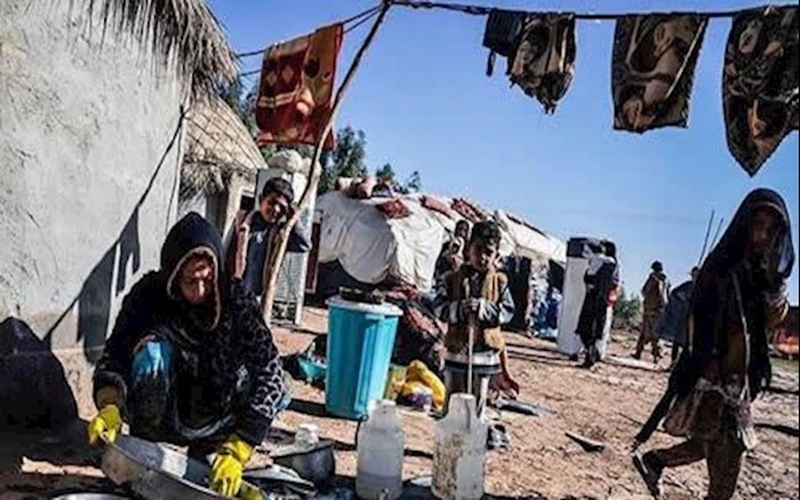

Denied basic citizenship rights, exploited in the harshest jobs, and threatened with arrest and deportation, undocumented Baloch workers face a daily struggle for survival in Iran.
A report by Iran’s ILNA news agency has described undocumented Baluch workers as “the most deprived section of Iran’s working class,” highlighting a crisis in which poverty, legal exclusion, and repression reinforce one another.
Published Tuesday, September 1, the report said these workers are scattered across Iran in search of the most basic means of survival. Many are employed in the country’s hardest and least secure jobs, receiving low wages and virtually no benefits. At the same time, they have little ability to protest exploitation because doing so can expose them to arrest, dismissal, or deportation.
According to ILNA, undocumented Baloch workers commonly collect recyclable materials and garbage, work as daily-wage construction laborers, or perform loading and unloading work at ports and southern docks. Most lack insurance and access to the legal protections available to other workers.
Their situation has become even more precarious as economic pressures deepen across Iran. For those living in border regions, unemployment and poverty leave families with increasingly desperate choices. Labor activist Abdollah Balvasi warned on August 30 that growing poverty among border families is pushing children and teenagers into kolbari—the dangerous transportation of goods across mountainous border routes—to help cover household expenses.
Citizens denied the most basic rights
The vulnerability of these workers begins long before they enter the labor market. ILNA reported that some Baloch people born in Iran to Iranian parents are nevertheless not recognized by government officials as Iranian citizens because they lack official identity documents.
Without a birth certificate or other recognized identification, people can be denied some of the most basic services and rights, including education, bank accounts, government subsidies, livelihood assistance, and access to electronic government services.
The scale of the problem remains unclear. In January 2025, Iran’s Civil Registration Organization said 1,694 cases involving undocumented Baloch residents were undergoing administrative procedures for the issuance of identity documents. The figure, however, represents only people who had formally sought documentation and therefore cannot be considered an estimate of the total undocumented population.
The consequences extend to an entire generation. In October 2025, a judicial official in Sistan and Baluchestan said more than 148,000 children and adolescents between the ages of seven and 18 in the province were outside formal education.
A year earlier, a member of the Dashtiari Central District Council estimated that approximately 98 percent of undocumented people belonged to low-income families and the poorest sections of society.
A problem passed from one generation to another
Human rights research has described the lack of documentation in parts of Balochistan as a problem with deep historical and structural roots.
A 2019 report by Iran Human Rights pointed to births that were never registered during the early decades of the civil registration system, particularly in remote villages and nomadic communities. The absence of documentation can then become hereditary: when a father or grandfather lacks an identity document, subsequent generations may be required to prove their paternal lineage and Iranian nationality.
Research published in the International Journal for Equity in Health has identified a combination of legal, administrative, economic, and social barriers behind the continuing problem. These include the great distances between rural communities and civil registration offices, limited access to medical facilities, home births, unregistered religious marriages, underage marriage, and administrative difficulties in proving nationality.
The cost and logistical difficulty of DNA testing, particularly in border areas, can add another obstacle to obtaining official documentation.
Arrest, detention, and the threat of deportation
For undocumented Baloch workers, exclusion from legal recognition can have an even more dangerous consequence: the risk of being treated as foreign nationals in their own country.
ILNA reported that hundreds of Baloch workers are arrested each year by Iranian authorities and transferred to detention camps used for deporting foreign nationals.
One example cited by the agency is that of Farhad Qorban-Jali, a Baluch man in his early 20s who lives with his family in Semnan. He had been detained in a deportation camp in the city for about a week at the time of the report.
Farhad lost his father and is the sole provider for a family of five. He began collecting recyclable materials in Tehran as a teenager and later learned welding before finding construction work after his family moved to Semnan. Authorities reportedly arrested him on the street.
His family now fears that he could be deported to Afghanistan, despite considering themselves Iranian.
Zohreh Sayadi, an activist working on the rights of undocumented people, told ILNA that authorities previously refrained from deporting detainees who identified as Iranian. Such individuals could often secure their release by providing witness statements or documentation establishing their family origins.
She said that during the past two or three years, however, the authorities’ approach has shifted again toward what she described as “ignoring, deportation, and elimination.”
The plight of undocumented Baloch workers therefore reflects more than a labor crisis. It reveals how poverty and bureaucratic exclusion can leave an already marginalized population vulnerable to exploitation, detention, and expulsion. Their daily struggle for work and survival takes place in an environment where even proving their right to belong can become a life-threatening ordeal.