Activists Call for an End to Clerical Rule, Oppose Executions, and Reject Both Theocracy and Monarchy
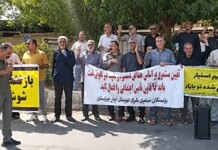
Activists affiliated with the Resistance Units of the People’s Mojahedin Organization of Iran (POMOI/MEK) carried out coordinated protest actions in Zahedan on Friday, December 19, delivering a series of political messages aimed at both Iran’s ruling clerical regime and any attempts to revive authoritarian rule under alternative forms.
The actions emphasized a clear rejection of all dictatorships—religious or monarchical—while framing the current moment as a decisive phase in Iran’s struggle for a democratic future. According to the messages circulated during the protest, activists warned against efforts to hijack Iran’s democratic movement or divert it into cycles of violence and repression, as occurred during previous historical transitions.

Rejection of Both Clerical and Monarchical Rule
A central theme of the protest was the explicit rejection of all authoritarian models of governance. Participants stressed that dictatorship remains tyranny regardless of whether it is justified through religious authority or royal symbolism. The activists framed their stance as a firm boundary against both the ruling clerical establishment and any nostalgia-driven attempts to rehabilitate monarchical rule.
The protest messaging underscored that Iran’s future, in the view of the Resistance Units, must not replicate past systems of repression. Instead, it called for a complete break from all forms of absolute power, whether exercised by clerics or crowned rulers.
Opposition to Executions and State Repression
Another major focus of their actions was opposition to the widespread use of executions by the Iran regime. Activists described capital punishment as a central tool of governance used to instill fear, suppress dissent, and prevent the escalation of public protests.
The protest framed the growing “No to Execution” movement as a struggle not only against state violence, but for the fundamental right to life and resistance. Participants called for national solidarity to confront and overturn death sentences, arguing that sustained public pressure is necessary to force the regime to retreat.
Organized Resistance and Strategy for Change
The Resistance Units emphasized the role of organized resistance as the regime’s most serious challenge. Their messaging portrayed structured, disciplined activism as the product of collective sacrifice by individuals committed to freedom and willing to bear personal cost for the future of Iran.

According to the protest narrative, the most dangerous crisis facing the clerical regime today is not external pressure, but the steady movement of Iranian society toward organized uprising. Recent developments, activists argued, demonstrate that space for regime-engineered alternatives or survival scenarios has sharply narrowed.
They presented the regime as facing only two paths: internal collapse or increased external confrontation combined with intensified domestic repression.
Rising Youth Participation and Economic Pressure
The protest also highlighted the expanding role of Iran’s younger generation, both inside the country and abroad, in joining resistance activities. Activists pointed to growing economic pressures—particularly rising fuel prices—as a catalyst for wider social unrest, noting that inflationary shocks disproportionately harm workers, the poor, and marginalized communities.
According to the protest messaging, fuel price hikes are expected to cascade across other sectors of the economy, deepening inequality and fueling public anger.
A Call for Secular, Democratic Governance
At the core of the Zahedan protest was a political platform built on three principles: the overthrow of the clerical rule system, a clear rejection of both clerical and monarchical authoritarianism, and the separation of religion and state.
The activists warned that the regime has intensified psychological warfare and demonization campaigns against the resistance movement in response to worsening internal conditions. They argued that only sustained protests and organized resistance can force the regime into retreat.
The actions concluded with renewed calls for accountability for past and present repression, rejecting both clerical and monarchical figures associated with bloodshed and authoritarian rule.