


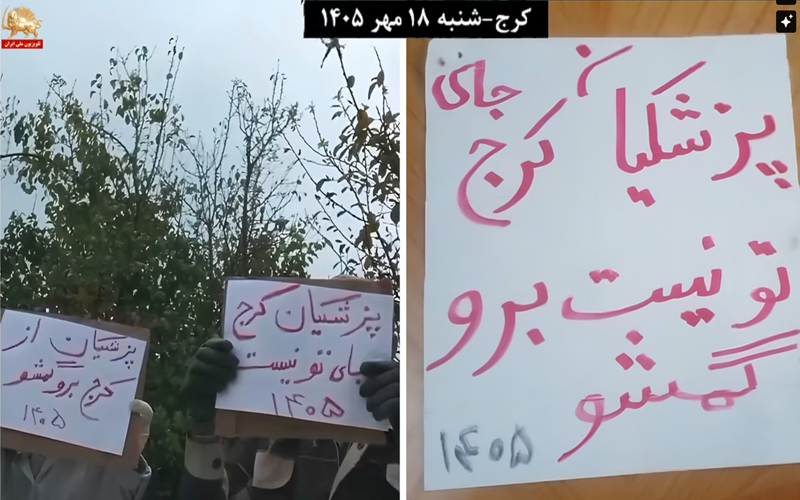

On October 10, 2026, rebellious youth in Karaj protested the visit of Iran’s regime president, Masoud Pezeshkian, with slogans rejecting his presence in the city and condemning the ruling establishment.
Rebellious youth in Karaj protested the visit of Iran’s regime president, Masoud Pezeshkian, on Saturday, October 10, 2026, with slogans rejecting his presence in the city and expressing opposition to the ruling establishment.
The protest activities directly challenged Pezeshkian’s visit, with repeated messages declaring that Karaj had no place for him and demanding that he leave. The slogans portrayed his presence not as a welcome presidential visit but as an occasion to voice public rejection of the regime and its leadership.
Among the slogans reported were:
- “Pezeshkian, Karaj is no place for you!”
- “Pezeshkian, get out of Karaj!”
- “Pezeshkian, leave Karaj and get lost!”
- “Pezeshkian, have some shame and leave Karaj!”
- “The president of the velayat-e faghih, a supporter of every crime, get out of Karaj!”
- “Criminal Pezeshkian, get out of Karaj!”
The slogans were repeated in different forms, reinforcing the central message that Pezeshkian was not welcome in the city. Some explicitly linked the president to the ruling system and its record of repression, while others focused on rejecting his presence.
The activities took place against the backdrop of mounting economic and social pressures across Iran, alongside widespread anger over executions, repression, and the regime’s failure to address the population’s basic demands.
Pezeshkian holds the presidency within a political system dominated by the supreme leader and the security and military apparatus, particularly the Islamic Revolutionary Guard Corps. The slogans used in Karaj reflected opposition not only to the president personally but also to the governing establishment he represents.
The repeated demand that Pezeshkian leave the city gave the protest a clear political message: the regime’s officials cannot assume that official visits will be met with public approval.
Although the reported material does not provide details about the number of participants or the precise locations of the activities, the slogans document a direct expression of opposition during the president’s visit.
The actions by rebellious youth in Karaj underscore the importance of dissent that challenges the regime’s political authority and rejects its attempts to project legitimacy through official appearances.
By turning Pezeshkian’s visit into an occasion for protest, the rebellious youth delivered a pointed message of rejection to the regime’s president and the system he represents.