



Amid record-high executions and systemic repression, Iranian Resistance Units send a nationwide message: the fight for a democratic republic cannot be hanged into silence.
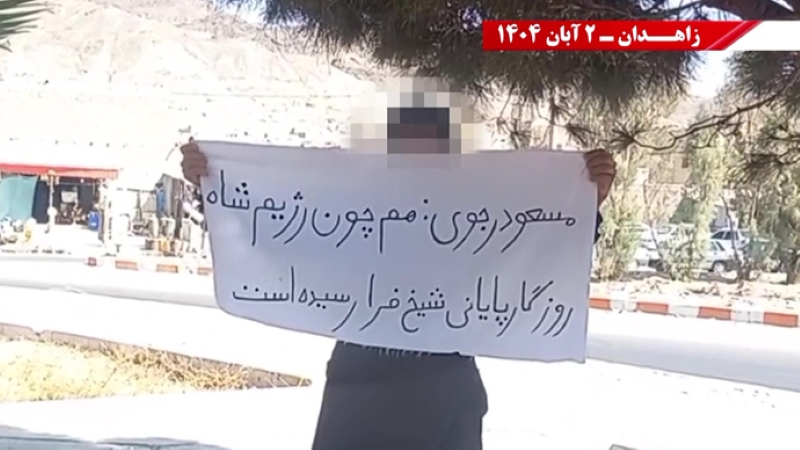
In the face of an unprecedented wave of state-sanctioned violence, the Iranian people’s resistance is intensifying. On October 24, the PMOI (People’s Mojahedin Organization of Iran) Resistance Units in Zahedan, the capital of Sistan and Baluchestan province, took to the streets to defy the regime’s machinery of repression and death. Their courageous action carried a clear message: repression will only fuel the fire of organized resistance.
Holding placards emblazoned with bold slogans, the Resistance Units turned fear into defiance. “The real answer to execution and repression is not compromise or fear, but uprising and resistance,” one sign read. Another declared, “The mullahs tried to define our fate with hangings, but we rose up in rebellion.” These words, displayed in one of Iran’s most oppressed provinces, struck at the heart of the regime’s rule of terror. Each placard symbolized a direct challenge to the regime’s authority and an enduring beacon of hope for millions living under tyranny.
"No Shah no Mullahs is a line drawn against dictatorship and dependence" pic.twitter.com/k1P9s6T1LS
— People's Mojahedin Organization of Iran (PMOI/MEK) (@Mojahedineng) October 25, 2025
Their courage stands out sharply against the backdrop of the regime’s brutal execution campaign. Between September 23 and October 22, 2025, the Iranian theocracy executed at least 280 prisoners, marking the highest monthly toll in 36 years. Since the start of the Persian year on March 21, 1,135 people have been executed—a shocking 110% increase over the same period last year. This surge in executions reveals the regime’s deepening fear of dissent and its desperate attempt to suppress an increasingly defiant population.
The Resistance Units’ rallying cry, “The crime of those sentenced to death is their love for freedom,” has become the moral counterpoint to this violence. Their activism echoes the ongoing “No to Execution Tuesdays” campaign—a weekly hunger strike organized by political prisoners across more than 50 prisons in Iran. Together, the protests inside and outside prison walls form a united front against a regime that relies on execution as its ultimate weapon of control.
"The era of all forms of dictatorship, whether religious or monarchical, is over" pic.twitter.com/CeDjbGcqDX
— People's Mojahedin Organization of Iran (PMOI/MEK) (@Mojahedineng) October 25, 2025
This wave of violence is not random. It is part of a systematic campaign to crush the organized resistance led by the PMOI. Beyond the gallows, the regime employs a slower, equally deadly method: denying political prisoners medical treatment. This deliberate policy—widely referred to as “slow-killing”—recently claimed the life of political prisoner Somayeh Rashidi, who died on September 25 after being denied medical attention for severe seizures. The regime dismissed her condition as “feigned illness,” exposing its calculated cruelty.
At least 17 PMOI supporters have been sentenced to death in recent weeks, underscoring the regime’s profound fear of the organization’s influence—particularly among the country’s youth. The regime’s lethal measures reveal not strength, but panic over a resistance movement that continues to expand despite decades of repression.
The Resistance Units’ message is not only a rejection of the current theocracy but also of any return to past dictatorship. Their slogans, “Death to the oppressor, be it the Shah or the mullahs,” and “No Shah, no Mullahs—our line against dictatorship and dependence,” make their vision unmistakably clear. They seek a democratic republic founded on people’s sovereignty, free from both religious and monarchical tyranny. It is a vision for an Iran liberated from the recurring cycles of despotism that have dominated its modern history.
As executions mount and repression deepens, the regime exposes its own weakness. The reliance on mass hangings and medical killings reflects a system that governs through fear, yet is increasingly terrified of its own people. But the PMOI Resistance Units’ persistence shows that no amount of brutality can silence the call for freedom.
Their solemn vow—“We will fight, we will die, we will take back Iran”—is not merely a slogan; it is a declaration of perseverance and faith in the inevitability of change. Against the gallows and the guns, the people of Iran, led by their organized resistance, continue to prove that the fight for a free, secular, and democratic republic is not a dream deferred, but a destiny already in motion.