


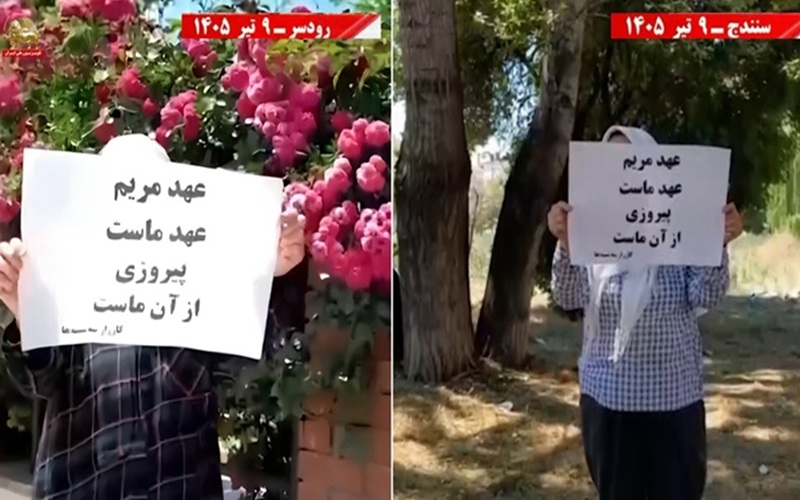

From declarations of commitment to democratic change to public support for the “No to Execution Tuesdays” movement, PMOI Resistance Units intensified their activities across dozens of Iranian cities despite ongoing repression.
Resistance Units affiliated with the People’s Mojahedin Organization of Iran (PMOI/MEK) have carried out a new wave of coordinated activities across Iran, publicly reaffirming their commitment to the Iranian Resistance and expanding support for the growing “No to Execution Tuesdays” campaign initiated by political prisoners.
The nationwide actions, which took place in cities across the country, combined public displays of support for Maryam Rajavi’s vision for a democratic Iran with renewed calls to end executions and defend political prisoners, underscoring the expanding role of Resistance Units in challenging the regime’s campaign of repression.
A Nationwide Pledge to Continue the Struggle
Following Maryam Rajavi’s recent address reaffirming the Iranian Resistance’s commitment to freedom, democracy, and national sovereignty, Resistance Units responded with coordinated public actions declaring their readiness to continue the struggle.
Large banners and posters bearing the slogan, “Maryam’s oath is our oath; victory belongs to us,” appeared in numerous cities, including Tehran, Isfahan, Shiraz, Karaj, Rasht, Sari, Amol, Kermanshah, Sanandaj, Bandar Abbas, Saravan, Tabas, Aligudarz, and Babolsar.
Beyond expressing solidarity with Rajavi’s message, many of the banners reiterated the Resistance’s core political principles, emphasizing freedom for all Iranians regardless of ethnicity, religion, or political belief.
Several messages highlighted support for Rajavi’s vision of a democratic republic, calling for:
- The rejection of all forms of dictatorship, including both religious rule and monarchical authoritarianism.
- Popular sovereignty through free and pluralistic elections.
- Separation of religion and state.
- Protection of individual and social rights in accordance with the Universal Declaration of Human Rights.
- Defense of Iran’s independence, freedom, and national dignity.
- Implementation of Maryam Rajavi’s Ten-Point Plan for Iran’s democratic future.
In Tehran, Resistance Units also displayed banners declaring their continued readiness to confront the regime and reaffirmed their loyalty to the movement’s leadership despite intensifying repression.
Several messages honored senior Resistance commanders, including Vahid Bani Amerian, while emphasizing that Resistance Units remain committed to continuing their activities inside Iran.
Other slogans stressed that their struggle is directed against every form of dictatorship, declaring:
“No to the rule of the Supreme Leader; yes to the sovereignty of the people in a free and pluralistic republic.”
Expanding Support for “No to Execution Tuesdays”
Alongside these political activities, Resistance Units intensified their participation in the nationwide “No to Execution Tuesdays” campaign, which has become one of Iran’s most visible grassroots movements opposing the regime’s extensive use of capital punishment.
Across cities including Tehran, Shiraz, Isfahan, Qom, Sanandaj, Mashhad, Ahvaz, Shahin Shahr, Semnan, Ramsar, Jahrom, Rudsar, and others, activists organized public displays, installed posters, distributed leaflets, and displayed protest slogans condemning executions and expressing solidarity with political prisoners.
Many of the messages directly linked the regime’s use of executions to its efforts to suppress growing public unrest.
Among the slogans displayed were:
- “No to executions. Yes to human dignity.”
- “Stop the executions.”
- “Political prisoners must be freed.”
- “Executions are the regime’s weapon against uprisings.”
- “From prison to the streets: No to execution.”
- “One voice, one cry: Never surrender, resistance until the end.”
In Tehran, activists called on citizens to break their silence against executions, while in Qom and Shahin Shahr banners warned that those responsible for executions would ultimately be held accountable.
Resistance Units also commemorated members of the Iranian Resistance who lost their lives, including fallen PMOI commander Vahid Bani Amerian and Resistance martyr Akbar Daneshvarkar, emphasizing the continuity of the movement despite the regime’s repression.
Linking Resistance Inside and Outside Prison Walls
The activities reflect the increasingly close connection between organized Resistance Units operating across Iran and the growing movement led by political prisoners inside the country’s prisons.
The “No to Execution Tuesdays” campaign, now observed in dozens of prisons nationwide, has become one of the most sustained acts of organized civil resistance against the regime’s escalating use of executions. By publicly amplifying the campaign in cities across the country, Resistance Units have sought to bridge the divide between imprisoned dissidents and activists operating outside prison walls.
The coordinated actions also reinforce a broader message repeatedly expressed by the Iranian Resistance: that the struggle for democratic change extends beyond opposition to executions alone and encompasses the broader demand for freedom, human rights, and popular sovereignty.
A Visible Challenge to the Regime
Despite an increasingly restrictive security environment and continuing arrests of activists, the latest wave of public actions demonstrates that organized resistance continues to operate in numerous cities across Iran.
By combining support for Maryam Rajavi’s democratic platform with solidarity for political prisoners facing execution, the Resistance Units presented a unified message: that the demand for political freedom, respect for human rights, and an end to state repression remains alive throughout the country.
As executions continue and the regime intensifies its crackdown on dissent, the persistence of these activities suggests that organized opposition networks continue to challenge the authorities’ efforts to silence calls for democratic change.