


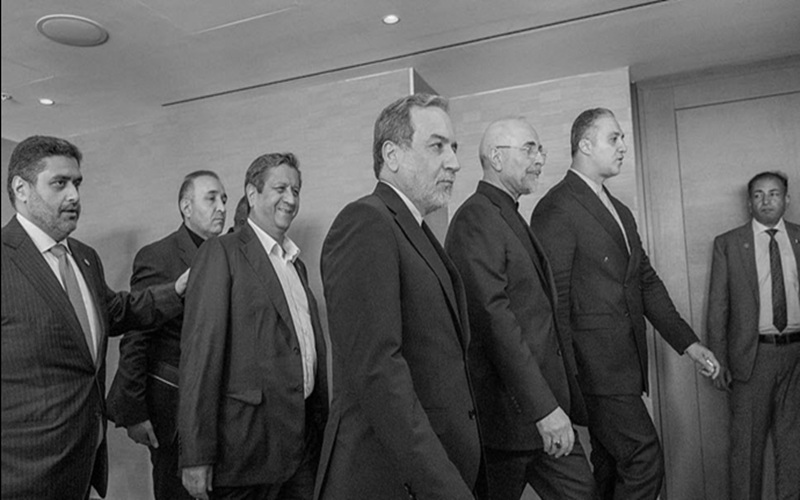

Public warnings, internal contradictions, and growing anxiety over renewed protests reveal a regime increasingly consumed by its own fragility.
For years, the Iranian regime has sought to project an image of absolute unity, portraying itself as an unshakable political and ideological system. Yet beneath the carefully orchestrated displays of strength, a different reality is emerging. Public statements by senior officials, state-controlled media, and even members of the ruling establishment increasingly expose a government struggling with internal divisions, institutional paralysis, and an overriding fear of its own people.
These are no longer observations made solely by outside analysts or opposition figures. The regime’s own representatives are openly acknowledging that its decision-making apparatus has become fractured and increasingly incapable of governing effectively.
One striking example came from cleric Lotfollah Dezhkam, who recently urged regime loyalists to follow Supreme Leader Mojtaba Khamenei’s position on negotiations “without moving ahead of him or falling behind him.” Dezhkam reminded supporters that Khamenei himself had authorized negotiations and insisted that no one claiming loyalty to the Supreme Leader should publicly oppose that decision.
Such a warning is revealing in itself.
Political systems that operate through confidence and institutional discipline do not need to remind their own supporters not to contradict the supreme authority. When senior clerics feel compelled to instruct insiders not to outpace—or undermine—the Supreme Leader, it signals that divisions have spread well beyond the public sphere. Competing factions are no longer merely debating policy; they are challenging the coherence of the regime’s chain of command.
The issue extends far beyond negotiations with the United States.
It reflects a broader crisis of governance in which competing political factions, security institutions, ideological organizations, and media personalities increasingly pull the state in different directions. The question is no longer simply whether the regime should negotiate with the outside world, but whether anyone within the system possesses undisputed authority to determine its course.
That assessment has been echoed by voices inside the regime itself.
The state-affiliated newspaper Jomhouri-e Eslami recently published an unusually blunt critique of the country’s governance, arguing that a nation of more than 90 million people cannot be run through arbitrary personal rule.
The newspaper observed that virtually every influential figure—from parliamentarians and clerics to television personalities, preachers, and ideological commentators—behaves as though they possess ultimate authority. It described the phenomenon as unprecedented, noting that so many competing centers of power attempting to govern a single country has few parallels in modern political history.
This admission is particularly significant because it comes from within the establishment itself.
It acknowledges what millions of Iranians experience every day: inconsistent policies, contradictory decisions, bureaucratic paralysis, and a government incapable of delivering coherent economic or administrative leadership.
The consequences are visible throughout Iranian society.
Runaway inflation, chronic unemployment, repeated energy shortages, collapsing public services, declining living standards, and widespread uncertainty are not isolated failures. They are symptoms of a political system whose competing power centers frequently obstruct one another while remaining collectively insulated from public accountability.
Yet the regime’s greatest concern does not appear to be internal disagreement alone.
Its greatest fear is the Iranian people.
That anxiety was articulated with unusual clarity by President Masoud Pezeshkian, who warned that if the regime fails to serve the public adequately, growing dissatisfaction could once again drive people into the streets.
He cautioned that should public frustration erupt into nationwide protests, the regime’s “prestige” would collapse.
Such remarks deserve careful attention.
Governments confident in their legitimacy rarely speak openly about fearing public demonstrations. Pezeshkian’s comments reflect an awareness shared across the ruling establishment: the appearance of stability is increasingly fragile, while public anger continues to accumulate beneath the surface.
Years of economic hardship, corruption, political repression, social restrictions, and broken promises have eroded public confidence. Millions of Iranians have watched their purchasing power collapse while opportunities diminish and accountability remains absent. The nationwide protests of recent years demonstrated that frustration can rapidly transform into organized resistance when political and economic pressures converge.
The regime understands this dynamic.
Its concern is not simply that protests could occur again, but that future demonstrations may prove even more difficult to contain. Every economic setback, every act of repression, and every visible disagreement among ruling elites further weakens the narrative of competence and inevitability upon which authoritarian systems depend.
History suggests that regimes often become most vulnerable not when opposition grows stronger alone, but when internal divisions intersect with widespread public discontent. Iran increasingly displays both characteristics simultaneously.
Factional disputes have become more visible.
Policy coherence has deteriorated.
Economic crises continue to deepen.
And senior officials now openly acknowledge the possibility of renewed nationwide protests.
These developments point to a political system increasingly governed by fear rather than confidence.
Ultimately, the future of Iran will not be determined by disagreements among competing factions within the ruling establishment. It will be determined by the aspirations of the Iranian people, who have repeatedly demonstrated their desire for fundamental political change.
The growing unease expressed by the regime’s own officials reflects a simple reality: they recognize that lasting stability cannot be sustained through repression, propaganda, or internal power struggles alone. A society burdened by economic hardship, denied political freedoms, and excluded from meaningful participation in shaping its future will continue to demand change.
The question is no longer whether the current system faces a crisis of legitimacy. Even many within the establishment now appear to acknowledge that it does. The real question is whether Iran’s future will continue to be defined by an increasingly divided authoritarian regime—or by a population determined to reclaim its voice and build a democratic republic founded on freedom, accountability, and the rule of law.