


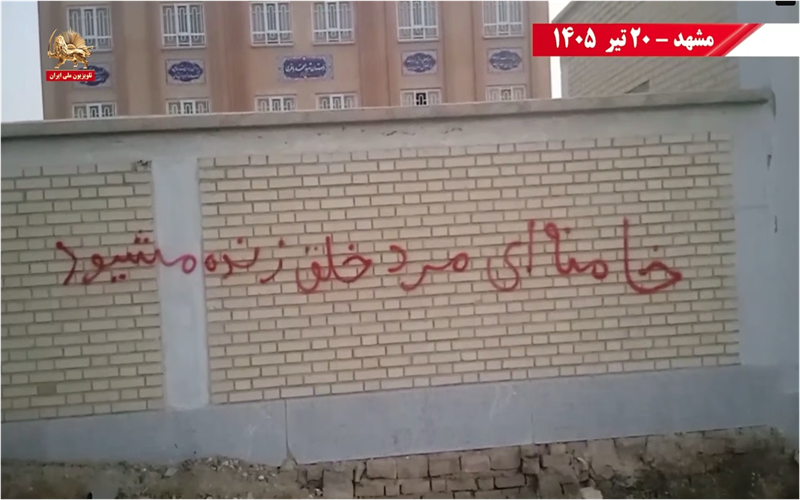

PMOI Resistance Units intensify anti-regime activities in Tehran, Zahedan, and other cities, highlighting support for a democratic republic, the Resistance leadership, and the international designation of the IRGC.
The PMOI’s Resistance Units have carried out a new wave of anti-repression activities across Iran, demonstrating the continued presence of organized resistance despite the regime’s extensive security apparatus. The coordinated campaign included slogans, graffiti, banners, and symbolic actions in numerous cities, conveying messages in support of freedom, democratic change, and the organized Resistance.
The latest activities came as the regime continues to tighten security following recent political developments. Rather than silencing dissent, however, the Resistance Units sought to project a message that the struggle for a democratic Iran continues with renewed determination.
Activities Spread Across Multiple Provinces
Resistance Units reported approximately 40 revolutionary actions in cities throughout the country, including Tehran, Isfahan, Mashhad, Shiraz, Kermanshah, Zahedan, Sari, Shahin Shahr, Gorgan, Rasht, Arak, Borujerd, and Hamedan.
In Tehran, activists displayed the emblem of the PMOI and banners praising the Resistance leadership while expressing support for the National Liberation Army. Similar messages appeared in several other cities, emphasizing opposition to the doctrine of Velayat-e Faqih and calling for democratic change.
In Shahin Shahr, Resistance Units commemorated June 20, 1981, describing it as the beginning of nationwide armed resistance against religious fascism. In Sari, activists displayed a quotation from Maryam Rajavi reaffirming her commitment to the freedom of the Iranian people.
Graffiti campaigns also expanded significantly. Resistance Units painted slogans in multiple locations, including 16 sites across Isfahan and six locations in Mashhad. Other cities, including Shiraz, Hamedan, and Kermanshah, witnessed wall slogans supporting the Resistance while rejecting both religious and monarchical dictatorship.
One recurring slogan declared:
“Death to the oppressor, whether the Shah or the Supreme Leader.”
The message reflects the Resistance’s longstanding rejection of both the former monarchy and the current theocratic regime, advocating instead for a democratic republic.
Zahedan Emerges as a Center of Resistance Activity
A second series of coordinated activities focused on Zahedan, where Resistance Units organized an extensive anti-repression campaign through banners and public messaging despite the regime’s heavy security presence.
The campaign prominently featured calls by Maryam Rajavi urging the international community to designate the Islamic Revolutionary Guard Corps (IRGC) as a terrorist organization. One banner stated:
“Listing the IRGC is essential for peace, stability, and security in the region and the world.”
Other banners argued that confronting the IRGC requires practical international measures rather than political or economic accommodation. The campaign also described the regime’s strategy as relying on domestic repression, pursuit of nuclear weapons, and the export of war and terrorism.
Resistance Leadership Messages Highlight Role of the IRGC
The Zahedan campaign also displayed quotations attributed to Massoud Rajavi, describing the IRGC as the principal instrument for preserving the regime’s rule.
Additional messages argued that the regime depends on external conflict and internal repression for its survival while expressing continued support for organized resistance against dictatorship.
Throughout the city, banners condemned both the current ruling establishment and the legacy of authoritarian rule, reinforcing the Resistance’s position that Iran’s future cannot lie in a return to either system.
Rejecting Both Monarchy and Theocracy
One of the central themes of the campaign was the rejection of all forms of dictatorship. Resistance Units emphasized that replacing one authoritarian system with another cannot deliver freedom to the Iranian people.
Among the slogans displayed in Zahedan were:
- “Monarchy and Velayat—one hundred years of crimes.”
- “Dictatorship is dictatorship, whether with a turban or a crown.”
- “Death to the oppressor, whether the Shah or the Supreme Leader.”
These messages underscore the Resistance’s advocacy for a democratic republic based on popular sovereignty rather than hereditary or religious rule.
Promoting a Democratic Alternative
The campaign also highlighted international support for Maryam Rajavi’s Ten-Point Plan for the future of Iran. Resistance Units displayed statements by former Italian Foreign Minister Giulio Terzi and Italian parliamentarian Naike Gruppioni, both of whom described the plan as a credible democratic roadmap for a free and pluralistic Iran.
Additional banners quoted Maryam Rajavi emphasizing that Iran’s future depends on establishing a democratic republic founded on freedom and peace, while affirming that a society awakened through sacrifice will not retreat in the face of repression.
Continuing Organized Resistance
The latest activities illustrate the continued efforts of the PMOI Resistance Units to challenge the regime’s atmosphere of fear through decentralized and symbolic actions across the country. From Tehran to Zahedan, the campaign combined anti-repression messaging with calls for international action against the IRGC, rejection of both monarchy and theocracy, and support for a democratic alternative based on the Iranian Resistance’s political platform.
As the regime continues to rely on arrests, intimidation, and censorship, the Resistance Units seek to demonstrate that organized opposition remains active in cities across Iran, keeping alive the demand for freedom, democracy, and fundamental political change.