


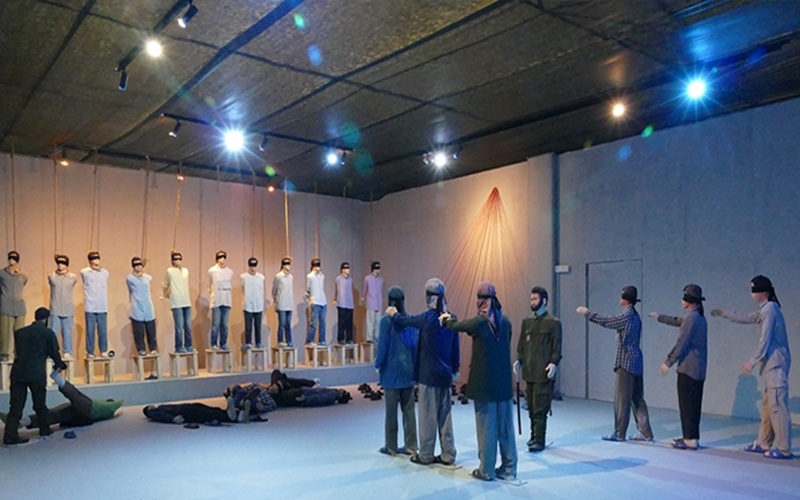

New evidence and survivor testimonies indicate that the 1988 massacre of political prisoners was the culmination of a months-long, coordinated operation involving prisoner classification, administrative restructuring, and logistical planning.
Thirty-eight years after the 1988 massacre of political prisoners in Iran, mounting documentary evidence and survivor testimonies continue to challenge the long-held narrative that the killings were merely a sudden response to military or political events during the final weeks of the Iran-Iraq war.
Instead, the available evidence points to a carefully orchestrated campaign that had been under preparation for months. Long before the executions began in the summer of 1988, the regime had already initiated a systematic process of identifying, classifying, and physically reorganizing political prisoners to facilitate what would become one of the largest mass executions of prisoners in modern Iranian history.
Rather than an improvised decision, the massacre appears to have been the culmination of a coordinated security, intelligence, and judicial operation.
The Prison Classification Project Began in Late 1987
The first stage of the operation began during the autumn and winter of 1987.
According to survivor accounts and historical documentation, special committees consisting of Intelligence Ministry interrogators and prison judicial officials distributed detailed questionnaires and conducted mandatory interrogations in prisons across Iran.
Political prisoners were repeatedly asked four key questions:
- What is your name and the precise charge against you?
- What sentence have you received, and how much of it remains?
- What is your current position regarding the organization or political group to which you belong?
- Are you willing to participate in a televised interview condemning your organization?
These questions were not routine administrative procedures. Instead, they became the mechanism for separating prisoners based on their political convictions.
Those who continued to identify themselves as members or supporters of the PMOI (People’s Mojahedin Organization of Iran) rather than accepting the regime’s derogatory labels, or who refused to renounce their beliefs, were reportedly categorized as prisoners “standing firm” (sar-e mowze) and placed on lists that later became the basis for the decisions of the so-called Death Commissions.
Prison Transfers Created the Infrastructure for Mass Executions
Preparing for executions on such a large scale required more than intelligence gathering. It also required reorganizing Iran’s prison system.
Throughout the winter of 1987 and the spring of 1988, authorities carried out a series of coordinated prisoner transfers.
Many political prisoners serving long sentences—including life imprisonment or sentences exceeding twenty years—were transferred from Gohardasht Prison to high-security wards in Evin Prison. These prisoners were regarded as the most committed members of the Resistance.
At the same time, more than one hundred prisoners known as melli-kesh—individuals whose legal prison terms had already expired but who continued to be detained—were transferred from Evin to Gohardasht.
Within Gohardasht itself, prisoners considered to pose a lesser political threat were concentrated in Ward 1. According to survivor testimony, this arrangement may have been intended to preserve a number of surviving prisoners who could later be cited to deny allegations of systematic extermination if international scrutiny arose. Nevertheless, many prisoners from that ward were also executed on August 9, 1988.
Authorities also dispersed prisoners from smaller cities to provincial prisons, making it more difficult for families to trace their relatives and reducing the likelihood that mass executions would immediately become public knowledge.
Administrative Changes Prepared the Judiciary
The logistical preparations extended beyond the prison walls.
The spring of 1988 witnessed significant changes within the judicial system and the prison administration.
One of the most notable appointments occurred on May 25, 1988, when cleric Esmail Shushtari became head of Iran’s State Prisons Organization. According to numerous accounts, his administration oversaw critical logistical measures, including tightening prison security, restricting communications, canceling guards’ leave, and preparing prison facilities for the operation of the Death Commissions.
During the same period, meetings of the Supreme Judicial Council reportedly intensified, accompanied by increasingly aggressive public rhetoric emphasizing decisive action against the regime’s internal opponents.
These developments suggest that administrative preparations for the coming executions were already well underway months before the formal issuance of the execution order.
Prison Officials Warned Inmates Months in Advance
Numerous survivor testimonies indicate that prison authorities were already aware of the prisoners’ fate well before the executions began.
Former political prisoners have recalled that during renewed interrogations in the spring of 1988, officials repeatedly warned detainees that they faced a “final determination” if they refused to cooperate.
One survivor from Evin Prison recalled interrogators telling prisoners:
“This is your final opportunity. Either cooperate fully, or your final fate will be decided.”
Similar warnings emerged from prisons throughout the country.
According to testimony concerning Tabriz Prison, the local religious judge reportedly told political prisoners in May 1988:
“Soon all of you will receive your final determination.”
The repeated use of the phrase “final determination” appears, in retrospect, to have been an unmistakable code for the execution campaign that was already being organized within the regime’s intelligence and judicial institutions.
The Executions Began Before the Publicly Known Fatwa
Historical evidence also challenges another widely repeated assumption—that the massacre began only after Ayatollah Khomeini’s written fatwa became operational.
Evidence indicates that preparations transitioned into implementation on July 19, 1988—the day after Tehran accepted UN Security Council Resolution 598, ending the Iran-Iraq war.
On that day, several political prisoners, including Gholamreza Kashani Aghdam, were reportedly executed in Evin Prison before the broader wave of mass executions commenced.
According to this interpretation, the regime sought to restore internal control following what it regarded as a humiliating political retreat. After abandoning its long-standing slogan of continuing the war “until victory,” the leadership redirected its focus toward eliminating its principal domestic opposition.
The executions that followed were therefore not an isolated reaction but part of a broader strategy to consolidate power during a moment of political vulnerability.
International Recognition of the Timeline
The chronology of the massacre has also received international attention.
On July 15, 2020, then-U.S. State Department spokesperson Morgan Ortagus marked July 19 as the anniversary of the beginning of Iran’s Death Commissions.
She stated:
“July 19th marks the anniversary of the start of Iran’s so-called ‘Death Commissions.’ On the orders of Ayatollah Khomeini, these commissions reportedly forcibly disappeared, and extrajudicially executed, thousands of political dissident prisoners. The current head of the Iranian Judiciary and current Minister of Justice have both been identified as former members of these ‘Death Commissions.’ The Iranian Judiciary is widely perceived to lack independence and fair trial guarantees, and the Revolutionary Courts are particularly egregious in ordering violations of human rights. All Iranian officials who commit human rights violations or abuses should be held accountable. The United States calls on the international community to conduct independent investigations and to provide accountability and justice for the victims of these horrendous violations of human rights organized by the Iranian regime.”
Instead of upholding justice, the Iranian judiciary oppresses and violates human rights. We urge the international community and individual governments to provide accountability and pursue justice for the regime's many victims. pic.twitter.com/Mr0HpJuJ5g
— State Department Spokesperson 2013-2025 (@statedeptspox_a) July 17, 2020
Her remarks reflected growing international recognition that accountability for the 1988 massacre remains an unresolved human rights issue.
A Crime Planned Months Before the Executions
The accumulated evidence paints a consistent picture. The prisoner classification project initiated in late 1987, the coordinated transfers between prisons, the restructuring of prison administration, the renewed interrogations, and the repeated threats issued by officials all point toward a centrally planned operation rather than a spontaneous decision.
By the time the Death Commissions convened in the summer of 1988, much of the groundwork had already been completed. Prisoners had been identified, categorized, relocated, and isolated. Administrative structures had been reshaped, and prison officials had been prepared for the operation.
For many human rights advocates and survivors, these facts reinforce the conclusion that the 1988 massacre was a premeditated crime against humanity—one planned months before the first executions and carried out through close coordination between Iran’s intelligence services, judiciary, and prison authorities.
Nearly four decades later, calls for an independent international investigation and accountability for those responsible continue, as the families of the victims and survivors seek justice for one of the darkest chapters in Iran’s modern history.