


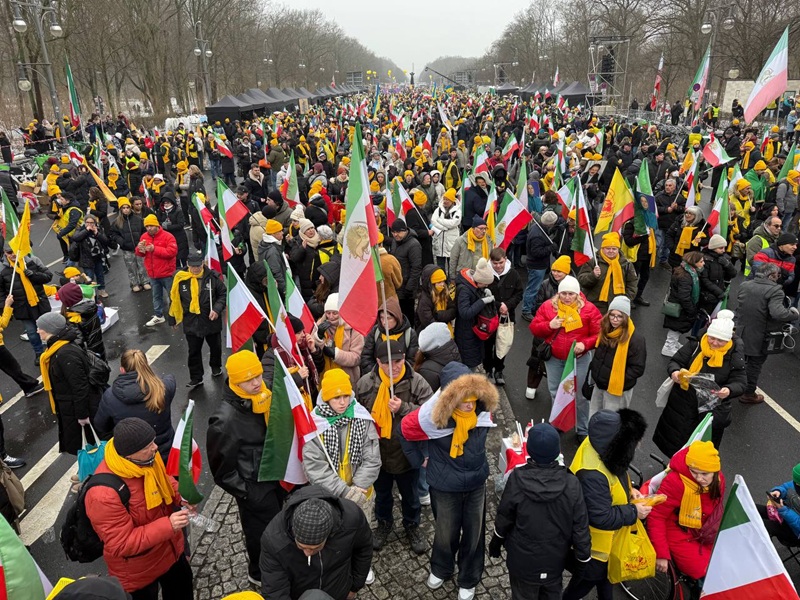

The Berlin rally was not a symbolic protest but a strategic declaration that Iran’s uprising has entered a decisive phase—beyond both monarchy and theocracy
The February 7 demonstration by free-minded Iranians in Berlin took place at a moment when Iranian society has entered a qualitative and decisive phase. This gathering was not merely another symbolic act of protest abroad. It was a political and organized response to a profound demand emerging from within Iran itself. The central questions, therefore, are clear: why Berlin, why at this moment, and what message did this demonstration truly convey?
The first distinguishing feature of the February 7 rally lies in its timing and political context. It coincided with the anniversary of the 1979 anti-monarchical revolution and deliberately linked that historical rupture to the January uprising inside Iran. This connection underscored a longer historical trajectory: the Iranian people’s struggle for freedom did not end in 1979, nor was it extinguished by decades of repression. Instead, it has re-emerged with greater clarity and maturity.
From Protest to a Demand for Regime Change
The Berlin demonstration carried an unambiguous message: the overthrow of the system of velayat-e faqih. The January uprising marked a turning point in Iran’s political landscape. Popular demands were no longer confined to reformist appeals or isolated social and economic grievances. They evolved into a comprehensive rejection of the entire ruling structure.
In this context, the Berlin rally should be understood as the external articulation of an internal will—one forged in Iran’s streets through sacrifice, resistance, and sustained defiance. The role of Iranians abroad has thus entered a new phase: translating the voice of those inside Iran into a clear and coherent political demand on the international stage.
The growing global attention to the January uprising, along with recent signals from international actors, suggests that this message has not gone unnoticed. The Berlin demonstration became political capital for the movement for change by affirming that the authentic voice of Iran does not lie in manufactured projects or diversionary lobbies, but in an organized and rooted resistance shaped by lived experience.
A Clear Historical Line: Neither Shah nor Supreme Leader
One of the most consequential messages of the Berlin rally was its explicit rejection of both religious and monarchical dictatorship. This boundary-drawing was not emotional or reactive; it was the product of costly historical experience. The slogan “Neither Shah nor Mullah” distilled forty-seven years of trial and error—a society that has learned that freedom cannot be achieved by returning to the past.
Efforts to rehabilitate monarchy represent a familiar pattern: leader-manufacturing detached from genuine social struggle. Iran has already paid dearly for such experiments. As emphasized during the Berlin event, the January uprising revealed three distinct forces: a people who paid with their lives; a ruling system that responded with unrestrained repression; and remnants of past authoritarianism (Pahlavi regime) seeking to appropriate the outcome.
Slogans such as “Long live the Shah” bear no relation to Iran’s contemporary democratic aspirations. On the contrary, they deepen fragmentation and objectively aid the machinery of repression. The Berlin demonstration showed that the current uprising is authentic, socially rooted, and grounded in real sacrifice. This clarity reflects a political maturity that refuses recycled versions of authoritarianism, however polished their presentation.
Articulating a Future Vision
Another key message of the Berlin gathering was its articulation of a concrete vision for Iran’s future: a democratic republic grounded in the separation of religion and state, aligned with the legacy of Mohammad Mossadegh, non-nuclear, at peace with the world, and based on full legal equality for all citizens and national communities.
Guided by the principle of “Neither Shah nor Mullah,” this vision directly addresses a recurring question posed internationally: is there a viable alternative to the current regime? The demonstration answered in the affirmative. It asserted that such an alternative exists—one that has endured decades of repression, combined the rejection of dictatorship with a commitment to freedom and justice, and placed women’s equal role in political leadership at its core.
The scale of participation and the tangible linkage between Iranians inside and outside the country indicated that the uprising has not stalled. It has moved into a more organized phase—one that demands political coherence, vigilance, and unity of purpose.
An Unambiguous Conclusion
The final message of the Berlin demonstration was both clear and unalterable: Iran’s future cannot be confiscated. On the anniversary of a revolution whose outcome was hijacked in 1979, Iranians declared that history would not repeat itself.
This rally was also an address to global leaders—to listen to the genuine voice of the Iranian people. The demands articulated in Berlin, including recognition of the people’s right to resist, urgent action to halt executions, support for free internet access, international accountability for regime leaders, closure of regime diplomatic centers, and disruption of its financial lifelines, demonstrated that this movement is not merely oppositional. It is programmatic, forward-looking, and politically defined.
In this sense, Berlin was not simply a location. It was a platform—announcing that Iran’s uprising has entered an irreversible stage.