


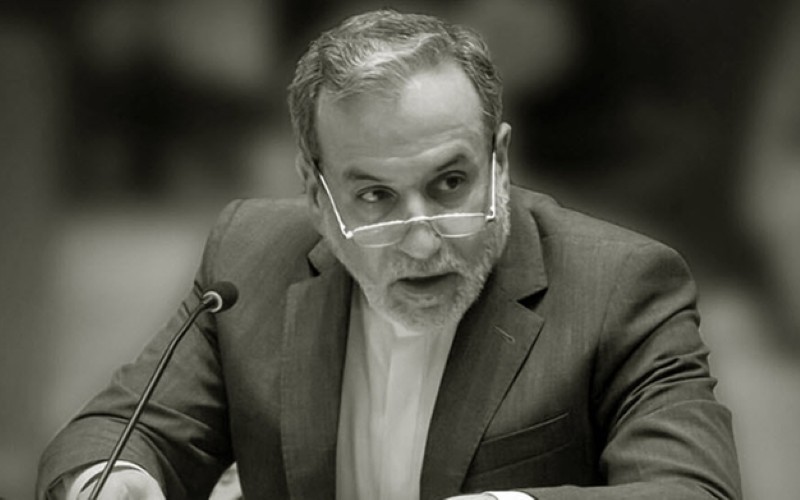

Abbas Araghchi’s rhetoric of “steadfastness” exposes a regime cornered by its own failures—where negotiation, escalation, and survival all point to the same dead end
As U.S.–Iran negotiations resume under mounting regional and international pressure, Iran regime’s foreign minister Abbas Araghchi has adopted a familiar tone—defiance framed as principle, rigidity dressed up as courage. Speaking on Sunday, February 8, at the so-called First National Congress on Foreign Policy and the History of Foreign Relations, Araghchi warned his audience that “fear is a lethal poison,” and argued that any form of “concession” has no endpoint.
The message was not addressed to Iran’s people, who have borne the cost of decades of isolation, sanctions, repression, and misrule. It was delivered instead to a carefully selected audience of regime loyalists and insiders—those who must be convinced that obstinacy equals strength, and that endurance means survival.
In the lexicon of Iran’s ruling establishment, “concession” does not mean accountability, reform, or prioritizing the public interest. It means any deviation from policies that have systematically impoverished society while entrenching authoritarian power. Araghchi’s warning was therefore not about protecting national sovereignty; it was about preserving a political system that equates retreat with existential threat.
“Steadfastness” as a Symptom of Strategic Exhaustion
Araghchi described Iran’s greatest challenge as “steadfastness,” arguing that even a single step backward could lead to an uncontrollable chain of retreats. He emphasized that regime President Masoud Pezeshkian shares this belief. The implication is revealing: the regime no longer sees flexibility as a strategic tool, but as a fatal weakness.
At the same time, Araghchi dismissed U.S. military posturing in the region, claiming it does not intimidate Tehran. Yet moments later, he justified Iran’s insistence on uranium enrichment—even at the risk of war—by asserting that “no one has the right to tell us what we should or should not have.”
This contradiction lies at the heart of the regime’s crisis. If war truly holds no fear, negotiations would be unnecessary. If negotiations are essential, then the rhetoric of absolute defiance is performative—designed to mask vulnerability rather than demonstrate strength.
Negotiation as Delay, Not Resolution
Despite his militant tone, Araghchi confirmed that there is broad agreement within the regime to continue negotiations, with future rounds to be scheduled through Omani mediation. This admission underscores a central reality: the regime is negotiating not to resolve its crisis, but to postpone it.
War is costly. Retreat is destabilizing. Both threaten the regime’s internal balance at a time when Iranian society is already in open rupture. Negotiations, therefore, function as a holding pattern—an attempt to buy time, manage pressure, and defer irreversible choices.
Araghchi’s remarks amount to an implicit confession: the regime is trapped in a strategic impasse of its own making.
A Deadlock with No People in It
The regime’s dilemma is stark. Meaningful retreat—whether on the nuclear program or regional policies—would likely trigger a cascade of further concessions under shifting global power dynamics, accelerating internal fragmentation. Refusal to retreat, on the other hand, risks escalation, isolation, and a new phase of crisis.
What is absent from this calculus is the Iranian people.
Neither war nor brinkmanship serves their interests. Decades of experience have shown that external confrontation strengthens repression at home, while sanctions and isolation devastate livelihoods. The regime’s insistence on framing the crisis as a matter of “standing firm” versus “submission” deliberately erases the public, whose demands center on dignity, freedom, and economic survival—not geopolitical posturing.
The Regime’s Real Fear
Behind Araghchi’s bravado lies the regime’s deepest anxiety: that neither war nor negotiation can neutralize the force reshaping Iran from within. Nationwide uprisings, sustained resistance, and the collapse of public trust have made it clear that the core threat to the regime is not foreign pressure, but domestic rejection.
This is why Supreme Leader Ali Khamenei continues to rely on delay, tactical ambiguity, and oscillation between confrontation and dialogue. It is a strategy of survival, not governance—moving “from one pillar to another,” as the Persian saying goes, in the hope that time itself can substitute for legitimacy.
The coming months will test this calculation. What they are unlikely to deliver is stability. A regime that defines fear as poison, but governs through fear alone, has already conceded the most important ground: the consent of its people.