


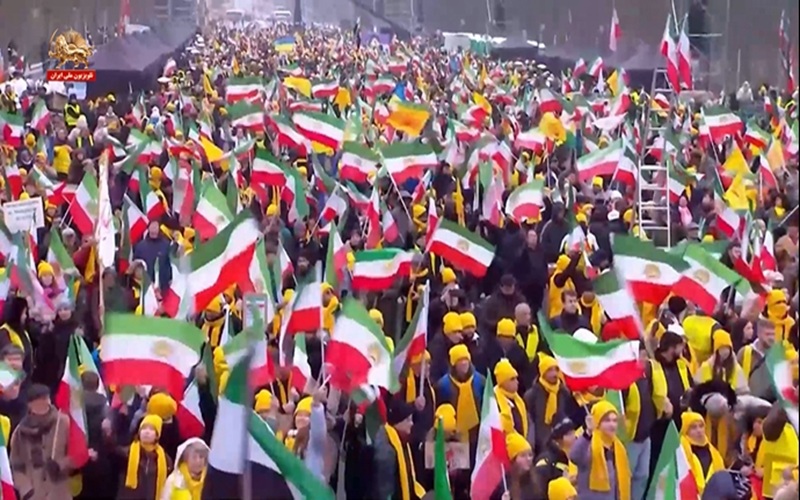

As Iran faces growing internal unrest and deepening political isolation, the annual gathering of the Iranian democratic opposition has become a symbol of an alternative vision for the country’s future.
At certain moments in history, political events become more than gatherings. They become markers of a nation’s aspirations, frustrations, and determination to shape its future.
For many Iranians, the upcoming June 20 gathering in Paris represents such a moment.
As Iran confronts one of the most turbulent periods in its modern history, the event is expected to bring together thousands of supporters of democratic change, human rights advocates, lawmakers, former government officials, and members of the Iranian diaspora from across the world. Their common message is straightforward: Iran’s future should be decided neither by the current theocratic regime nor by a return to authoritarian rule from the past, but by the Iranian people themselves.
A Regime Facing Multiple Crises
Nearly five decades after the 1979 revolution, the cleric regime faces challenges that extend far beyond economic difficulties.
Persistent inflation, widespread poverty, corruption scandals, political repression, and growing public dissatisfaction have eroded the regime’s legitimacy in the eyes of many Iranians. Repeated waves of nationwide protests over the past decade have demonstrated that public frustration is not limited to any single social class, region, or generation.
At the same time, Tehran’s regional interventions and confrontational foreign policies have increasingly linked the regime’s internal instability to broader concerns about regional security.
The result is a government that faces pressure both at home and abroad while struggling to convince large segments of its own population that it represents their interests.
The Emergence of a Democratic Alternative
One of the central questions in discussions about Iran’s future has always been whether a viable democratic alternative exists.
The National Council of Resistance of Iran (NCRI) argues that such an alternative does exist and has spent decades presenting itself as a coalition committed to democratic governance, secularism, gender equality, and the separation of religion and state.
Supporters of the movement point to its endurance through decades of repression, imprisonment, executions, and political pressure as evidence of its resilience. They argue that despite extensive efforts to eliminate organized opposition, the demand for democratic change inside Iran has continued to grow.
For many participants in the June 20 gathering, the event is therefore not simply a political rally. It is a demonstration that organized resistance to dictatorship remains alive and capable of mobilizing support both inside and outside Iran.
Rejecting Both Forms of Dictatorship
One of the defining themes of recent opposition gatherings has been the slogan “Neither Shah nor Mullahs.”
The phrase reflects a position that rejects both the current religious dictatorship and any attempt to restore authoritarian forms of rule associated with Iran’s monarchical past.
This distinction has become increasingly important as debates over Iran’s future intensify.
Many Iranians who support democratic change argue that the country’s political crisis cannot be solved by replacing one form of authoritarianism with another. Instead, they advocate a democratic republic based on popular sovereignty, free elections, political pluralism, and respect for fundamental human rights.
The June 20 gathering seeks to amplify this message at a time when competing visions for Iran’s future are being actively debated.
Human Rights at the Center
The demand for political change in Iran is inseparable from the issue of human rights.
Executions continue to draw international criticism. Political prisoners remain behind bars. Freedom of expression, assembly, and association face severe restrictions. Women, ethnic minorities, religious minorities, and dissidents continue to confront institutional discrimination and repression.
As a result, calls to end executions, protect civil liberties, and establish democratic institutions have become central themes of opposition activism.
Supporters of the NCRI frequently highlight the Ten-Point Plan proposed by Maryam Rajavi, which outlines a vision for a democratic republic based on universal suffrage, gender equality, separation of religion and state, judicial independence, and respect for international human rights standards.
Whether one agrees with every aspect of the proposal or not, it represents an effort to move the discussion beyond opposition to the current regime and toward a concrete vision for what could follow it.
More Than a Gathering
The significance of the June 20 event extends beyond the speeches delivered on stage.
For participants, it serves as a demonstration of solidarity with those inside Iran who continue to advocate for political change despite the risks they face. It is also intended to send a message to policymakers around the world that the Iranian people should not be viewed solely through the lens of the ruling regime.
In this sense, the gathering has become an annual reminder that the story of Iran is not limited to its rulers. It is also the story of millions of citizens who continue to demand freedom, accountability, and democratic governance.
A Defining Moment
The future of Iran will ultimately be determined by the Iranian people themselves.
Yet moments of collective action can help shape that future by demonstrating the strength of public aspirations and the existence of organized alternatives.
For supporters of democratic change, the June 20 gathering is one such moment. It represents not only opposition to an authoritarian system but also a belief that a free, secular, and democratic republic is possible.
As Iran approaches another critical chapter in its history, the significance of that message may be greater than ever.