


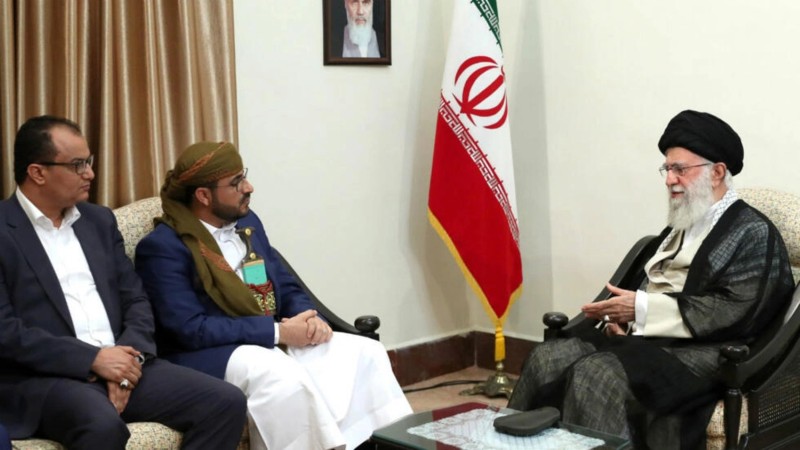

New reports expose Tehran’s use of Houthi-controlled ports as the new epicenter of its shadow economy
The latest remarks by Ibrahim Haydan, the Interior Minister of Yemen’s internationally recognized government, have once again turned attention toward the Iranian regime’s shadow networks for financing and arms trafficking across the Middle East. Haydan revealed that since the collapse of Bashar al-Assad’s regime in Syria, the Iranian regime has transferred a large portion of its illicit drug and weapons operations to Yemen and its allied Houthi militias.
These revelations raise pressing questions about how Tehran has restructured its regional smuggling routes, what entities are financing these activities, and how pseudo-financial institutions such as Lebanon’s Qard al-Hasan Association continue to serve as a backbone for Iran’s covert economic empire.
From Syria to Yemen: A Strategic Shift
During the Syrian civil war, Assad’s regime had relied heavily on Iran-backed networks to sustain itself under international sanctions. Under the command of Maher al-Assad, Syria’s Fourth Division collaborated with Hezbollah to establish large-scale Captagon production facilities in Latakia, Homs, and Qusayr. By 2023, Syria had become the global hub of Captagon production, generating an estimated annual revenue of $5–10 billion—surpassing the value of all its official exports during the war.
These profits sustained both the Assad regime and Iran’s regional proxies. But with the fall of Assad and the new government in Damascus cutting ties with Tehran, the old trafficking routes through Syria and Lebanon collapsed. International monitoring of Mediterranean and Lebanese ports made Iran’s traditional smuggling networks increasingly vulnerable.
In response, the Iranian regime has shifted its operations to Yemen—where the Houthi militias, trained and funded by Tehran, control key ports including Al-Hudaydah, Al-Mokha, and Al-Salif, as well as access to the strategic Bab al-Mandab strait. According to Yemeni officials, Syrian technicians arrested in recent raids were operating Captagon factories in Yemen—direct evidence of Tehran’s relocation of expertise and production capacity from the Levant to the Arabian Peninsula.
Financial and Strategic Motives
By moving the heart of its trafficking operations to Yemen, Tehran seeks to achieve multiple goals:
- Creating new revenue streams to offset sanctions and the financial collapse inside Iran.
- Empowering the Houthis as a self-financing proxy capable of sustaining military confrontation in the Red Sea.
- Establishing alternative smuggling corridors for arms shipments to the region.
- Destabilizing Gulf Arab states and threatening global trade through the Bab al-Mandab waterway.
This approach illustrates the regime’s long-standing strategy of combining illicit trade, proxy warfare, and ideological expansion to project power despite growing isolation.
The Role of Hezbollah’s Financial Arm
Tehran’s financial backbone for these networks remains the Qard al-Hasan Association in Lebanon—formally a microfinance charity but effectively the financial arm of Hezbollah. Established in 1982 and registered officially in 1987, the association provides interest-free loans using gold and jewelry as collateral. However, the U.S. Treasury has designated it as part of Hezbollah’s financing apparatus, enabling Tehran to move funds through informal transfer systems and evade sanctions.
Following the 2019 collapse of Lebanon’s formal banking sector, Qard al-Hasan became the de facto bank of Hezbollah, controlling liquidity and serving as a conduit for Iranian funds. Through its opaque and unregulated structure, it also facilitated the flow of money across the region—including to Syria and now Yemen—supporting the logistical backbone of Tehran’s proxy operations.
A Network of Shadow Economies
The route connecting Tehran, Beirut, Damascus, and Al-Hudaydah has evolved from a simple smuggling corridor into a coordinated military-financial structure. With Syria’s old network dismantled, Tehran’s focus on Yemen represents a calculated adaptation aimed at maintaining the survival of what it calls the “Axis of Resistance.”
But this shift comes at a heavy cost: it exacerbates insecurity in the Red Sea, fuels narcotics trafficking across the Arabian Peninsula, and deepens Lebanon’s economic crisis by continuing to siphon resources through Hezbollah’s parallel economy.
Iran’s Expanding Footprint in the Red Sea
As the Iranian regime faces tightening financial restrictions and increased international scrutiny of money laundering activities in Lebanon, it is resorting increasingly to cash-based transactions and informal trade. The Houthis’ territorial control, maritime access, and operational autonomy make them an ideal partner in this new stage of Tehran’s regional shadow operations.
What was once the Syrian corridor for drugs and weapons has now been reborn along the Yemeni coast—threatening not only the stability of the Arabian Peninsula but also global trade routes passing through the Bab al-Mandab.
In this new configuration, the Iranian regime continues to prove that its most resilient weapon is not only its arsenal but its capacity to build an “economy of resistance”—a transnational web of militias, smugglers, and financial intermediaries sustaining its regional ambitions in defiance of isolation.