


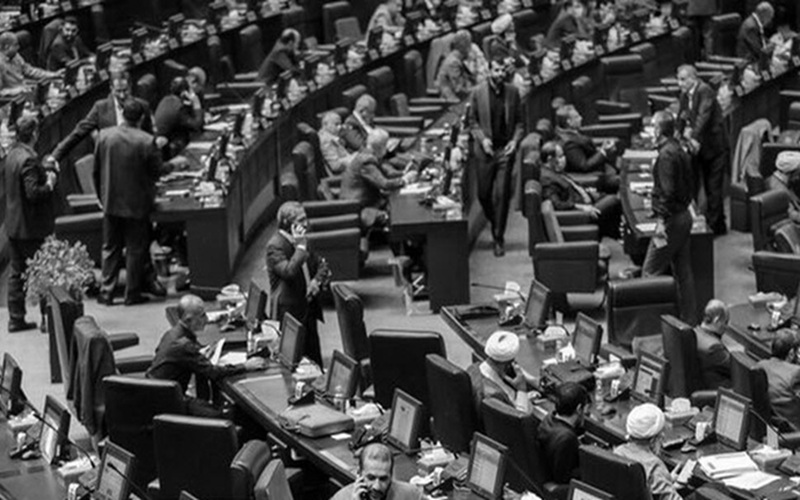

Disputes over foreign policy, parliamentary action against officials, and threats against political rivals expose growing divisions within Iran’s ruling establishment over how to confront the United States.
Iran’s regime is experiencing escalating internal conflict as rival factions clash over the war with the United States, diplomatic negotiations, and the government’s handling of domestic affairs. Recent moves against political opponents, calls to impeach Foreign Minister Abbas Araghchi, and threats of summary trials have highlighted the growing difficulty of containing disputes within the regime.
The confrontation extends beyond verbal attacks. Following the imprisonment of hard-line cleric Hamid Rasaee after a complaint by Parliament Speaker Mohammad Bagher Ghalibaf, 35 members of the regime’s parliament signed a motion seeking Araghchi’s impeachment. The move underscored the divisions over the foreign minister’s diplomatic activities and the regime’s approach to the United States.
The dispute has also taken a more threatening tone. During nighttime gatherings by regime supporters, demonstrators targeted former President Hassan Rouhani and former Foreign Minister Mohammad Javad Zarif with slogans accusing them of serving foreign interests. Some participants threatened political figures with a fate resembling that of former President Akbar Hashemi Rafsanjani, whose death in a swimming pool in 2017 has remained a subject of public controversy.
One lawmaker defending the prospect of impeaching Araghchi despite the wartime circumstances reportedly declared: “In wartime, we even have summary trials.”
The regime’s president Masoud Pezeshkian has repeatedly complained about insults and accusations directed at his government, while senior figures have advanced conflicting positions on whether the regime should pursue negotiations or continue the military confrontation.
Two Conflicting Strategies Over the War
At the heart of the infighting lies a fundamental disagreement over how the regime should respond to the confrontation with Washington.
One faction argues that the regime cannot sustain the military conflict indefinitely and must retreat from its current position to bring the crisis to an end. From this perspective, an agreement with the United States, even if it requires significant concessions, is necessary to limit further damage.
The opposing camp rejects the idea that an agreement can provide lasting security. Its proponents argue that signing documents or reaching an understanding with Washington will not establish effective deterrence and insist that the regime must continue the confrontation.
This divide reaches the highest levels of the ruling establishment. The competing positions have persisted despite the authority formally concentrated around Supreme Leader Mojtaba Khamenei and the role of the Supreme National Security Council in coordinating national security policy.
The result is a visible struggle over the regime’s most consequential strategic decision: whether to seek an end to the confrontation through negotiations or continue a course that carries further military and political risks.
Infighting Spreads Beyond Foreign Policy
The divisions are not confined to the war. Rival factions have also clashed over economic measures, including the government’s voucher program, as well as internet policy and disputes involving the Central Bank.
These disagreements reflect competing approaches to managing the regime’s economic and social problems. However, the conflict over relations with Washington has become particularly consequential because it affects decisions about the regime’s immediate security and political survival.
The controversy surrounding Araghchi illustrates how diplomatic decisions have become ammunition in the internal power struggle. His opponents have questioned his actions and contacts with American representatives, arguing that such moves should not occur without prior authorization from the supreme leader.
The impeachment campaign therefore serves not only as a challenge to the foreign minister but also as a vehicle for factional pressure over the regime’s negotiating position.
Why the Regime Is Struggling to Contain Its Divisions
The intensifying confrontation raises questions about the effectiveness of the institutions responsible for managing internal disputes. Neither the supreme leader’s office nor the Supreme National Security Council has been able to reconcile the competing strategic positions sufficiently to prevent repeated public clashes.
The political consequences are increasingly apparent in parliamentary maneuvers, public denunciations, and threats against rival officials. Instead of presenting a coherent position on war and diplomacy, the ruling establishment has exposed disagreements over the direction of its policy.
The conflict does not, by itself, establish that the regime is on the verge of collapse. It does, however, demonstrate the difficulty its factions face in agreeing on a common response to mounting external pressure and domestic challenges.
As long as the competing camps remain divided over whether to negotiate or continue the war, disputes over individual officials are likely to remain intertwined with the larger struggle over the regime’s strategic direction. The escalating infighting reflects a ruling establishment struggling to reconcile fundamentally different approaches to a crisis with direct implications for its future.