


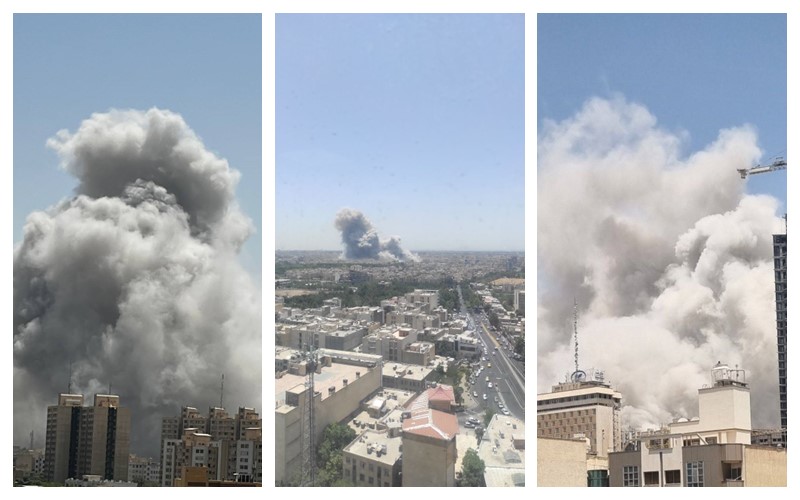

Ceasefire Tensions Linger, Nuclear Accountability Disputed, and Iran’s Domestic Crisis Deepens
Day 18 – Overview Despite the ceasefire between Israel and the Iranian regime, tensions remain high across diplomatic, economic, and military fronts. Political discontent is mounting within the regime’s leadership, the economic fallout continues, and the status of Iran’s damaged nuclear infrastructure is increasingly under global scrutiny.
1. No Date Set for Negotiations, Tensions Remain Iranian Foreign Ministry spokesperson Esmail Baghaei stated on Monday that no definitive date has been agreed upon for talks with Europe or the United States. Despite earlier claims by U.S. President Donald Trump that negotiations would begin this week, Iran’s top officials continue to deny any formal agreement or schedule. Political deputy Majid Takht-Ravanchi reaffirmed that Iran would only negotiate if it received explicit guarantees that it would not be attacked during talks. Meanwhile, both Trump and U.S. envoy Steve Witkoff have expressed readiness for a “comprehensive peace agreement.”
Baghaei also emphasized Iran’s dissatisfaction with the positions taken by France and Germany regarding Israel’s attack, calling them “unacceptable.”
2. Nuclear Program Dispute and Enrichment Rights Takht-Ravanchi reiterated Iran’s insistence on domestic uranium enrichment. “The level and capacity is debatable,” he said, “but banning enrichment and threatening bombing is law of the jungle.” Ambassador Amir Saeed Iravani echoed this in a UN interview, calling uranium enrichment Iran’s “indisputable right.”
Spokesman Baghaei confirmed that IAEA inspectors are still in Iran but reiterated that nuclear facilities were “severely damaged.” The Atomic Energy Organization of Iran is assessing the extent of the destruction to determine the path forward for cooperation.
3. Attacks’ Aftermath and Regional Unrest According to the regime’s judiciary spokesman Asghar Jahangir, the official death toll in Iran from the 12-day war now stands at 935. However, he did not clarify how many were civilians or military personnel.
Additionally, the United Nations has reported that 130,000 Afghan refugees were expelled from Iran in the week following the war.
4. Economic Fallout Post-War Despite a declared ceasefire, Iran’s economy continues to suffer. The Tehran Stock Exchange dropped 196,000 points over three days, including a 56,000-point fall on Monday alone. The free market dollar rate surged past 90,000 tomans, and gold prices also climbed significantly.
5. Internal Criticism of Foreign Policy and Alliances Former Deputy Parliament Speaker Ali Motahari criticized Russia for refusing to supply the S-400 defense system to Iran, despite Iran’s support in Ukraine. He suggested Moscow’s hesitance stems from fears it could be used against Israel.
Former Parliament Security Commission head Heshmatollah Falahatpisheh warned that if hostilities resume, the world may face “the most suicidal war in history.”
Ahmad Bakhshayesh Ardestani, a current member of the regime’s Parliament National Security Commission, admitted that Israeli infiltration was “easily achieved” and urged Tehran to resume negotiations with Washington to avoid an ongoing military standoff.
6. Regime Posturing and Ideological Messaging Rahim Safavi, senior advisor to the Supreme Leader, declared the recent war a failure for Iran’s enemies. He claimed that the “final victory” belongs to Iran and heralded the emergence of a “New Middle East centered on the Islamic Revolution.”
Chief Justice Mohseni-Eje’i also warned against trusting the United States, calling Trump “vile” and accusing him of inconsistent rhetoric.
7. Ceasefire Fragility and Continued Threats The Shargh newspaper labeled the ceasefire “temporary and vague,” suggesting its sustainability cannot be guaranteed.
IRIB-affiliated expert Ebrahim Mottaqi predicted that Israel could launch another strike within a week.
8. Seismic Consequences and Strategic Strikes The Etemad newspaper cited a report by Professor Mehdi Zare, revealing that over 3,400 projectiles caused more than 1,500 explosions and accompanying earthquakes across the nuclear-targeted regions.
9. Targeted Assassinations and Intelligence Leaks The Wall Street Journal reported that Israel’s “Operation Narnia” eliminated key nuclear scientists to disrupt Iran’s program. Nine were killed in the opening hours, with two more assassinations later.
10. Intelligence Assessments Diverge According to the Associated Press and The Washington Post, CIA Director John Ratcliffe told Congress that Iran’s uranium stockpile may be buried under rubble, but intercepted communications show Iranian officials believed the attacks were less destructive than expected. Trump continues to insist the strikes “obliterated” Iran’s nuclear capacity.
11. Additional IRGC Casualty Confirmed Regime media confirmed the death of Abolfazl (Hossein) Nikoei, a senior Quds Force commander, in an Israeli strike in Tehran. He had operated alongside Qassem Soleimani in Syria.
12. New Updates – Domestic and Diplomatic Backlash
- Judiciary spokesman Jahangir raised the official war death toll to 935, still without civilian/military breakdown.
- Iran’s stock market has suffered significant losses since the ceasefire, and currency values continue to collapse.
- Former officials blame internal divisions and distraction for allowing Israeli infiltration.
- Motahari and Falahatpisheh warn of geopolitical failures and demand policy shifts.
- Takht-Ravanchi firmly rejected U.S. demands for zero-enrichment, calling them coercive.
- Iravani and Baghaei warned of a strong military response if Israel or the U.S. take further action.
Conclusion Iran’s regime, already reeling from the military and diplomatic fallout of the 12-day war, now faces a growing internal crisis. With renewed calls for reform, economic instability, and international scrutiny, Tehran stands at a crossroads between continued confrontation or a path toward diplomacy and reconstruction. The uncertainty surrounding the nuclear program and future talks with the West underscores the fragile state of both the regime and the region.