


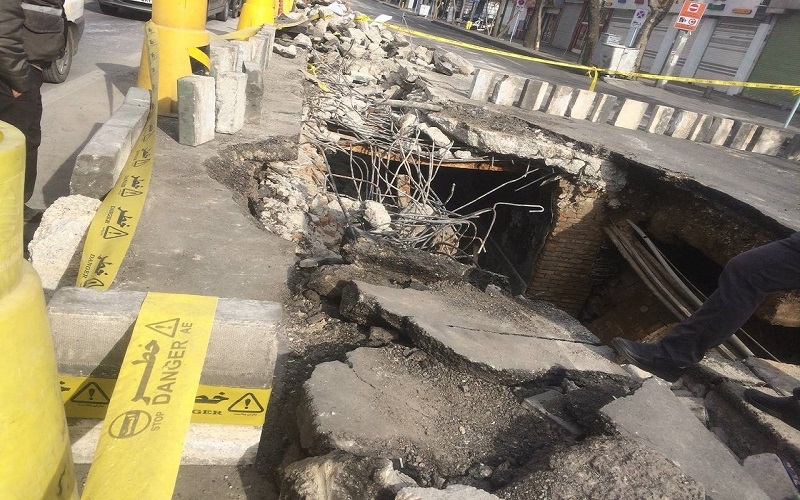

An official from Iran’s Ministry of Roads and Urban Development has raised serious concerns about the rapidly worsening land subsidence in Tehran, where subsidence rates have reached 20 centimeters. This alarming issue now affects over three million residents living within the city’s subsidence zone.
Ali Baitollahi, head of the Risk Tolerance Department at the Road, Housing, and Urban Development Research Center, spoke to ILNA news agency on Wednesday, September 18. He revealed that the subsidence zone in Tehran now stretches over 50 kilometers in length and 30 kilometers in width. He added, “Based on studies conducted, more than three million people, including those in the surrounding cities, are living in this dangerous zone.”
Baitollahi explained that subsidence was previously limited to the outskirts of Tehran’s Districts 17, 18, and 19. However, the issue has now expanded dramatically, engulfing a large portion of the city.
He warned about the severe consequences of this ongoing subsidence, emphasizing the risks posed to critical infrastructure. “Fuel tanks located within the subsidence zone could lead to significant economic and social consequences,” he noted. In particular, the Rey fuel tank, Tehran’s largest gasoline supplier, is situated directly at the center of the affected area. Additionally, the South Tehran Refinery, another vital piece of infrastructure, is also located within the subsiding region.
Baitollahi further highlighted the industrial sector’s vulnerability, stating that many factories and facilities are situated directly on the subsidence zone, putting them at high risk.
Geologists attribute this worsening subsidence to poor water resource management. The extraction of underground water has left large voids, leading to the ground sinking across various regions of Iran. Official reports show that at least 14 provinces are grappling with subsidence, with rates exceeding 10 centimeters in some areas.
The head of the General Department of Environment and Sustainable Development of Tehran Municipality has previously referred to land subsidence as a “silent earthquake” or “land cancer,” warning that Tehran holds the unfortunate record for the highest subsidence rates globally. Despite the grave danger this poses to residents, no comprehensive solution has been implemented to mitigate the problem.
Baitollahi has been critical of the government’s lack of action in addressing this crisis. “There is no mention of subsidence in any of the country’s construction laws or regulations,” he lamented, underscoring the need for urgent policy reforms.
Similarly, Ali Javidaneh, head of Iran’s Mapping Organization, likened the land subsidence issue to a “time bomb.” In May, he revealed that maps detailing the country’s subsidence zones had been sent to relevant agencies. However, he expressed frustration that these agencies have not utilized the data for proper planning and preventive measures.
The crisis extends beyond Tehran, threatening several other major cities and even historic landmarks across Iran. Experts have sounded the alarm about the increasing subsidence around ancient sites like Persepolis and Naqsh-e Jahan Square, where it risks causing irreparable damage to Iran’s cultural heritage.
As the subsidence crisis deepens, the urgency for a coordinated and comprehensive response grows more pressing. Without decisive action, the consequences for Tehran’s infrastructure, economy, and historical treasures could be devastating.