


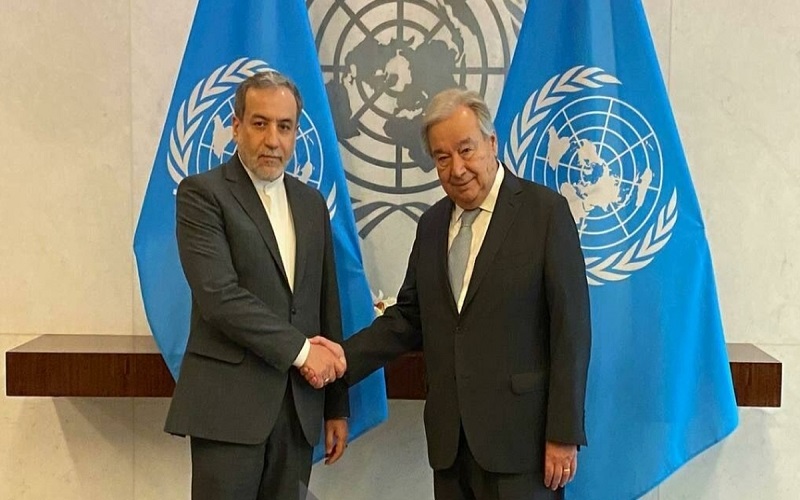

In a recent response to UN Secretary-General Antonio Guterres’ call for Iran’s regime to reaffirm its commitment to not seeking nuclear weapons, Abbas Araghchi, the regime’s foreign minister, took to X (formerly Twitter) to express his frustration. He described the request as “rude” and unnecessary, emphasizing that Iran’s stance on nuclear weapons has already been clearly articulated.
Araghchi referenced the Joint Comprehensive Plan of Action (JCPOA), highlighting a specific clause from the “Preamble and General Provisions” section of the agreement. The clause states: “Iran reaffirms that under no circumstances will Iran ever seek, develop, or acquire any nuclear weapons.”
He characterized this as a permanent and unequivocal commitment. However, the JCPOA and its associated United Nations Security Council Resolution 2231 are set to expire in October 2025 under the agreement’s sunset provisions, raising questions about the long-term credibility of Iran’s commitments post-expiration.
This expiration, known as “Termination Day,” marks the end of significant restrictions on Iran regime’s nuclear program.
However, according to several officials and experts, including Rafael Grossi, Director General of the International Atomic Energy Agency (IAEA), the JCPOA has lost its practical significance due to Iran’s continued breaches of its nuclear obligations.
Notably, no credible international authority has been able to verify the peaceful nature of Iran regime’s nuclear activities. This casts doubt on Tehran’s repeated assurances that it does not seek nuclear weapons.
Shifting Narratives and Conditional Commitments
Araghchi’s statement sought to portray Iran’s adherence to the global non-proliferation regime by referencing historical examples, such as Iran’s signing of the Nuclear Non-Proliferation Treaty (NPT) in 1968 during the Shah’s regime. He also pointed to a religious fatwa by Supreme Leader Ali Khamenei, which allegedly prohibits the development of nuclear weapons.
However, experts have noted that such religious edicts are neither legally binding nor permanent, as they can be reinterpreted or revised based on political expediency. This raises serious doubts about the credibility of Tehran’s claims and its ultimate intentions regarding its nuclear program.
Adding to the uncertainty, Kamal Kharazi, a senior adviser to Khamenei, has hinted at the possibility of a shift in Iran’s nuclear doctrine. He stated, “If our existence is threatened, we will change our nuclear doctrine.” This rhetoric underscores Tehran’s strategy of maintaining ambiguity about its ultimate intentions.
The “Trigger Mechanism” and Diplomatic Gamesmanship
Iran regime’s leadership appears focused on crossing the October 2025 Termination Day without triggering the “snapback” mechanism, which would reinstate UN sanctions.
In this context, Tehran has employed a familiar strategy: expressing a willingness to negotiate while advancing its nuclear capabilities. Following the Trump administration’s potential maximum pressure campaign, Iran has moderated its rhetoric, emphasizing diplomacy as the preferred path.
Kazem Gharib Abadi, a deputy to Araghchi, recently described dialogue as “the most rational solution.” Similarly, Mohammad Javad Larijani, another regime official, has suggested that Tehran is prepared to negotiate even with the evil to protect its interests.
This shift in tone coincides with heightened international concerns over Iran regime’s nuclear advancements and its apprehension about the potential for a strong international backlash against its ambitions.
European nations, which previously resisted U.S. efforts to reimpose sanctions during Trump’s first presidency, are now alarmed by Tehran’s uranium enrichment activities.
Iran has significantly increased its stockpile of 60% enriched uranium, a level close to weapons-grade. According to Rafael Grossi, Iran’s production has accelerated dramatically, reaching over 30 kilograms per month.
The IAEA estimates that 42 kilograms of uranium enriched to this level would be sufficient for one nuclear bomb, and Iran currently possesses about 200 kilograms. Grossi noted that no other country has enriched uranium to such levels without eventually developing nuclear weapons.
A Calculated Gamble
Iran’s escalating enrichment activities stem from its growing internal crises, including fears of a new wave of nationwide protests following the 2022 uprisings, and its significant defeats in the region.
These pressures have led Tehran to intensify its nuclear program as a means to project strength and distract from domestic vulnerabilities.
By sharpening its nuclear threat, Tehran aims to extract concessions from Washington, potentially leading to sanctions relief. This would allow the regime to maintain its hold on power while avoiding the complete collapse of its economy.
However, this strategy is not without risks. The international community’s patience is wearing thin, and Iran’s actions could prompt a unified response from Western powers. With Termination Day approaching, the coming months will be critical in determining whether Tehran’s gambit succeeds or backfires.
Conclusion
Iran regime’s nuclear strategy remains a complex interplay of commitments, threats, and calculated ambiguity. While Tehran continues to assert its peaceful intentions, its actions tell a different story. As the expiration of the JCPOA approaches, the international community must adopt a firm and decisive stance against the Iranian regime. Prolonged negotiations and policies of appeasement only serve to empower this regime, undermining international peace and stability, particularly in the Middle East.