
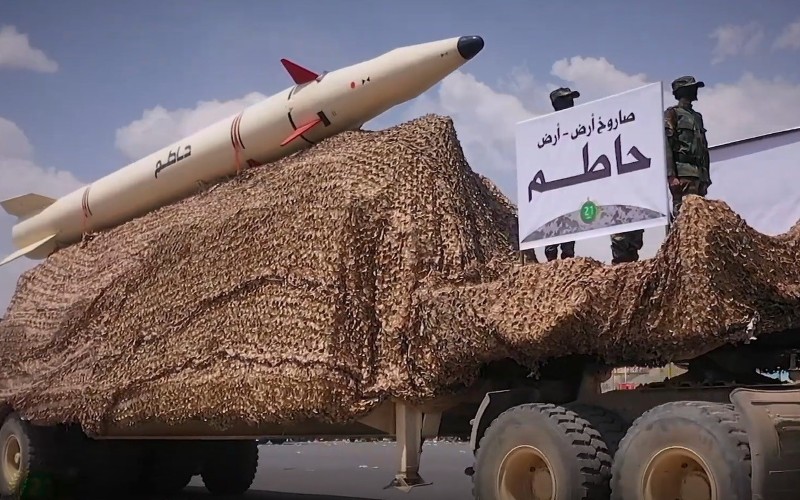

Satellite images reveal Tehran’s renewed focus on missile production despite sanctions and war damage.
New satellite imagery analyzed by the Associated Press indicates that Iran’s regime has begun rebuilding missile production sites that were heavily damaged during the recent 12-day war with Israel. While the reconstruction underscores Tehran’s determination to restore its missile capabilities, analysts note that a crucial element remains missing: the large planetary mixers required for producing solid-fuel rocket propellant.
The Associated Press reported on Wednesday that restoring missile capacity is a top priority for the Iranian regime, as Tehran anticipates the possibility of renewed conflict with Israel. Missiles remain one of the few deterrent tools available to Iran following the extensive destruction of its air defense systems during the war—systems that Iranian’s regime officials insist will never be subject to negotiation with the West.
Critical Need for Solid-Fuel Technology
Experts say Tehran’s primary focus is securing access to planetary mixers, which use rotating blades around a central axis to evenly blend solid propellant. Without them, Iran regime’s ability to mass-produce solid-fuel missiles is severely limited.
Iran’s regime has a history of acquiring materials and components from China, and observers suggest it may again turn to Beijing for assistance—particularly with United Nations sanctions possibly being reimposed at the end of this month, targeting missile development programs.
Satellite images from September show reconstruction underway at facilities in Parchin and Shahroud. According to Sam Lair, a researcher at the James Martin Center, specialized buildings used for propellant mixing are being repaired after Israeli strikes that specifically targeted those sites.
Strategic Priority for Tehran
Iran’s solid-fuel missile sites at Parchin, Khojir, and Shahroud had already been hit by Israeli forces before the October 2024 war. The current pace of reconstruction highlights the missile program’s central role for Tehran, in contrast to nuclear facilities that remain largely inactive after sustaining war damage.
Karl Parkin, another researcher at the James Martin Center, told AP that before the war, Iran had the capacity to produce more than 200 solid-fuel missiles per month. Fuel-mixing has become the key bottleneck in Iran regime’s missile arsenal. If Tehran overcomes this limitation, it can return to mass production.
Iranian regime Defense Minister Aziz Nasirzadeh recently acknowledged a shift in military priorities, stating: “The 12-day war with Israel has changed some of our priorities. We are now focused on producing equipment with greater accuracy and operational capability.”
Links to China and Regional Risks
Reports indicate that Iran may rely on China to supply mixers and propellant, similar to chemicals linked to the deadly explosion at Bandar Rajaei port in Bandar Abbas, which killed at least 70 people. Shortly afterward, the United States sanctioned Chinese firms accused of selling propellant materials to Iran.
Evidence also suggests that the Islamic Revolutionary Guard Corps (IRGC) previously transferred a planetary mixer to an underground missile facility in Masyaf, Syria. The Israeli military released images showing that the device resembled Chinese-manufactured equipment.
In early September, Iranian President Masoud Pezeshkian attended China’s “Victory Day” military parade alongside senior military officials. However, neither Tehran nor Beijing disclosed the details of discussions with Chinese leader Xi Jinping, and Chinese state media made no mention of potential missile-related cooperation.
China’s Foreign Ministry responded vaguely to questions, stating that Beijing was willing to use its influence to promote peace and stability in the Middle East while affirming support for Iran’s sovereignty and security. Analysts argue that China could also provide guidance systems and microprocessors essential to missile production.
A Hudson Institute expert warned that if Tehran leverages ties with Beijing to rebuild its military capabilities, “the 12-day war will only be a temporary pause, not a decisive defeat.” Sam Lair added that if Iran restores production to pre-war levels, “the sheer volume of missiles would make it far harder for Israel to destroy or intercept them.”
No Room for Negotiation
The speed of Iran regime’s reconstruction efforts and its continued investment in missile technology underscore the regime’s long-term commitment to expanding its arsenal. Despite international pressure and potential UN sanctions, Tehran is unlikely to ever negotiate away its missile program—cementing its role as a core pillar of the regime’s military strategy.