


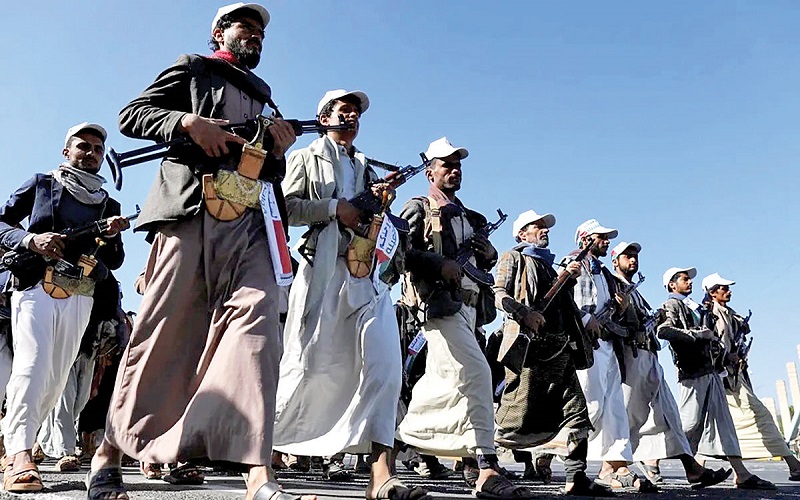

June 6, 2025 – In a landmark verdict with broad implications for Middle East security and international arms trafficking, a US federal jury has convicted a Pakistani national, Muhammad Pahlawan, 49, on multiple charges stemming from a clandestine weapons smuggling operation supplying Iranian-made advanced conventional arms to Houthi rebel forces in Yemen.
According to the U.S. Department of Justice, the case marks a major success in disrupting illicit networks that link Iran’s Islamic Revolutionary Guard Corps (IRGC) with militant groups destabilizing the region.
High-Stakes Interdiction in the Arabian Sea
The case centers on a dramatic interdiction that took place on January 11, 2024. U.S. Navy and Coast Guard forces operating from the USS Lewis B. Puller boarded an unflagged dhow in the Arabian Sea off the Somali coast. Onboard, they found 14 mariners, including Pahlawan, who was acting as captain. A search of the vessel uncovered a cache of Iranian-made weapons, including ballistic missile parts, anti-ship cruise missile components, and a warhead.
U.S. officials say the weaponry matched systems used by Houthi forces in their recent attacks against merchant and military vessels in the Red Sea and Gulf of Aden—attacks that surged following the October 7 Hamas attack on Israel.
Pahlawan reportedly attempted to deceive U.S. personnel during the boarding and later threatened his own crewmembers and their families to maintain silence.
A Wider Smuggling Network Linked to the IRGC
Evidence presented at trial revealed that Pahlawan’s January voyage was part of a broader smuggling operation conducted from August 2023 through January 2024. At the center of the scheme were two Iranian nationals, brothers Shahab and Yunus Mir’kazei, who are allegedly affiliated with the IRGC.
Together, the Mir’kazei brothers coordinated the movement of weapons from Iran’s coast to Yemen via Pahlawan, who facilitated ship-to-ship transfers off the Somali coast under the cover of night. The brothers not only directed the logistics of the operation but also funded it, providing coordinates, resources, and multiple payments to Pahlawan for each smuggling run.
Convictions and Sentencing
Following the trial, Pahlawan was convicted of:
-
Conspiring to provide material support to terrorists
-
Supporting Iran’s and the IRGC’s weapons of mass destruction (WMD) programs
-
Transporting explosive devices for use by the Houthis
-
Threatening witnesses and obstructing justice
Each of the primary charges carries a maximum sentence of 20 years. Pahlawan is scheduled for sentencing on September 22, 2025. A federal judge will determine his punishment after reviewing U.S. Sentencing Guidelines and other statutory factors.
A Coordinated Government Effort
The conviction is the result of extensive interagency cooperation. Prosecutors from the Eastern District of Virginia and the Department of Justice’s National Security Division led the case, with support from the FBI’s Counterterrorism Division and Washington Field Office.
The investigation was also supported by the Department of Defense, Department of Homeland Security, Naval Criminal Investigative Service, Diplomatic Security Service, and the Department of State. The Justice Department’s Office of International Affairs played a key role in coordinating cross-border legal matters.
“This case highlights the long arm of U.S. law enforcement and our determination to dismantle the illicit arms networks that fuel violence and instability in the Middle East,” said Sue J. Bai, head of the Justice Department’s National Security Division.
Broader Implications
The case underscores Washington’s ongoing efforts to curb Iran’s influence in the region and disrupt the flow of weapons to proxy groups like the Houthis. As tensions remain high in the Red Sea corridor—a critical global trade route—this conviction sends a strong message to international arms traffickers and their state sponsors.