Soaring medical inflation, hollow insurance schemes, and regime priorities push retirees and patients toward financial ruin.
While the leader of Iran’s regime continues to boast about “progress” and the nation’s “resilience for Islamic honor,” the lived reality of millions of workers, employees, retirees, and patients tells a starkly different story.
Across the country, the healthcare system is unraveling, treatment costs are being shifted directly onto households, and illness has become a trigger for poverty, asset liquidation, and even family breakdown.
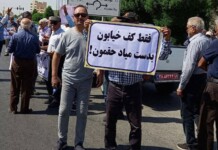
On Monday, December 15, 2025, as dozens of protests by retirees erupted nationwide over livelihoods and benefits, domestic media reported that Social Security retirees are now facing what has been described as a “medical inflation tsunami.” This crisis is no longer abstract or gradual; it is immediate, measurable, and devastating.
Official data from Iran’s Statistical Center show healthcare inflation reaching 48.2 percent. Under the regime’s own Seventh Development Plan, out-of-pocket medical payments were supposed to fall to 35 percent.
Instead, retirees now shoulder nearly 70 percent of treatment costs. This represents a tripling of the financial burden on a population that typically survives on monthly pensions of 10 to 15 million tomans—amounts already eroded by chronic inflation.
Such cost explosions have turned the treatment of serious illnesses into an economic nightmare. According to ILNA, in cases where a full course of cancer treatment reaches 900 million tomans, even a nominal 30 percent copayment translates into 270 million tomans paid directly by the patient.
For a minimum-income retiree, this is only possible through selling a home or exhausting lifetime savings—often forcing patients to abandon treatment altogether. In practice, the so-called “right to healthcare” has become a class privilege.
Meanwhile, companies affiliated with the Social Security Organization promote schemes such as “Supplementary Insurance” or “Golden Complementary Insurance,” advertising “unlimited coverage.”
In reality, these plans impose even heavier premiums on retirees. Labor and pension activists argue these initiatives are not solutions but attempts to legitimize extracting additional payments from citizens whose treatment, by law, should be fully covered.
Parviz Ahmad Panjaki, a member of the High Council of Social Security Retirees, states that basic insurance has effectively lost its function. Social Security-owned hospitals, plagued by decay and underfunding, can no longer provide adequate services.
He notes that retirees seeking complementary coverage for themselves and their families may be forced to pay up to six million tomans per month in premiums—an amount entirely incompatible with pension-level incomes.
Yet the retirees’ crisis is only one facet of a broader healthcare collapse. In recent weeks, the Iranian Thalassemia Association warned that the removal of subsidized currency for medicines and medical equipment has driven prices of vital drugs up by four to twelve times.
Some families, desperate to continue treatment for their children, have reportedly resorted to selling kidneys or corneas—an appalling testament to the moral and economic degradation of a system that still claims to uphold “social justice.”
At the same time, pharmaceutical industry insiders report empty pharmacy shelves, accumulated government and insurance debts exceeding 150 trillion tomans, and the bankruptcy of thousands of pharmacies.
Mohammad Abdehzadeh, head of the Health Economy Commission at the Tehran Chamber of Commerce, has warned that the final three months of 1404 (Persian year) could mark the most severe period for Iran’s pharmaceutical sector in decades. Crucially, he emphasizes that the roots of this crisis lie not merely in sanctions, but in structural inefficiency and the regime’s fundamentally distorted priorities.
Compounding the disaster is the free fall of the national currency. A dollar trading at 131,000 tomans and a gold coin priced at 144 million tomans make it clear that even when medicine is available, vast segments of society cannot afford it.
An $83 minimum monthly wage, combined with runaway food and healthcare inflation, has pushed millions into a daily struggle for survival—reflected in rising theft, suicides, and the erosion of social security.
Despite this, the Iranian regime continues to invoke “financial constraints” as justification. This claim rings hollow in light of recent statements by the U.S. Treasury indicating that Tehran provided at least one billion dollars to Hezbollah in Lebanon over the past year.
For ordinary Iranians, the question is unavoidable: if there is no money for elderly patients, thalassemia sufferers, or cancer treatment, how are such vast resources found—and prioritized—for external agendas?
Activists in pensioners’, labor, and healthcare sectors stress that Iran’s medical crisis is no longer a temporary problem. The forced sale of assets by retirees, the cruel choice between treatment and death for patients, and the disintegration of families are the cumulative result of years in which ideological, security, and regional ambitions have been placed above public welfare.
In this context, costly supplementary insurance schemes are not signs of support, but documentary evidence of the regime’s retreat from its most basic responsibilities toward the people it governs.