


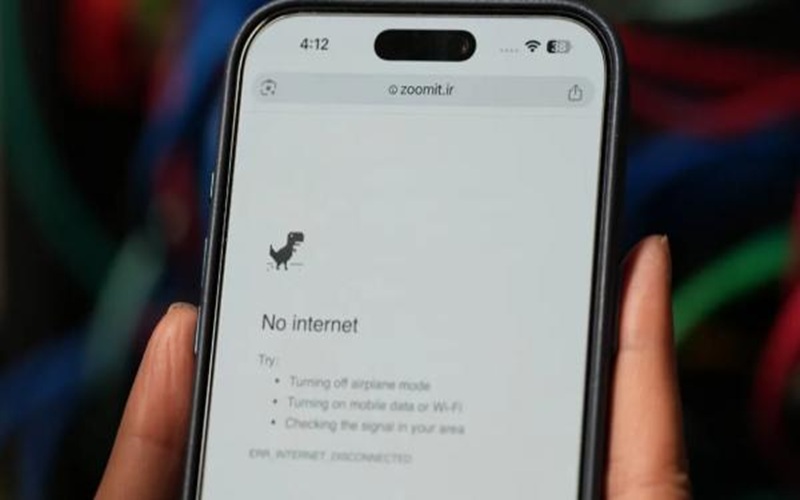

With internet access reduced to near zero and inequality institutionalized, Iran faces a volatile convergence of economic collapse, social anger, and state repression.
In April 2026, Iranian society finds itself in a state best described as the “calm before the storm.” More than two months after the near-total shutdown of international internet access—replaced by ineffective and discriminatory schemes such as the so-called “Pro Internet”—tensions between an increasingly explosive society and the ruling establishment have reached a new and dangerous threshold.
Access to the global internet in Iran has now plummeted to a catastrophic 2 percent. This is no longer a temporary technical disruption or a short-term security measure; it is a profound indictment of a regime that, at the height of its desperation, has resorted to holding cyberspace hostage as a last line of defense.
Digital Siege: Fear of a Society Ready to Erupt
Faced with the tremors of a restive population, Iran’s regime has effectively engaged in what can be described as digital self-destruction—buying time in a bid for survival. By severing 85 million citizens from the outside world, authorities are fully aware that the internet in today’s Iran is not merely a communication tool; it is the lifeline of independent information and the lens through which society perceives truth.
This enforced digital blackout is a tacit admission of fear. A regime that dreads a few seconds of video footage, a citizen report, or an image of empty dinner tables has little choice but to turn off the lights entirely. The aim is clear: to prevent the voices of protest echoing through Iran’s streets from reaching the global stage.
Yet imposed silence online does not equate to calm offline. On the contrary, it stockpiles anger—an anger that, deprived of expression in the digital sphere, seeks release in the physical world.
Digital Apartheid: Inequality as State Policy
One of the most striking and brazen aspects of this crisis is the emergence of a class-based internet system. While ordinary citizens are confined to a mere 2 percent connectivity rate, security institutions and regime-affiliated networks enjoy privileged access through exclusive digital channels.
This digital inequality is not incidental; it reflects the structural logic of authoritarian governance. Access, opportunity, and resources are reserved for insiders, while the broader population is subjected to censorship, restriction, and isolation. By formalizing this “digital apartheid,” the regime has effectively declared that basic rights are contingent upon political loyalty.
For many Iranians, witnessing state-linked actors exploit unrestricted access—often to expand surveillance and propaganda—has reinforced the perception that systemic change is not just desirable, but necessary.
Internet Shutdown: A Tool of Control or a Catalyst for Revolt?
The authorities appear to believe that cutting off internet access suppresses the potential for organized dissent. In reality, the prolonged shutdown is rapidly becoming a catalyst for unrest.
The consequences are severe: small businesses are paralyzed, freelancers have lost their livelihoods, and millions face economic suffocation. The shutdown has also fostered a pervasive sense of confinement, as if an entire nation has been placed under house arrest.
A report published by the state-run website Fararu, on April 28, 2026, highlights the scale of economic distress. According to the employment platform Jobvision, a record 318,000 resumes were submitted in a single day—an indication of surging job demand amid collapsing opportunities. The combined impact of war and extended internet disruption has wiped out vast segments of employment, pushing a large portion of the workforce into joblessness.
When public demands regress from political freedoms to the mere “right to access 2 percent of the internet,” it signals that societal pressure has reached a critical threshold—one where an explosion becomes increasingly inevitable.
The Rise of “Config Economy”: Profiting from Restriction
Even as authorities justify the shutdown on security grounds, a parallel economy has emerged around restricted access. The sale of VPN configurations—known locally as “config”—has evolved into a lucrative black market, widely perceived as being tolerated or even facilitated by state-linked actors.
Sociologist Mohammad Fazeli recently described this phenomenon as a form of systemic exploitation. The cost of purchasing limited data access has surged dramatically, doubling within days. Meanwhile, privileged groups continue to benefit from unrestricted “Pro Internet” services.
This situation exposes the hollowness of official justifications. Rather than a security necessity, the shutdown increasingly resembles a mechanism for profit extraction—one that deepens inequality, fuels resentment, and erodes any remaining public trust.
A Society on the Edge
Past uprisings—from November 2019 to the protests of 2022 and January 2026—demonstrated that internet shutdowns can temporarily suppress unrest. This time, however, the prolonged nature of the disruption has amplified uncertainty and anger across all segments of society.
Even insiders within the system are reportedly warning that the internet blackout is no longer an effective control mechanism. Instead, it risks becoming the very trigger for a new wave of nationwide protests.
The ruling establishment now faces a stark dilemma: restoring internet access could enable renewed organization and mobilization through social media, while the continuation of the shutdown continues to suffocate the economy and intensify public fury.
Each passing day without restoration pushes the country closer to a breaking point. In this situation, the question is no longer whether unrest will resurface—but when and how explosively it will unfold.