


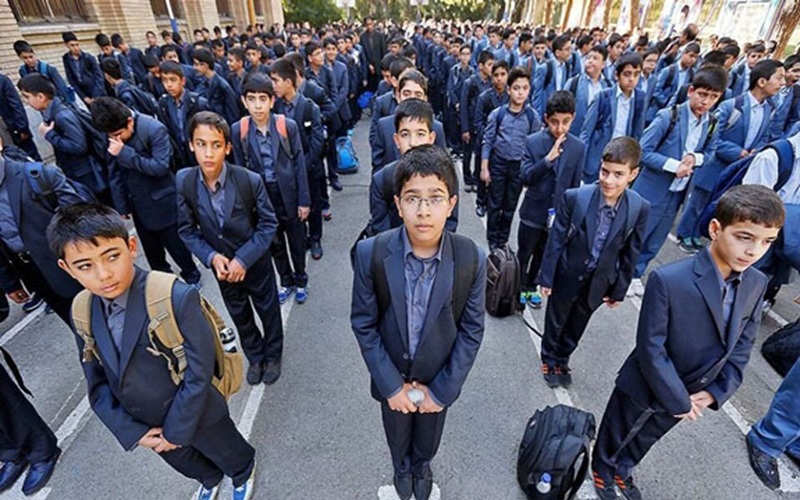

Underfunded schools, teacher burnout, inadequate basic facilities, and soaring stationery prices are deepening educational inequality and undermining children’s future prospects.
Iran’s education system is facing a deepening crisis as poverty, inadequate school infrastructure, and deteriorating working conditions for teachers undermine the quality of education available to millions of children. From schools without drinking water or heating to families unable to afford basic stationery, the consequences of chronic neglect are increasingly visible in classrooms across the country.
The crisis reflects structural failures under Iran’s regime, where the education system struggles to provide even the minimum conditions necessary for effective learning. Teachers face mounting financial pressure and professional exhaustion, while students’ educational opportunities increasingly depend on their families’ ability to pay for basic necessities.
Low Salaries and Teacher Burnout Undermine Education
Teachers are among those bearing the heaviest burden of the crisis. A primary-school teacher recently described how monthly salaries fail to cover the actual cost of living, leaving educators struggling financially despite their demanding workloads.
Severe staff shortages and the advanced age of many colleagues have increased workloads and contributed to professional burnout. Delays and inadequacies in overtime payments, poor welfare provisions, and insufficient health insurance further compound the problem.
The teacher described a situation in which salaries run out before the middle of the month, raising a fundamental question: how can educators maintain their motivation and continue delivering quality lessons when their income cannot meet basic household expenses?
These pressures are also contributing to the loss of experienced personnel, as some teachers consider leaving the profession. The consequences extend beyond the teachers themselves. Staff shortages and exhaustion reduce the time, energy, and resources available to support students’ learning.
Expecting teachers to compensate for systemic deficiencies through personal sacrifice cannot provide a sustainable solution.
Schools Without Basic Facilities Deny Students Equal Opportunities
The infrastructure crisis compounds these difficulties. Effective learning requires more than a classroom and a teacher. Laboratories, sports facilities, playgrounds, recreational space, adequate sanitation, clean drinking water, and appropriate heating all contribute to children’s educational development.
Yet schools across Iran lack many of these essentials.
In provinces including Sistan and Baluchestan, some children attend makeshift schools with extremely limited facilities. Other schools reportedly lack drinking water, adequate sanitation, or heating systems capable of protecting students during cold weather.
Such conditions directly affect students’ ability to concentrate, participate in lessons, and develop their academic potential. The stark differences between schools also deepen educational inequality, leaving children in poorer and underserved areas at a substantial disadvantage compared with their peers.
The consequences are particularly serious because most children have the capacity to progress academically when provided with appropriate instruction and a supportive learning environment. Inadequate infrastructure and insufficient educational resources can prevent that potential from being realized.
Rising Poverty Makes Basic School Supplies Unaffordable
Poverty is creating another barrier to education: the rising cost of basic school supplies.
During the current school year, the price of a box of colored pencils reportedly reached 400,000 to 500,000 tomans, representing an estimated increase of 150 to 200 percent compared with the previous year.
For families already struggling to afford food, housing, and other essentials, purchasing stationery, notebooks, pens, and other school materials has become increasingly difficult. Children who lack these basic supplies cannot participate in classroom activities on equal terms with their classmates.
The problem is especially severe amid widespread poverty. The source describes more than 70 percent of the population as living below the poverty line, although the precise estimate depends on the poverty measure used.
Under these conditions, the financial burden of education falls increasingly on households least able to bear it. Poverty therefore affects not only children’s immediate classroom experience but also their long-term prospects for academic advancement and employment.
A Crisis That Threatens Iran’s Future
Teachers are expected to educate and prepare the next generation despite inadequate salaries, excessive workloads, limited resources, and students’ growing material needs. Meanwhile, children are expected to learn in environments that often fail to provide the basic conditions for effective education.
This combination creates a damaging cycle: poverty restricts access to educational resources, inadequate schooling weakens students’ opportunities, and reduced opportunities make it harder for young people to escape poverty.
Iran’s education crisis is therefore not simply a question of classroom management or individual teachers’ performance. It is a systemic failure affecting millions of children and the country’s future workforce.
Without meaningful improvements in teacher compensation, school infrastructure, educational funding, and support for low-income families, the gap between children who can access quality education and those who cannot will continue to widen.
A school system that cannot guarantee safe classrooms, basic supplies, and adequately supported teachers cannot fulfill its central responsibility: giving every child a fair opportunity to learn, develop, and build a future.