


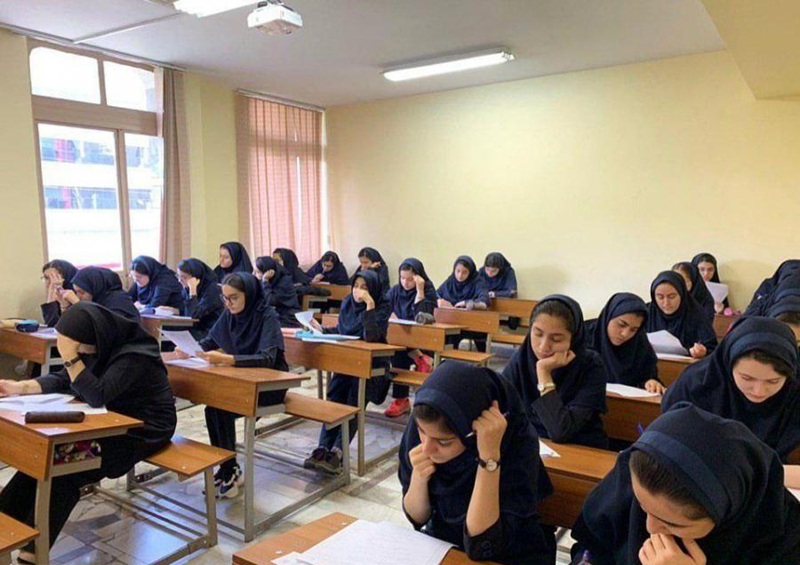

Regime-linked data reveal shrinking education budgets, collapsing household incomes, and a growing generation of Iranian children denied basic schooling
Iran’s state-run newspaper Iran has acknowledged what millions of families already experience daily: under the Iranian regime’s rule, education is becoming increasingly unaffordable, inaccessible, and ineffective. According to the report, a combination of regime-imposed budget cuts and the collapse of household incomes has severely weakened both state and family capacity to fund students’ education.
Citing Hadi Mousavi-Nik, head of the Social Support and Poverty Alleviation Policies Group at the regime’s Parliament Research Center, the newspaper reported on Monday, December 22, that government spending on Iran’s education system has fallen by 12 percent over the past 15 years. At the same time, families—struggling under relentless inflation and declining real incomes—have lost the ability to cover basic education-related expenses.
Mousavi-Nik’s data show that during the 2010s, education accounted for around 4 percent of household expenditures, but in recent years that figure has dropped to just 2 percent. This sharp decline, he admitted, is not the result of improved efficiency or reduced need, but rather the direct consequence of falling household income levels.
Economic Mismanagement with Generational Consequences
The education crisis is inseparable from the broader economic collapse engineered by the regime’s decades of failed economic, domestic, and foreign policies. Runaway inflation, the erosion of purchasing power, and unprecedented price hikes in essential goods have pushed millions of families—particularly low-income households—into survival mode, where education becomes a luxury rather than a right.
Numerous reports have already warned about the devastating psychological and physical toll of this economic pressure on Iranian citizens. The consequences are now clearly visible in classrooms—or in many cases, in the absence of classrooms altogether.
Mousavi-Nik linked declining household education spending directly to falling academic performance, stating that worsening economic conditions increase barriers to learning and lead to higher dropout rates. “We have repeatedly observed that as economic conditions deteriorate, educational obstacles increase,” he said, adding that one of the most serious outcomes is students being forced out of school entirely.
Nearly One Million Children Already Out of School
The scale of the crisis is staggering. In August, amid mounting warnings about a surge in school dropouts, Education Minister Alireza Kazemi admitted that 950,000 students in Iran are currently out of school. Independent assessments suggest the reality is even worse.
Farshad Ebrahimipour, a member of the regime Parliament’s Education Commission, stated last September that during the 2024–2025 academic year, nearly two million students were not registered in schools, primarily due to economic hardship. These figures expose a silent but accelerating collapse that the regime has neither prevented nor meaningfully addressed.
Academic Decline Even for Those Still in School
The crisis does not end with dropouts. Even students who remain in the education system are suffering from a dramatic decline in quality. According to Iran newspaper, average student GPAs last year fluctuated between 8 and 10, a level that signals systemic failure rather than individual underperformance.
This widespread academic decline has intensified concerns about the long-term damage to Iran’s human capital—damage that will outlast the current economic crisis and further entrench inequality.
Poverty Trap and Stalled Social Mobility
Mousavi-Nik warned that family poverty has become a structural barrier to the advancement of future generations. Referring to intergenerational mobility, he acknowledged that upward social movement in Iran has become alarmingly weak.
According to his figures, a child born into the lowest income decile in Iran has a 40 percent chance of remaining in that same decile as an adult. By contrast, in countries such as Canada, the likelihood of failing to improve one’s social position is only 20 percent—a stark comparison that underscores the regime’s failure to provide even minimal equality of opportunity.
A System Designed to Fail the Young
Taken together, these admissions from the regime’s own institutions paint a damning picture: an education system systematically starved of resources, families crushed by poverty, and a ruling structure unwilling—or unable—to prioritize the future of Iran’s children. What the regime frames as an “economic challenge” is, in reality, the predictable outcome of long-term misrule, corruption, and ideological priorities that have sacrificed education for political survival.
For millions of Iranian students, the cost of this failure is not abstract. It is measured in lost years, abandoned classrooms, and a future increasingly closed off before it even begins.