


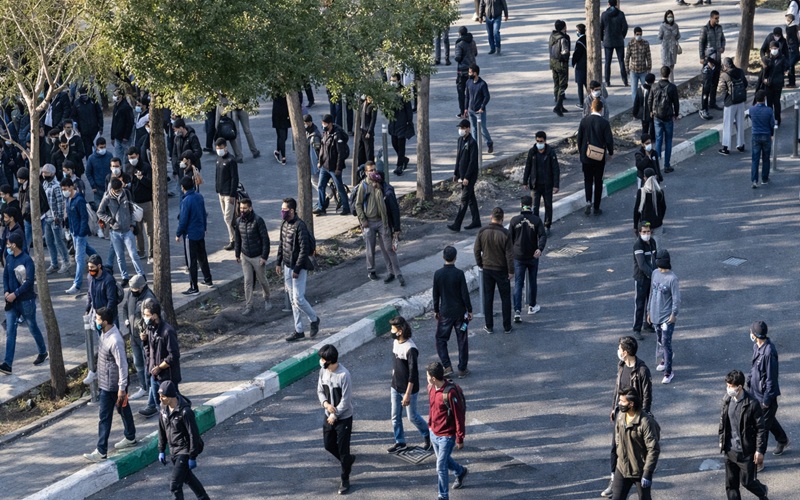

A reported rise in support for fundamental political change reflects a profound shift in how large sections of Iranian society view the country’s political system.
Over the past two decades, Iran has experienced a series of political, social, and economic crises that have profoundly altered how many citizens view the country’s political system and the possibility of change.
One indicator of this transformation is the reported shift from support for gradual reform within the existing system toward demands for fundamental and structural change.
On September 29, 2026, the Iranian website Ensaaf News published comments by Ebrahim Hajiani, a sociologist and the first head of the Iranian Students Polling Agency (ISPA), concerning changes in political attitudes among Iranians.
Hajiani said that a political culture survey conducted in 2003–2004 found that only about 8 percent of respondents favored fundamental changes in the country. According to him, repeated polling by different opinion-research institutions has since placed that figure at approximately 67 percent.
If accurate, the reported increase represents a striking change in political attitudes. It suggests that the expectation of gradual reform within the existing political framework has lost much of its previous appeal, while demands for deeper structural change have become significantly more widespread.
Two Decades of Accumulating Crisis
Several developments have contributed to this transformation.
Iran’s prolonged economic deterioration has directly affected workers, retirees, students, farmers, drivers, and other sections of society. Inflation, declining purchasing power, unemployment, inadequate pensions, and rising living costs have turned economic grievances into recurring social and political protests.
At the same time, successive waves of protest have broadened public awareness of the limits of the existing political system. The 2009 protests, the nationwide uprisings of 2017–18 and 2019, and the 2022 uprising each exposed different dimensions of the confrontation between society and the regime.
Generational change has also played a role. Younger Iranians have grown up amid widespread access to global information and communication networks, making it increasingly difficult for the regime to control the flow of information or isolate Iranian society from developments beyond its borders.
The result is a widening gap between social demands and the political structures governing the country.
From Reform to Structural Change
The significance of the reported 8 percent and 67 percent figures lies less in their precise numerical value than in the direction of change they are presented as demonstrating.
The figures come from a source and polling tradition operating within Iran, and the methodology and comparability of the surveys would need to be examined before drawing definitive conclusions about the entire population. Nevertheless, the reported trend points to an important question: how much confidence remains in the possibility of meaningful change through gradual reform?
The growing frequency of protests and the breadth of grievances suggest that the debate over Iran’s future increasingly extends beyond changes within individual government institutions or policies. For many citizens, the question is becoming whether the existing political structure itself can address the country’s accumulated crises.
This represents a significant transformation in Iran’s political culture. A society that once placed greater emphasis on gradual reform is increasingly confronted with demands for deeper change.
The widening distance between society and the regime is therefore likely to remain one of the central factors shaping Iran’s political future. The reported shift in public attitudes provides one indication of how profoundly that relationship has changed over the past two decades.