


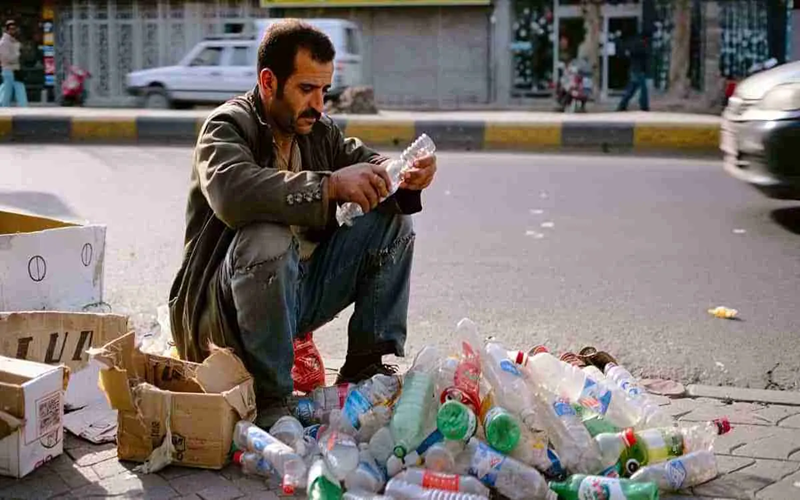

A new report puts Iran’s monthly livelihood basket at 900 million rials, while the purchasing power of workers’ wages has collapsed, exposing the depth of a widening structural poverty crisis.
Iran’s deepening cost-of-living crisis has pushed poverty to a scale that is increasingly difficult to conceal.
According to the latest estimates published on August 24 by the state-run Ebtekar newspaper, the cost of the basic livelihood basket has reached 900 million rials per month, while seven of Iran’s ten income deciles are now below the poverty line.
If Iran’s population is estimated at approximately 90 million, the figure would mean that around 63 million people are living below the poverty line.
The implications extend far beyond income statistics. For millions of families, the ability to afford basic food—including protein, dairy products, and other essential items—is increasingly out of reach.
The Collapse of Purchasing Power
The figures published by Ebtekar reveal the extraordinary gap that has developed between wages and the cost of living.
According to the newspaper, the producer price index has climbed to an unprecedented 71 percent. At the same time, workers’ wages have lost much of their ability to cover basic household expenses.
At the beginning of the year, workers’ wages reportedly covered 58.24 percent of living costs. By the end of July, that figure had fallen to just 27.58 percent.
In practical terms, workers’ monthly income is now sufficient to cover only a fraction of their basic expenses. The newspaper’s calculation suggests that wages effectively cover approximately eight days of living costs, leaving workers to struggle through more than 20 days of each month without sufficient income to meet basic needs.
This is not simply a decline in living standards. It represents the systematic erosion of purchasing power.
When wages remain far behind the cost of essential goods and services, households are forced to respond by reducing food consumption, abandoning nonessential medical care, taking on debt, selling assets, or relying on informal support networks.
Poverty Is Becoming a Structural Condition
The scale of the figures points to a crisis that cannot be explained solely by temporary economic mismanagement, inflation, or fluctuations in global markets.
When seven out of ten income deciles fall below the poverty line, poverty ceases to be a marginal problem affecting a limited section of society. It becomes a defining feature of the economic system.
The livelihood basket reaching 900 million rials illustrates the widening distance between what families need to maintain a basic standard of living and what ordinary workers can actually earn.
The result is a society in which employment itself increasingly fails to provide economic security.
A worker may have a job and a regular wage, yet still be unable to afford adequate food, housing, healthcare, education, transportation, and other basic necessities.
Where Is Iran’s Wealth Going?
The central question raised by these figures is not simply why prices have increased.
It is why a country with substantial natural resources, energy reserves, industrial capacity, and a large domestic market has been unable to provide its population with basic economic security.
The answer cannot be reduced to technical inefficiency.
For decades, enormous resources have been diverted into priorities unrelated to improving the living conditions of ordinary people. Resources that could have supported productive investment, infrastructure, employment, healthcare, education, and social welfare have instead been consumed by military expansion, regional intervention, repression, and the maintenance of an extensive security apparatus.
The economic consequences are ultimately paid by households.
Money lost through corruption and mismanagement does not simply disappear from an accounting ledger. It translates into higher prices, lower investment, weaker public services, declining wages, unemployment, and reduced purchasing power.
The Economic Cost of Entrenched Power
A major part of this structure is the network of political and economic institutions surrounding the supreme leadership and the Islamic Revolutionary Guard Corps (IRGC), which has accumulated influence across major sectors of Iran’s economy.
This concentration of economic power has contributed to an environment in which large resources and strategic economic sectors remain beyond effective public accountability.
As a result, economic policy is increasingly disconnected from the needs of ordinary households.
The consequences are visible in the daily lives of millions: rising food prices, unaffordable housing, declining purchasing power, growing debt, and increasing numbers of families unable to maintain a basic standard of living.
The poverty figures published by Ebtikar therefore provide more than another snapshot of inflation. They reveal the outcome of a much deeper economic structure.
From Economic Crisis to Social Crisis
When workers can afford only a fraction of their monthly living expenses, the effects inevitably spread throughout society.
Families cut consumption. Businesses lose purchasing power among their customers. Children may be forced to leave education to contribute to household income. Healthcare becomes increasingly inaccessible. Malnutrition and housing insecurity become more widespread.
At the same time, declining household demand weakens economic activity, creating a vicious cycle in which poverty itself contributes to further economic deterioration.
This is why the figure of seven deciles below the poverty line should not be viewed merely as another economic statistic.
It signals the erosion of the social foundations of the economy.
A Population Under Mounting Pressure
The latest poverty estimates come amid years of inflation, currency depreciation, declining real wages, unemployment, and deteriorating public services.
For ordinary Iranians, the crisis is experienced not through economic terminology but through everyday choices: which food to buy, which bill to postpone, which medical treatment to abandon, or how to survive until the next paycheck.
The growing distance between wages and the cost of living demonstrates that the crisis is structural rather than temporary.
As long as the institutions responsible for economic decision-making remain insulated from meaningful accountability, the burden will continue to fall disproportionately on workers, pensioners, small businesses, and low-income families.
The latest figures therefore present a stark picture of an economy in which poverty is no longer an exception. It has become the lived reality for the majority of the population.
The question facing Iranian society is consequently much larger than whether another economic measure can temporarily reduce inflation or stabilize prices.
It is whether the country’s vast resources and economic potential will ultimately be used to improve the lives of its people—or continue to serve a political and institutional structure whose priorities have produced deepening poverty, inequality, and deprivation.
For millions of Iranians now struggling to meet the most basic costs of living, the answer to that question is becoming increasingly urgent.