


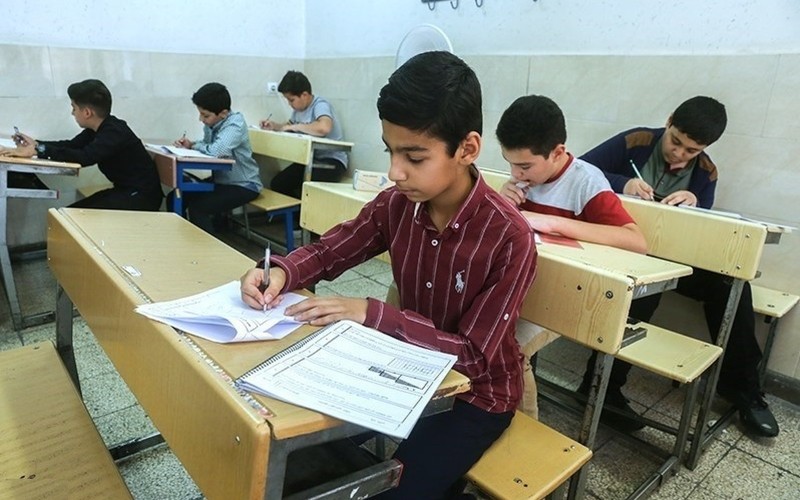

Despite constitutional guarantees of free education, parents are forced to pay bribes for enrollment while class-based schooling deepens inequality.
Parents Forced to Pay for “Free” Education
“If you want us to register your child, you have to pay 9 million tomans because you are out of bounds.”
“They told me if I am within the limit, I must pay 5 million tomans, but if I am outside, 10 million.”
“There is only one public school in the entire 6th district of Tehran. They say, ‘We don’t have room,’ and then tell us to go to a private school—as if everyone has 150 million tomans a year.”
These are just a few testimonies from Iranian parents, published in domestic media and on social networks, exposing the widespread practice of schools demanding illegal fees for student enrollment. In some cases, parents have been forced to pay up to 20 million tomans simply to secure their child’s spot in a public school.
Constitutional Rights Trampled
Article 30 of the Iranian regime’s constitution explicitly states: “The government is obligated to provide free educational facilities for the entire nation until the end of secondary school and to expand higher education facilities free of charge to the extent of the country’s self-sufficiency.”
Yet in practice, public education is far from free. While education officials and parliamentarians publicly insist that charging fees at public schools is illegal, parents continue to face demands for money. Officials routinely ask families to report such violations, but the practice remains rampant, showing the disconnect between rhetoric and reality.
Two-Tier Education System
Iran’s education system now operates on a deeply unequal, class-based model. Wealthy families send their children to well-funded non-profit or private schools, while poorer families are left with under-resourced public schools that lack facilities, staff, and quality teaching.
This dual system has led to a stark divide in outcomes. According to recent university entrance exam results, not a single top-ranking student came from a public school. Of the top 29 students nationwide, 22 came from SAMPAD (elite schools for the gifted), four from private schools, and the rest from specialized government-supported institutions—none from ordinary public schools.
Millions of Children Left Behind
Official statistics report nearly one million Iranian children were out of school in the 2023–2024 academic year. But census data suggests the true figure may be closer to four million, primarily from poor families in deprived regions.
Dropping out is not always due to poverty alone. Many students leave school out of frustration with the low quality of public education, eventually abandoning their studies for low-paying jobs in order to survive.
Justice in Education, a Forgotten Principle
Education is supposed to be the great equalizer—the institution that reduces inequality and ensures equal opportunity for all. International law, including the UN Convention on the Rights of the Child, recognizes free education as a fundamental right.
Yet in Iran, this right has been stripped away. The regime’s failure to uphold its constitutional obligation has entrenched class divisions, leaving millions of children without access to quality education.
The result is a society where opportunity is determined not by merit or effort, but by wealth and proximity to resources. As education justice disappears, so too does social justice, deepening inequality and eroding the future of an entire generation.